Rudolf Steiner often described Anthroposophy as a form of “spiritual science.” For modern readers, that phrase can sound like a contradiction. Science usually refers to knowledge gained through observation, experimentation, measurement, and results that others can independently verify. Spirituality appears to belong to a different realm, one shaped by faith, intuition, revelation, or personal experience.
Steiner believed this division between science and spirituality was too narrow. He argued that human beings could investigate spiritual reality through disciplined forms of consciousness. Just as scientists train themselves to observe the physical world carefully, Steiner believed spiritual seekers could train their thoughts, emotions, and perceptions to observe realities beyond the physical senses.
He did not want people merely to believe that a spiritual world exists. He wanted them to learn how to experience it consciously.
From Natural Science to Spiritual Investigation
Steiner respected the achievements of modern science. He did not argue that spiritual explanations should replace the careful study of nature. Instead, he believed science had limited itself by assuming that only physical matter could become an object of reliable knowledge.
The problem, as Steiner saw it, did not lie in the scientific method itself. It lay in restricting that method to what the physical senses could detect.
Steiner’s early intellectual work drew heavily upon Johann Wolfgang von Goethe, whose studies of plants, color, and natural forms emphasized direct and sustained observation. Goethe approached nature as something living and developing rather than as a collection of separate mechanisms. Steiner edited Goethe’s scientific writings and believed Goethe’s approach offered a model for a more participatory form of knowledge.
Spiritual science attempted to carry that kind of attentive observation into the life of consciousness. Instead of observing a plant, mineral, or physical process, the spiritual investigator would begin by observing thought, memory, imagination, emotion, and the activity of the self.
Steiner believed these inner experiences could become more precise through training.
Spiritual Knowledge Versus Religious Faith
Religious faith usually begins with trust. A believer may trust Scripture, a religious tradition, a spiritual teacher, or a community that preserves certain teachings. Faith can also involve confidence in realities that cannot be directly seen.
Steiner did not necessarily reject faith, but he did not consider it the final goal of spiritual development. He distinguished between receiving a teaching from someone else and knowing a spiritual reality through one’s own experience.
A Christian, for example, may believe in the spiritual identity of Christ because of the testimony of Scripture and the Church. Steiner wanted the spiritual investigator to move toward a direct perception of the reality behind that testimony. He believed Christ was not merely a figure of religious devotion but a cosmic spiritual being whose activity could become an object of higher knowledge.
This approach led Steiner far beyond conventional Christian theology. His teachings incorporated reincarnation, karma, the evolution of consciousness, spiritual hierarchies, and repeated stages of earthly and cosmic development. Although he presented Christ as central to human history, his interpretation differs substantially from historic Christian doctrine.
Steiner therefore did not understand spiritual science as another name for traditional Christianity. He saw it as a path through which the truths concealed within religion, mythology, and initiation traditions could become consciously known.
Physical science depends upon instruments. Telescopes extend vision into distant space. Microscopes reveal structures that the unaided eye cannot perceive. Steiner believed human consciousness could also become an instrument, but it first had to undergo preparation.
In Knowledge of the Higher Worlds and Its Attainment, Steiner describes a path of inner development based on concentration, meditation, patience, reverence, and moral responsibility. He argues that higher perception should not arise from uncontrolled fantasy or emotional excitement.
The student begins by learning to direct attention deliberately. Ordinary consciousness moves rapidly from one impression to another. Thoughts appear, emotions respond, and outside events continually interrupt the mind. Steiner’s exercises attempt to strengthen the individual’s ability to hold an image or thought steadily without losing awareness or falling into a dreamlike state.
He also places great importance on emotional balance. A person seeking spiritual knowledge must learn not to become controlled by fear, desire, anger, or personal ambition. Otherwise, private wishes may disguise themselves as spiritual revelations.
For Steiner, moral development was not separate from knowledge. It formed part of the method. The character of the observer affected what the observer could perceive.
Imagination, Inspiration, and Intuition
Steiner described three major stages of higher knowledge: Imagination, Inspiration, and Intuition. He used these words in specialized ways.
Imagination did not mean inventing fantasies. It referred to the ability to perceive meaningful spiritual images without confusing them with ordinary physical objects. These images acted as expressions of realities that could not appear directly to the physical senses.
Inspiration moved beyond the images toward the spiritual relationships or communications expressed through them. The investigator attempted to understand what the images revealed rather than interpreting them through personal preference.
Intuition represented an even deeper form of participation. In Steiner’s terminology, intuition meant direct contact with the inner nature of a spiritual being or reality. It did not mean a vague feeling or an unexplained hunch.
These stages were meant to provide spiritual investigation with an ordered method. They also reveal why Steiner’s thought attracts readers interested in symbolism. Myths, religious images, archetypal patterns, and natural forms may carry meanings that cannot be reduced to their literal appearance.
Yet Steiner repeatedly warned that the investigator must learn to distinguish genuine perception from imagination in its ordinary, fantasy-producing sense. Whether his method succeeds remains one of the central questions surrounding Anthroposophy.
Is Spiritual Science Really Science?
Modern science requires more than careful personal observation. Its claims must normally be testable, measurable, and open to independent verification. Another qualified researcher should be able to examine the evidence and determine whether the same conclusion follows.
Steiner argued that spiritual perceptions could also be verified, but only by people who had developed the necessary faculties. He sometimes compared this situation to learning mathematics. A person who has not studied geometry cannot evaluate an advanced geometric proof, but that does not make geometry a matter of private opinion.
Critics see a serious weakness in this comparison. Mathematical reasoning can be demonstrated publicly through shared logical steps. Spiritual visions cannot be displayed or measured in the same way. When two spiritual investigators disagree, no universally accepted procedure can determine which perception is correct.
For that reason, Anthroposophy should not be confused with empirical science as that term is generally understood today. Steiner’s spiritual science is better approached as an esoteric philosophy, a method of inner development, and a body of spiritual claims.
This distinction does not make Steiner’s questions meaningless. It simply prevents us from accepting the word “science” without examining how he used it.
A Path Between Materialism and Unquestioning Belief
Steiner attempted to find a path between two positions he considered incomplete. On one side stood materialism, which reduced reality to physical matter and treated consciousness as a product of biological processes. On the other stood religious belief that asked people to accept spiritual teachings without experiencing their truth directly.
Spiritual science was his proposed third path.
He wanted to preserve the clarity, discipline, and intellectual responsibility associated with science while opening inquiry to spiritual dimensions of existence. He believed the human mind could participate in reality rather than merely observe it from a distance.
This vision helps explain why Steiner’s work continues to interest people drawn to depth psychology, Christian esotericism, Hermetic philosophy, mythology, and the study of consciousness. He treated symbols as more than decorative images. He believed they could become thresholds through which the mind encountered deeper structures of reality.
Steiner’s approach also invites caution. The desire for spiritual knowledge can make people vulnerable to projection and self-deception. A compelling inner experience does not automatically prove that its interpretation is true. Any serious engagement with Steiner must preserve critical thought alongside spiritual openness.
What Steiner’s Question Still Asks of Us
The importance of Steiner’s “spiritual science” may lie as much in the question it raises as in the answers he offered.
Can spiritual life involve disciplined inquiry, or must it remain a matter of private belief? Can imagination reveal something true without becoming fantasy? Does consciousness merely observe the world, or does it possess capacities that modern materialism has not fully explained?
Steiner believed human beings did not have to choose between reason and spiritual experience. He envisioned a form of knowledge in which careful thought, moral development, and contemplative perception worked together.
Readers do not have to accept all of his conclusions to recognize the value of that challenge. Steiner asks us to become more conscious of how we know, what we mean by evidence, and whether the visible world exhausts the boundaries of reality.
His spiritual science remains controversial because it stands at an uncertain border. It is more systematic than ordinary mysticism, yet it does not meet the public standards of empirical science. It draws upon Christianity while departing from traditional Christian doctrine. It values imagination while warning against fantasy.
That borderland is precisely what makes Steiner both difficult and compelling.
For many people, Rudolf Steiner’s writings are unusual on first encounter. He describes spiritual beings, higher worlds, levels of consciousness, and forms of perception that extend beyond the five physical senses. Yet readers sometimes discover that these ideas feel strangely familiar. Steiner seems to give words to intuitions they have carried for years but never quite knew how to express.
Why do some people feel such a strong connection to Steiner’s understanding of spiritual reality?
Part of the answer may lie in a very old human intuition: that the visible world is not the whole of reality.
Rudolf Steiner and the Spiritual World
Rudolf Steiner (1861–1925), the founder of Anthroposophy, believed that human consciousness could develop beyond ordinary sensory perception.
For Steiner, the spiritual world was not merely a matter of religious belief. He argued that spiritual realities could become objects of disciplined investigation. Through the cultivation of attention, imagination, meditation, and moral development, a person could gradually develop what Steiner regarded as higher forms of perception.
This led him to describe different levels of spiritual existence as well as various kinds of spiritual beings involved in human and cosmic development.
These ideas can sound extraordinary to someone encountering Steiner for the first time. Yet the broader idea that reality contains intelligent spiritual beings is hardly unique to Anthroposophy.
Christianity speaks of angels and demons. Judaism contains extensive traditions concerning spiritual beings. Other religious and philosophical traditions have likewise understood the cosmos as containing forms of consciousness beyond ordinary humanity.
Steiner places those possibilities within his own elaborate spiritual cosmology.
Giving Language to Spiritual Intuition
One reason Steiner may resonate with certain readers is that he gives conceptual language to experiences that can otherwise be difficult to describe.
People sometimes report moments of profound intuition, unexpected experiences of presence, meaningful coincidences, overwhelming encounters with beauty, or the sense that reality possesses a depth that cannot be reduced to matter alone.
None of these experiences, by themselves, proves Steiner’s spiritual cosmology.
But they can make his questions compelling.
Someone who has always sensed that consciousness may be more mysterious than conventional materialism suggests may encounter Steiner and think, “Someone else has taken this possibility seriously.”
That recognition can create a powerful connection.
Steiner, Jung, and the Mystery of Consciousness
This is also one reason I find the comparison between Rudolf Steiner and Carl Jung so interesting.
Jung approached extraordinary experiences primarily through the psyche. His archetypes can appear as autonomous personalities, images, or presences that seem to possess an existence independent of the conscious ego.
Steiner went further. He regarded at least some spiritual beings as realities that exist independently of an individual’s psychology.
The distinction matters.
If someone experiences what seems to be a spiritual presence, Jung might encourage us to ask what psychological reality the experience reveals. Steiner might ask whether consciousness has actually encountered something beyond itself.
Those explanations do not necessarily produce the same worldview, but both refuse to dismiss unusual human experiences merely because they do not fit comfortably within ordinary rational consciousness.
Feeling deeply connected to a spiritual idea does not establish that the idea is objectively true.
Human beings can misunderstand experiences. We can project our expectations onto events. Psychological needs can influence interpretation. An experience may be profoundly meaningful without our explanation of it being correct.
That is why spiritual openness should accompany discernment.
Interestingly, the Christian Scriptures encourage precisely this kind of testing.
Paul writes:
“Test everything; hold fast what is good.” —1 Thessalonians 5:21 (ESV)
Similarly, 1 John warns:
“Beloved, do not believe every spirit, but test the spirits to see whether they are from God.” —1 John 4:1 (ESV)
Christianity therefore does not require us to deny spiritual realities. Quite the opposite. But neither does it tell us to accept every spiritual claim simply because it feels profound.
This creates an especially interesting space in which to study Steiner.
Taking Steiner Seriously Without Accepting Everything He Says
There are two easy ways to approach Rudolf Steiner.
One is to accept his spiritual descriptions because they resonate with us.
The other is to dismiss them immediately because they fall outside our existing understanding of reality.
I find the space between those positions much more interesting.
Steiner invites us to consider substantial questions about consciousness and spiritual knowledge.
Does consciousness extend beyond ordinary sensory awareness?
Can spiritual perception be cultivated?
Are experiences of spiritual beings entirely psychological, or might they sometimes correspond to realities outside the individual psyche?
Can spiritual experience ever become a disciplined form of knowledge?
And how might Christians evaluate Steiner’s claims alongside biblical teachings about God, humanity, angels, spiritual discernment, and revelation?
Those questions deserve more than an automatic yes or no.
Why Steiner Still Fascinates People
Steiner’s enduring attraction may ultimately have less to do with his answers than with the questions he was willing to ask.
He takes seriously the possibility that human consciousness participates in a reality far larger than the material world immediately available to our senses.
For people who have already felt hints of that mystery, Anthroposophy can provide an unexpectedly detailed map of territory they suspected existed but had never explored systematically.
Whether that map accurately describes the territory is another question.
And perhaps that is where the most interesting exploration begins.
Rudolf Steiner is difficult to place in a single category. He was a philosopher, lecturer, spiritual teacher, literary scholar, educator, artist, and social thinker. His ideas helped inspire Waldorf education, biodynamic agriculture, anthroposophical medicine, eurythmy, distinctive forms of architecture, and intentional communities. Yet these practical movements grew from a much larger and stranger spiritual vision—one that attempted to bring disciplined thought to questions usually left to religion, mysticism, or esotericism.
Steiner called this approach anthroposophy, often translated or described as “wisdom of the human being.” He believed that human consciousness could develop beyond ordinary sense perception and gain direct knowledge of spiritual reality. He did not want people simply to believe his teachings. And he claimed that spiritual knowledge could be pursued methodically through meditation, ethical formation, concentrated thinking, and careful observation of one’s inner life.
That claim makes Steiner both fascinating and controversial. Was he developing a rigorous path of spiritual inquiry, constructing an elaborate esoteric cosmology, or doing some combination of the two? This question will accompany us throughout Rose and Rune’s exploration of his work.
Who Was Rudolf Steiner?
Rudolf Steiner was born in 1861 in what was then the Austrian Empire. As a young man, he studied mathematics, natural science, philosophy, and literature. An important early assignment brought him into sustained contact with the scientific writings of Johann Wolfgang von Goethe. Steiner later worked at the Goethe and Schiller Archive in Weimar, where he edited Goethe’s scientific work.
Goethe’s influence remained central to Steiner’s thinking. Goethe resisted reducing nature to isolated mechanical parts. He sought to understand living forms through patient observation of their patterns, transformations, and relationships. Steiner believed this approach could lead beyond materialism without abandoning clarity or disciplined inquiry.
In 1894, Steiner published The Philosophy of Freedom, also translated as The Philosophy of Spiritual Activity and Intuitive Thinking as a Spiritual Path. The book explores freedom, knowledge, and the activity of thinking itself. Although it predates Steiner’s mature esoteric teaching, it provides an important philosophical foundation for his later claim that consciousness can become an instrument of knowledge.
Steiner became involved with the German section of the Theosophical Society in the early twentieth century. Theosophy had already introduced Western audiences to ideas involving karma, reincarnation, hidden masters, spiritual evolution, and ancient wisdom traditions. Steiner adopted some of its vocabulary and cosmological framework, but he increasingly developed a distinct path shaped by German philosophy, Goethean thought, Rosicrucianism, and an esoteric interpretation of Christianity.
He eventually separated from the Theosophical Society and helped establish the Anthroposophical Society. One major point of conflict concerned the Theosophical leadership’s promotion of the young Jiddu Krishnamurti as a messianic figure. Steiner rejected that identification and placed the life, death, and resurrection of Christ at the center of his own understanding of spiritual history.
Before his death in 1925, Steiner delivered thousands of lectures and addressed subjects ranging from prayer and reincarnation to education, medicine, farming, architecture, drama, economics, and the lives of bees. This vastness helps explain why newcomers often struggle to determine where to begin.
What Is Anthroposophy?
Anthroposophy is the spiritual and philosophical movement that emerged from Steiner’s work. Its name joins Greek roots commonly associated with the human being (anthropos) and wisdom (sophia). At its center is the conviction that human beings can come to know spiritual reality rather than relying only on tradition, authority, or belief.
Steiner frequently described anthroposophy as a form of spiritual science. He did not mean laboratory science in the ordinary modern sense. Instead, he wanted to carry qualities such as disciplined observation, conceptual clarity, and repeatable practice into the study of consciousness and spiritual experience.
This is one of his boldest claims. Steiner believed that the investigator should not be treated as an irrelevant outsider. The condition of the observer matters. Just as a musician must train the ear and hand, a spiritual researcher must train attention, thought, imagination, and moral perception. For Steiner, the human being becomes the instrument through which supersensible realities are investigated.
Supporters see this as a serious attempt to overcome the rigid division between subjective experience and objective knowledge. Critics answer that Steiner’s spiritual findings cannot be independently tested or falsified in the way scientific claims normally can. Rose and Rune will use the phrase “spiritual science” as Steiner used it, while keeping this important distinction in view.
Anthroposophy presents the human person as more than a physical organism. Steiner describes several interrelated dimensions of human existence, often identified as the physical body, etheric or life body, astral body, and “I” or ego organization. These terms can initially sound like a map of invisible substances, but Steiner also uses them to describe different orders of life and consciousness.
The physical body connects human beings with the mineral world. The etheric dimension concerns life, growth, regeneration, and formative activity. The astral dimension involves sensation, desire, pleasure, pain, and awareness. The “I” names the distinctively human center capable of self-consciousness, freedom, moral development, and transformation.
Steiner also gives special attention to thinking, feeling, and willing. These are not merely mental functions. They are three ways through which human beings participate in the world. Healthy spiritual development seeks neither to suppress them nor to let one dominate the others. It aims to bring them into a freer and more conscious relationship.
Readers familiar with Carl Jung may hear echoes of individuation, active imagination, the transformation of consciousness, and the encounter with realities larger than the everyday ego. The comparison can be fruitful, but Steiner and Jung should not be collapsed into one system. Jung generally framed his work as depth psychology and remained cautious about making metaphysical claims from psychic experience. Steiner presented detailed descriptions of spiritual worlds, cosmic history, reincarnation, and nonphysical beings as reports of supersensible investigation.
A Path of Inner Development
Steiner did not present anthroposophy only as a body of ideas. He offered exercises intended to cultivate spiritual perception while strengthening clarity and self-command. These include concentration, meditation on images or phrases, observation of natural processes, reflection on one’s thinking, and disciplined review of daily experience.
Several of his most approachable works focus on this path. How to Know Higher Worlds describes conditions and exercises for spiritual development. A Road to Self-Knowledge presents eight meditations on the physical and spiritual nature of the human being. The Threshold of the Spiritual World considers experiences and beings that Steiner believed become perceptible as consciousness develops.
Ethical preparation plays an essential role in this work. Steiner repeatedly warns against curiosity, vanity, fantasy, emotional imbalance, and the desire for spiritual power. Higher perception, in his view, should be accompanied by patience, self-knowledge, reverence, and moral responsibility.
This does not remove every danger. Meditation can intensify projection as easily as perception, and elaborate systems can cause practitioners to interpret ambiguous experiences according to prior expectations. A responsible study of Steiner must therefore ask not only, “What exercise does he prescribe?” but also, “How does he distinguish insight from imagination, suggestion, or self-deception?”
Steiner’s Esoteric Christianity
Christ occupies a central place in Steiner’s mature cosmology. He describes the death and resurrection of Jesus—what he often calls the Mystery of Golgotha—as a decisive event in the spiritual evolution of humanity and the Earth.
This Christian emphasis distinguishes Steiner from some forms of modern Theosophy, but his Christianity differs substantially from historic Christian doctrine. His teachings include karma, reincarnation, spiritual hierarchies, cosmic evolution, and unconventional interpretations of the Gospel narratives. He also understood biblical events through a sweeping esoteric history that extends far beyond the historical and literary claims of Scripture.
For that reason, Steiner should not be presented simply as a conventional Christian theologian or mystic. Christian readers may find his devotion to Christ intriguing while rejecting major parts of his cosmology. Students of Western esotericism may instead place him near Theosophy, Rosicrucianism, German Naturphilosophie, and modern occultism.
From Spiritual Vision to Daily Practice
One reason Steiner remains influential is that he applied his worldview to ordinary human activities. Anthroposophy did not remain confined to books and lecture halls.
The first Waldorf school opened in Stuttgart in 1919. Its educational model emphasizes developmental stages, imagination, storytelling, artistic activity, practical work, and a rhythm of learning intended to address the whole person. Waldorf education later spread internationally, although individual schools vary in how visibly they present their anthroposophical roots.
Steiner’s agricultural lectures inspired biodynamic farming, an approach that treats the farm as an integrated living organism. His work also influenced architecture, movement through eurythmy, visual art, drama, social theory, special education, and approaches to health and medicine.
These applications deserve to be studied individually. Their historical influence does not automatically validate every spiritual or scientific explanation associated with them. Some Steiner-inspired practices have generated meaningful communities and creative alternatives. Other claims—especially medical or empirical claims—require evidence that spiritual conviction alone cannot provide.
Why Is Steiner Controversial?
Steiner’s work invites scrutiny for more than its supernatural claims. His collected lectures contain ideas about race, ethnicity, human evolution, disability, illness, and historical development that readers may find troubling or harmful. Scholars and anthroposophical institutions continue to debate how these passages should be interpreted and how directly they affect the movement’s later practices.
It is not enough to dismiss every criticism as misunderstanding. Nor is it fair to reduce a vast and changing body of work to its most objectionable lines without examining their contexts and consequences. Serious study requires both intellectual openness and moral clarity.
Steiner also spoke with extraordinary confidence about lost civilizations, planetary evolution, spiritual beings, previous lives, and events inaccessible to ordinary historical investigation. Readers must decide what kind of authority, if any, such claims should possess. Calling a system rigorous does not by itself prove that its conclusions are true.
Anthroposophy asks a daring question: What if consciousness can become a disciplined means of knowing spiritual reality? Steiner devoted his life to answering yes. Our task is to understand what that answer means, how he believed it could be tested, what it produced, and where its limits may lie.
A Beginner’s Reading Path
Readers who want to begin with Steiner might consider this order:
A Road to Self-Knowledge — a compact series of eight meditations.
The Philosophy of Freedom — the philosophical foundation of freedom and intuitive thinking.
How to Know Higher Worlds — Steiner’s best-known account of spiritual development.
Theosophy — an introduction to his understanding of the human being and spiritual worlds.
The Threshold of the Spiritual World — short reflections on advanced anthroposophical concepts.
None of these books needs to be rushed. Steiner’s vocabulary becomes clearer through comparison, rereading, and reflection. Beginners may benefit from keeping a journal of key terms, questions, agreements, objections, and connections with other traditions.
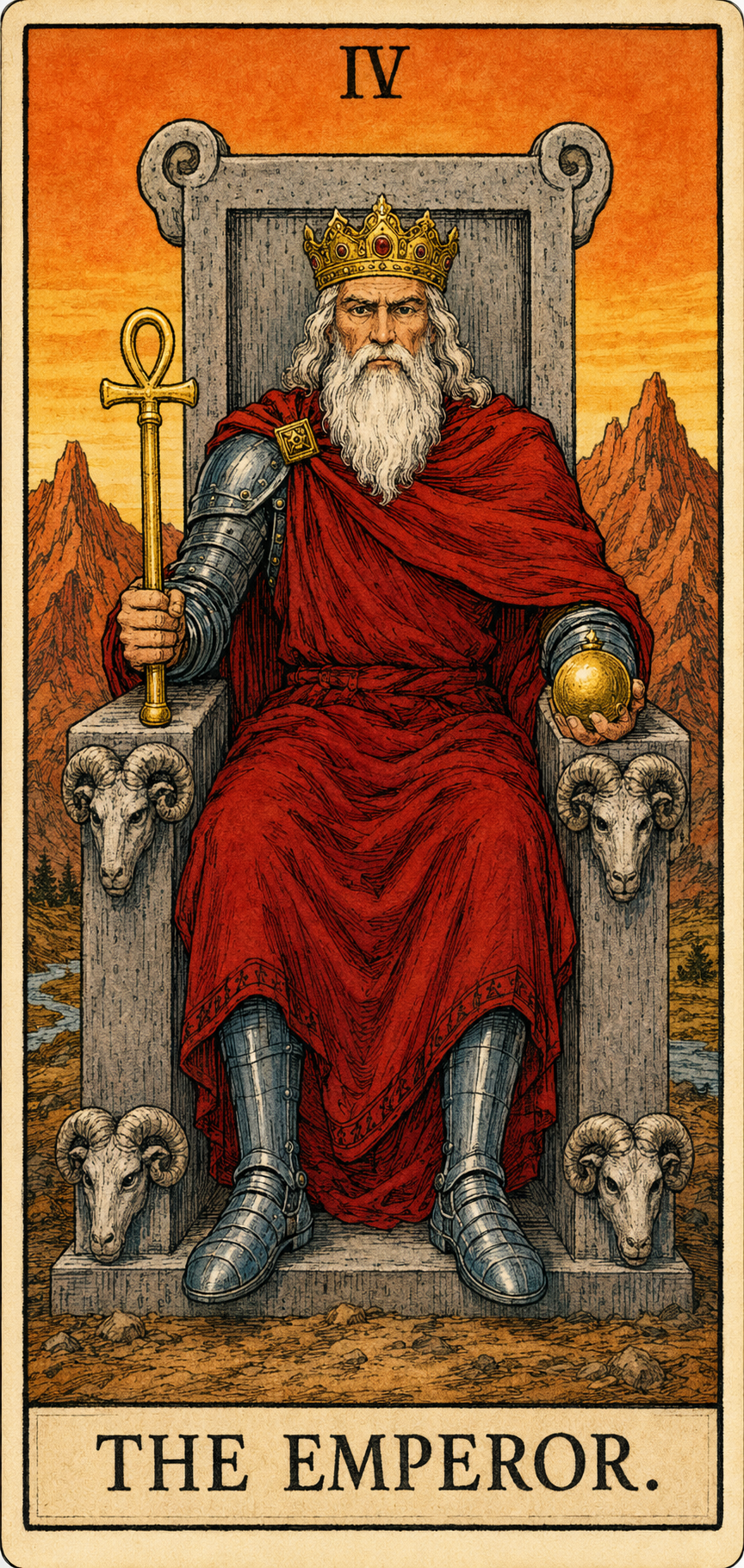
Among the Major Arcana, few cards provoke stronger reactions than The Emperor. Some readers meet him as a symbol of stability, order, and wise leadership. Others see rigidity, domination, or the burdens of authority. Both responses reveal something true. The Emperor stands at the point where structure enters the Fool’s journey in a decisive way. If The Empress suggests abundance, nurture, and generative life, The Emperor introduces boundary, law, form, and the disciplines that allow life to endure.
The Emperor tarot meaning remains important because the card addresses a permanent human question: how should power be used? That question belongs not only to rulers and institutions but also to parents, teachers, artists, spiritual seekers, and anyone responsible for shaping a life. Authority can protect or oppress. Order can support growth or suffocate it. The card therefore invites more than a simple positive or negative judgment. It asks readers to reflect on the relationship between strength and wisdom, will and restraint, command and service.
Within the deck, The Emperor follows The Empress and precedes The Hierophant. This placement is meaningful. After the fertile creativity of The Empress, the sequence turns toward pattern, governance, and continuity. Then it moves into inherited teaching, tradition, and communal meaning. The Emperor thus occupies a threshold between natural abundance and social order. He represents the principle that gives shape to what might otherwise remain diffuse. In practical terms, he concerns the building of systems, the keeping of promises, the creation of laws, and the cultivation of mature responsibility.
This article contains affiliate links.
Serious tarot study benefits from approaching this card through several lenses at once. Historically, The Emperor developed from early triumph imagery into a richly layered esoteric symbol. Artistically, the Rider-Waite-Smith and Thoth decks each reshaped the card in ways that still influence modern interpretation. Psychologically, the card speaks to the archetype of the father, ruler, lawgiver, and organizer. Mythologically, it resonates with gods and kings associated with sovereignty, sky power, justice, and civilization. Esoterically, it opens onto astrology, Qabalah, alchemy, and Christian Hermetic reflection.
For readers who want a deeper symbolic education, Rose and Rune also recommends The Hermetic Mirror, a course exploring esoteric symbolism, contemplative interpretation, and the inner logic of Western mystery traditions in an accessible way.
This guide follows a scholarly but accessible path. We will examine historical origins, Rider-Waite-Smith symbolism, Thoth symbolism, archetypal and Jungian themes, mythological parallels, alchemical and Christian Hermetic reflections, the Tree of Life, astrology, chakra correspondence, upright and reversed meanings, practical journaling prompts, meditation, related cards, and frequently asked questions. Along the way, we will draw on respected voices including Rachel Pollack, Mary K. Greer, Benebell Wen, Lon Milo DuQuette, Robert M. Place, Adam McLean, Arthur Edward Waite, Aleister Crowley, and other historians and interpreters where appropriate.
Rather than reducing the card to fortune-telling slogans, this article treats The Emperor as a symbolic teacher. His lesson is not merely about control. It is about rightful order, mature stewardship, and the difficult art of embodying strength without losing soul.
Core themes: rightful power, the shaping of form, mature responsibility, boundaries that protect life, and the ethical use of will
The number four is central to understanding the card. In numerology, four suggests foundation, stability, structure, and material order. A square has four sides. Many sacred and philosophical systems organize reality through fours: four directions, four seasons, four elements, four evangelists, four rivers of paradise, and the four suits of tarot. The Emperor therefore represents a stabilizing principle. He does not generate life in the way The Empress does. Instead, he gives life durable form.
Historical Origins of the Card
To understand The Emperor tarot meaning, it helps to begin with tarot’s earliest history rather than with modern occult assumptions. Tarot emerged in fifteenth-century Italy as a card game, not as a fully developed esoteric system. Historians such as Michael Dummett, Ronald Decker, Thierry Depaulis, and Robert M. Place have shown that the earliest trump cards belonged to a cultural world shaped by courtly pageantry, civic symbolism, Christian moral imagination, and Renaissance political life rather than by a secret Egyptian priesthood or an ancient occult code (Dummett; Decker, Depaulis, and Dummett; Place).
Early Imperial Imagery
In the earliest surviving decks, the Emperor appears as a ruler seated on a throne, often holding orb, scepter, or shield. The image would have been legible to Renaissance viewers. It represented temporal authority, civic order, masculine sovereignty, and the visible structures of power. The card belonged to a sequence of trumps that dramatized hierarchy and human destiny. In that sequence, the Emperor stood below transcendent or ecclesiastical figures such as the Pope but above ordinary social roles. He symbolized worldly rule at its highest level.
The early Tarot de Marseille tradition preserved this broad idea. The Emperor remained a crowned ruler, usually shown in profile or near profile, seated in a posture of command. Compared with later decks, the image was simpler and less overtly esoteric. Yet even in these earlier forms, the card already suggested themes that would endure: authority, governance, law, and the ordering of human life through stable institutions.
From Political Figure to Symbolic Principle
As tarot moved into occult interpretation in the eighteenth and nineteenth centuries, readers began to see more than a literal emperor. Antoine Court de Gébelin and later occultists reimagined the trumps as carriers of hidden wisdom. By the time of Éliphas Lévi and the Hermetic Order of the Golden Dawn, the Emperor had become part of a larger symbolic network involving astrology, Hebrew letters, ceremonial magic, and Qabalah. This did not erase the older political meaning. Instead, it expanded it. The ruler on the throne became an image of cosmic order, disciplined will, and the shaping intelligence that gives law to life.
Robert M. Place is especially helpful here because he balances historical caution with symbolic sensitivity. He notes that tarot images often gained new meanings over time without losing earlier ones. The Emperor could remain a worldly ruler while also becoming an archetype of structure and authority in a broader spiritual sense (Place, The Tarot: History, Symbolism, and Divination).
Rider-Waite-Smith Changes
The Rider-Waite-Smith deck, published in 1909, transformed how modern readers understand the card. Arthur Edward Waite and Pamela Colman Smith retained the imperial throne and crown but intensified the symbolic atmosphere. The ruler now sits against a stark mountainous landscape. Rams decorate the throne. Red robes and armor emphasize fiery force. The image feels less like a portrait of a historical monarch and more like a distilled emblem of rulership itself. Waite’s brief notes in The Pictorial Key to the Tarot frame the card in terms of worldly power, authority, and realized thought, but Smith’s art gives it psychological and mythic depth.
Thoth Deck Changes
Aleister Crowley and Lady Frieda Harris took the card in a more overtly esoteric direction in the Thoth deck. Their Emperor is not merely a seated king. He is a fiery, symbolic concentration of Aries, Mars, creative potency, and imperial order. Crowley links the card to the Hebrew letter Heh and to a complex network of astrological and Qabalistic ideas in The Book of Thoth. The result is a card that feels less civic and more cosmic. Yet the central concern remains recognizable: power that imposes form.
Across these developments, the card evolved from a recognizable ruler into a multi-layered symbol of sovereignty, law, and disciplined creative force. That long history matters because it keeps modern interpretation grounded. The Emperor is not only a personality type. He is also a historical image of rulership, a philosophical emblem of order, and a spiritual question about how form should govern life.
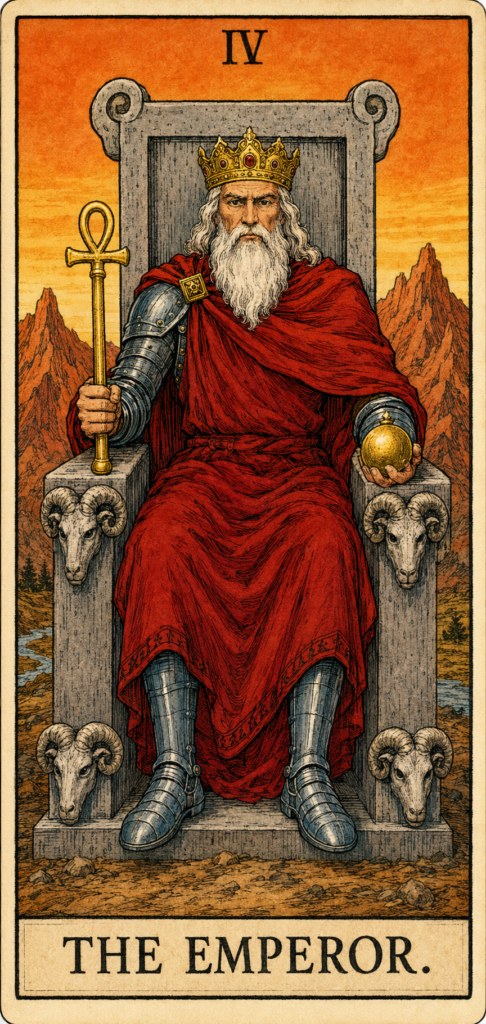
The Rider-Waite-Smith Emperor is one of the most recognizable images in modern tarot. Pamela Colman Smith presents a stern ruler seated on a stone throne adorned with ram heads. He wears a crown and red robes over armor. In one hand he holds an ankh-like scepter; in the other, an orb. Behind him rise barren mountains. A narrow river appears in the distance. Every element contributes to a symbolic language of command, structure, and disciplined force.
The Throne and Rams
The stone throne suggests permanence. This is not a temporary seat or a decorative chair. It implies law, institution, and the hard durability of structure. The ram heads immediately connect the card with Aries, the cardinal fire sign ruled by Mars. Aries brings initiative, courage, assertion, and the power to begin. Yet on the throne, that force is no longer raw impulse alone. It has become established authority.
Rachel Pollack often emphasizes that tarot symbols gain power through relationship. Here the ram is not charging across a field. It is carved into the throne. Fiery instinct has been fixed into order. That shift helps explain why The Emperor is not simply about aggression. He represents force that has become system, will that has become law, and initiative that has become governance (Pollack, Seventy-Eight Degrees of Wisdom).
Red Robes and Armor
The Emperor’s red robes reinforce the fiery, martial quality of the card. Red suggests vitality, blood, courage, passion, and action. Under the robes, however, lies armor. This combination matters. The card does not show unguarded emotional warmth. It shows protected power. Armor implies readiness, defense, and distance. The ruler is not merely expressive. He is fortified.
Mary K. Greer’s approach to tarot often invites readers to ask how a symbol feels in the body and in lived experience. The armor of The Emperor can feel reassuring when one needs boundaries, discipline, or protection. It can also feel intimidating when one longs for tenderness or flexibility. The card therefore contains a tension between safety and severity, which is one reason it remains psychologically rich (Greer, 21 Ways to Read a Tarot Card).
Scepter, Orb, and Crown
The scepter resembles an ankh, an Egyptian symbol of life, though Waite does not dwell on this detail. The orb suggests dominion over the world. Together they imply that rulership concerns both vitality and order. The crown marks legitimacy. This is not the power of a rebel or a usurper. It is sanctioned, visible authority. In symbolic reading, that can point to inner legitimacy as well. The Emperor asks whether one has claimed rightful responsibility rather than merely reacting to circumstances.
Mountains and River
The mountains in the background are barren and severe. They evoke endurance, height, and the difficulty of rule. This is not the lush garden world of The Empress. It is a landscape of stone and exposure. The small river in the distance is easy to miss, yet it matters. It hints that life still flows within the domain of structure. The Emperor is not meant to destroy vitality but to channel it. Benebell Wen’s integrative approach is useful here: the card often concerns the management of energy through systems, habits, and frameworks that make sustained growth possible (Wen, Holistic Tarot).
Numerology and Hidden Symbolism
As card IV, The Emperor belongs to the number of foundation. Four stabilizes the creative impulse of one, the polarity of two, and the synthesis of three. In many symbolic systems, four marks the point where energy becomes inhabitable. A house needs four walls. A city needs laws. A ritual needs form. A life needs discipline. Waite and Smith’s symbolic choice to emphasize stone, geometry, and seated command aligns perfectly with this numerological logic.
Seen through Pollack, Greer, and Wen together, the Rider-Waite-Smith Emperor becomes more than a stern father figure. He is the archetype of structure itself: necessary, powerful, potentially protective, and always in danger of hardening into rigidity if not balanced by wisdom and heart.
Thoth Tarot Symbolism
The Thoth Emperor, painted by Lady Frieda Harris under Aleister Crowley’s direction, intensifies the card’s astrological and esoteric dimensions. Crowley retains the title The Emperor, but the image is less naturalistic than the Rider-Waite-Smith version. It is a symbolic field of Aries, Mars, rulership, and generative command. The figure appears armored and enthroned, often with heraldic and geometric features that emphasize force organized into pattern.
Crowley’s Emphasis on Aries
In The Book of Thoth, Crowley links The Emperor to Aries and to the fiery initiating force of spring. This is crucial. The card is not only about established authority. It is also about the primal surge that begins a cycle. Aries is cardinal fire: the power to start, assert, penetrate, and define. Crowley’s Emperor therefore carries a more overtly sexual and creative charge than Waite’s more civic ruler. The card becomes an emblem of formative force entering manifestation.
Lon Milo DuQuette, in Understanding Aleister Crowley’s Thoth Tarot, helps modern readers navigate this symbolism by showing how Crowley’s attributions work together rather than in isolation. Aries, Mars, the ram, the scepter, and the geometry of the card all reinforce a single principle: energy that establishes order through decisive assertion.
Qabalistic and Esoteric Layers
Crowley assigns the card to the Hebrew letter Heh. In his broader system, Heh participates in a web of correspondences involving breath, revelation, and formative expression. The Emperor also stands in relationship to The Star through Crowley’s idiosyncratic treatment of the Tetragrammaton and the letters of the divine name. Even readers who do not adopt Crowley’s exact framework can see that the card is meant to express more than political command. It is a metaphysical principle of ordering fire.
Compared with the Rider-Waite-Smith deck, the Thoth Emperor feels less paternal in a social sense and more elemental in a cosmic sense. The card is not primarily about a father on a throne. It is about the fiery law by which form asserts itself. That shift can deepen interpretation. It reminds readers that structure is not merely cultural. It is also woven into the rhythms of nature, season, incarnation, and creative emergence.
How the Thoth Version Deepens Understanding
The Thoth deck broadens The Emperor tarot meaning by making the card less moralistic and more ontological. Instead of asking only whether authority is good or bad, it asks what authority is. It shows that every act of creation requires delimitation. To build is to choose. To govern is to define. To incarnate is to accept form. Crowley’s version can therefore help readers see The Emperor not only as a person but as a universal principle: the fiery architecture of
manifestation.
The Card’s Archetypal Meaning
From a Jungian and archetypal perspective, The Emperor belongs to the family of ruler, father, king, lawgiver, and organizer images. These are not merely social roles. They are recurring psychic patterns that shape how human beings imagine order, authority, protection, and responsibility. Carl Jung’s work on archetypes does not discuss tarot in a systematic way, yet his ideas offer a powerful lens for understanding why The Emperor continues to resonate. The card depicts a pattern of consciousness that seeks to establish stable form against chaos.
The Mature Ruler
In its mature expression, this archetype protects what is vulnerable, creates sustainable order, sets clear boundaries, and accepts responsibility for consequences. The mature Emperor does not dominate for the sake of ego. He governs in service of continuity. He understands that love without structure can become diffuse, while structure without love becomes sterile. Pollack often points out that the Major Arcana portray developmental energies. In that sense, The Emperor represents the stage at which life requires discipline, definition, and ethical command (Pollack).
The Shadow Ruler
Every archetype has a shadow. The shadow Emperor appears as tyranny, emotional repression, inflexibility, authoritarianism, domination, or fear disguised as control. Jungian thought is especially helpful here because it reminds us that shadow is not simply evil. It is often an exaggerated or distorted form of a genuine need. The desire for order can become obsession. The wish to protect can become possessiveness. The call to lead can become the need to command. The Emperor’s shadow asks readers to examine where structure has hardened into defense.
Stephan Hoeller’s Jungian and Gnostic reflections on symbolic life are useful in this context because they emphasize inner authority. The deepest task is not merely to obey outer structures or rebel against them, but to develop a conscious relationship to law within the self. The Emperor can therefore represent the formation of an inner governor: the part of the psyche that can choose principle over impulse.
Universal Human Experience
Most people encounter The Emperor archetype repeatedly across life. It appears in fathers and father figures, institutions, bosses, governments, teachers, traditions, and internalized standards. It also appears whenever a person must become more structured: setting boundaries, managing finances, building a practice, keeping vows, or taking responsibility for a community. The card’s enduring power lies in this universality. One need not be a king to wrestle with sovereignty. Every life eventually asks: what rules will govern me, and how will I govern what has been entrusted to me?
Mythological Connections
The Emperor gathers together motifs found across many mythologies: the sky father, the lawgiver, the warrior king, the founder of order, and the guardian of civilization. No single myth exhausts the card, but several traditions illuminate its symbolic range.
Greek Mythology
Greek mythology offers obvious parallels in Zeus, king of the gods, associated with sky power, law, and sovereignty. Yet Zeus is not a perfect Emperor figure in a moral sense. His myths also reveal excess, appetite, and instability. That complexity is instructive. The Emperor is not a sanitized ideal. He includes the danger that power may justify itself. A more civic parallel might be found in Athena’s political wisdom or in the lawgiving dimension of Apollo, but Zeus remains the clearest image of rulership backed by force.
Egyptian Mythology
In Egyptian symbolism, Osiris and Horus both contribute useful resonances. Osiris represents kingship, continuity, and sacred order, while Horus embodies rightful rule and the restoration of balance. Egyptian kingship was never merely political. It was cosmic, tied to ma’at, the principle of truth and order. This is close to one of The Emperor’s deepest meanings: authority is justified when it aligns with a larger order rather than serving private appetite.
Norse Mythology
Norse mythology offers Odin and Tyr as illuminating comparisons. Odin is a ruler associated with wisdom, sacrifice, and sovereignty, though he is more liminal and magical than The Emperor usually appears. Tyr, by contrast, is linked to law, oath, and the maintenance of order, especially through his sacrificial courage in the binding of Fenrir. Tyr’s willingness to lose a hand for the sake of cosmic stability reflects a key Emperor theme: real authority often requires cost, discipline, and duty.
Biblical Symbolism
Biblical parallels are more complex because scripture often treats kingship ambivalently. David and Solomon can illuminate aspects of The Emperor, especially in relation to rule, temple, law, and covenantal responsibility. Yet the Bible also repeatedly warns that kings can become corrupt, oppressive, and idolatrous. This tension is valuable. It prevents simplistic glorification of power. The Emperor, read through biblical symbolism, becomes a meditation on stewardship under judgment rather than absolute self-authorization.
Other Mythic Parallels
Roman images of Jupiter, medieval images of the rex justus or just king, and even Arthurian kingship all contribute to the card’s symbolic field. In each case, the central question remains the same: what makes rule legitimate? Myth answers in different ways, but most traditions agree that authority must be linked to justice, continuity, and service to something larger than the ruler’s ego.
Alchemical Symbolism
Alchemy may seem at first more naturally related to cards like Temperance, Death, or The Magician, yet The Emperor has an important alchemical role. Alchemy is not only about transformation through dissolution. It is also about containment, vessel, proportion, and the disciplined ordering of process. Without structure, the work fails. In that sense, The Emperor represents the principle that holds the opus together.
The Vessel and the Law of Process
Adam McLean’s work on alchemical symbolism repeatedly shows how images of kings, vessels, geometric forms, and ordered stages communicate inner development as much as laboratory procedure. The Emperor can be understood as the vessel principle: the containing form within which transformation becomes possible. Fire without a vessel destroys. Fire within a vessel refines. This is an elegant way to understand the card’s relationship to Aries and Mars. The Emperor does not eliminate fire. He gives it lawful direction.
Fixation and Coagulation
Alchemical texts often speak of processes by which the volatile becomes fixed and the subtle becomes embodied. The Emperor belongs to this logic of fixation. He is not the whole work, but he represents a necessary stage in which energy becomes stable enough to endure. In psychological terms, insight must become habit. In spiritual terms, inspiration must become discipline. In practical terms, vision must become structure. The Emperor is therefore allied with coagulation, establishment, and the architecture of transformation.
At the same time, alchemy warns against premature hardening. If matter is fixed too early, the work stagnates. This offers a subtle caution about the card. Structure is necessary, but excessive rigidity can arrest development. The alchemical Emperor must know when to contain and when to allow further change.
Christian Hermetic Reflections
For readers interested in Christian Hermetic interpretation, The Emperor invites reflection on authority, order, stewardship, and the relation between divine law and human rule. This need not become dogmatic. The card can be approached symbolically and contemplatively. Christian Hermetic thought often seeks correspondences between spiritual truth, cosmic order, and the moral life. In that framework, The Emperor represents the principle by which form serves wisdom.
Meditations on the Tarot
Valentin Tomberg’s Meditations on the Tarot is especially relevant because it treats the Major Arcana as contemplative gateways rather than predictive devices. Although Tomberg does not reduce the cards to one-to-one doctrinal statements, his method encourages readers to ask how each image reveals a spiritual lesson. In that spirit, The Emperor can be read as the mystery of authority purified by service. Power becomes legitimate when it protects life, establishes justice, and submits itself to truth.
Christian Symbolic Parallels
Christian symbolism offers several fruitful parallels: the righteous king, the wise steward, the builder who counts the cost, and the father who disciplines without cruelty. The card may also invite meditation on the tension between law and grace. Law gives form. Grace gives life. Without law, life can become chaotic. Without grace, law becomes dead letter. The Emperor, especially when balanced by The Empress, can symbolize the necessary marriage of order and living abundance.
From a Hermetic perspective, the card also reflects the macrocosmic principle that creation is ordered, intelligible, and patterned. Human beings participate rightly in that order when they cultivate self-command, truthful speech, and responsible action. The Emperor therefore becomes less a celebration of domination than a call to mature stewardship.
The Tree of Life and Hebrew Letter
In the Golden Dawn system, The Emperor corresponds to the Hebrew letter Heh and to Path 15 on the Tree of Life, connecting Chokmah and Tiphareth. Heh is often associated with breath, revelation, and a window or opening. This may seem surprising for such a solid, martial card, yet the symbolism becomes clearer when one considers that true authority is not mere force. It is formative expression. Breath becomes word. Word becomes law. Law becomes order.
Heh and Formative Expression
Heh appears in the divine name YHVH and carries deep symbolic importance in Jewish and Hermetic traditions. As a letter associated with opening and manifestation, it fits The Emperor’s role in giving shape to power. The card is not only about holding authority. It is about expressing it in a way that becomes visible and effective. That expression can be just or unjust, wise or foolish, but it is always formative.
Chokmah, Tiphareth, and the Path
Chokmah is often associated with primal wisdom, dynamic force, and the outpouring of creative energy. Tiphareth concerns harmony, beauty, and the balanced center. A path between them suggests the movement by which raw power becomes ordered expression. The Emperor can therefore be understood as a mediator between force and harmony. He channels initiative toward form. In Golden Dawn terms, the Aries attribution reinforces this reading: cardinal fire becomes lawful direction.
These correspondences deepen interpretation by showing that The Emperor is not merely a social archetype. He is also a metaphysical principle within a larger map of manifestation. The card asks how power descends into form and whether that form reflects wisdom.
Astrological Correspondences
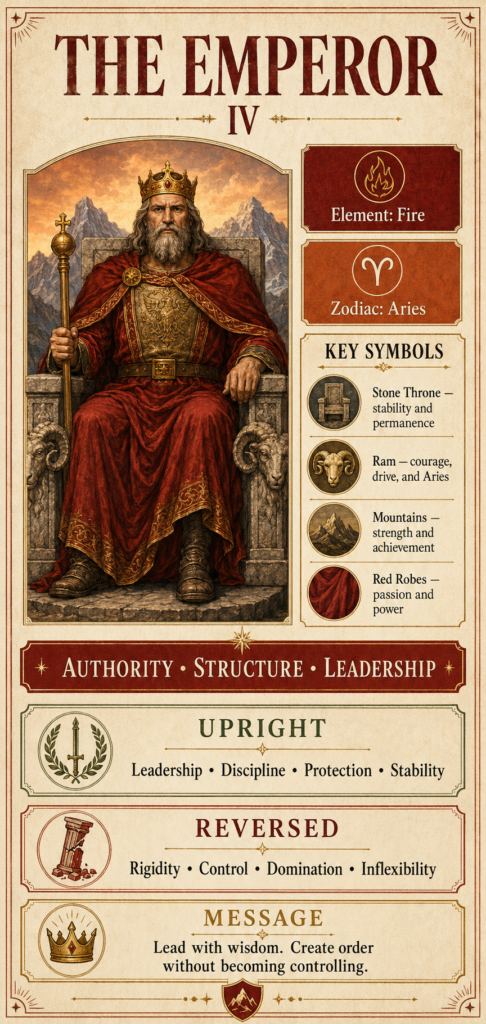
The Emperor is traditionally associated with Aries, ruled by Mars, and with the element of Fire. This triad is essential to the card. Aries is the first sign of the zodiac, a cardinal fire sign linked to initiative, assertion, courage, and the power to begin. Mars contributes force, drive, conflict, and decisive action. Fire adds vitality, will, and transformative energy.
Yet The Emperor is not simply impulsive Aries energy. The card shows what happens when that force becomes organized. It is fire under command. This is why the card can signify leadership, executive function, strategic action, and the ability to set direction. It also explains the shadow side. When Mars and Aries lose balance, they can become aggression, impatience, domination, or the inability to listen.
Traditional occult correspondences therefore enrich interpretation. They remind readers that The Emperor is not cold in essence. He is hot, active, and forceful. The stone throne and rigid posture are not signs of emotional emptiness alone. They are signs that fire has been disciplined into rulership.
Chakra Correspondence
Although chakras arise from Indian traditions rather than tarot’s historical roots, many contemporary readers find symbolic correspondences helpful. The Emperor most naturally aligns with the Solar Plexus Chakra, associated with will, agency, confidence, discipline, and self-governance. This chakra concerns the capacity to act in the world with coherence and purpose. That is very close to the card’s central energy.
Some readers also connect The Emperor with the Root Chakra because of its themes of stability, safety, and structural support. This secondary association makes sense, especially when the card appears in relation to home, finances, institutions, or the need for grounding. Still, the Solar Plexus remains the strongest symbolic fit because The Emperor is not only about being secure. He is about directing power.
Psychologically, a balanced Emperor reflects healthy confidence, clear boundaries, and the ability to make decisions without collapsing into fear or aggression. Spiritually, the card suggests disciplined embodiment: bringing intention into action through mature self-command.
Upright Meaning
Upright, The Emperor often signals a need for structure, responsibility, and principled leadership. This does not mean the card always points to a literal authority figure, though it can. More often, it asks what kind of order is now required. The moment may call for discipline, planning, boundaries, or the courage to take command of one’s own life. The card suggests that stability will not arise by accident. It must be built.
Personal Growth
In personal growth, The Emperor encourages self-mastery. It may appear when a person needs better routines, stronger boundaries, or greater accountability. The card can support the development of confidence, especially confidence rooted in competence rather than image. It asks whether one is willing to become reliable.
Relationships
In relationships, the card can point to commitment, protection, steadiness, and clear expectations. At its best, it suggests a bond strengthened by maturity and mutual respect. At times, however, it may indicate imbalance if one partner controls too much or struggles to express vulnerability. The card invites reflection on whether structure in the relationship is supportive or restrictive.
Career and Work
In career contexts, The Emperor often speaks clearly. It can signify leadership, management, entrepreneurship, institutional roles, administration, policy, long-term planning, or the building of systems. The card favors strategy over improvisation. It supports the work of creating frameworks that endure. For creative people, this may mean learning that inspiration alone is not enough. A practice needs schedule, budget, boundaries, and follow-through.
Creativity and Spiritual Development
Creatively, The Emperor asks how vision can be given form. Spiritually, it suggests discipline, rule of life, and the shaping power of practice. Prayer, study, ritual, journaling, and contemplation all benefit from structure. The card does not oppose mystery. It provides the container in which mystery can be approached faithfully.
Reversed Meaning
Reversed, The Emperor often points to distortion in the realm of authority and structure. That distortion may take the form of excess or deficiency. Sometimes the card suggests control, rigidity, domination, stubbornness, or authoritarian behavior. In other cases, it indicates the opposite problem: weak boundaries, lack of discipline, avoidance of responsibility, or difficulty establishing order.
Psychologically, the reversed card can reveal an unresolved relationship to power. A person may fear becoming controlling and therefore avoid leadership altogether. Another may cling to control because vulnerability feels unsafe. In either case, the invitation is not simplistic negativity. The card asks what a healthier expression of authority would look like.
In relationships, the reversal may signal imbalance around rules, expectations, or emotional expression. In work, it can point to poor management, burnout caused by over-control, or the collapse of needed systems. Spiritually, it may suggest legalism on one side or undisciplined drift on the other. Growth comes through recalibration: enough structure to support life, enough humility to keep structure from becoming an idol.
Practical Reflection Questions
Where in my life do I need stronger boundaries?
What responsibilities have I been postponing?
How do I respond to authority, and why?
When does discipline support my growth, and when does it become self-punishment?
What systems would make my creative or spiritual life more sustainable?
Do I confuse control with safety?
Where am I being asked to lead with maturity?
What kind of ruler is my inner voice: wise, harsh, absent, or inconsistent?
How can I embody strength without becoming rigid?
What commitments need clearer structure?
Which habits are building the life I want, and which are undermining it?
What does rightful authority mean to me?
How do I hold power when others depend on me?
What would mature self-governance look like in this season of life?
Where do I need more courage to define, decide, or protect?
Meditation Exercise
Find a quiet place and sit upright. Breathe slowly until your attention settles. Imagine a stone throne before you on a high, clear mountain. The air is sharp, the horizon wide. Upon the throne sits The Emperor, not as a tyrant but as a presence of steady authority.
Notice the ram symbols, the red robes, the crown, the orb, and the scepter. Ask inwardly: What in my life needs order? Wait without forcing an answer. Then ask: What am I being asked to protect? Finally ask: Where has control replaced wisdom, or where has avoidance replaced responsibility?
Imagine the Emperor placing one object in your hands: a key, a staff, a stone, or a written law. Receive whatever appears. Let it symbolize the form of discipline now needed in your life. When you are ready, thank the figure and return your attention to the breath. End by writing one concrete action you will take in the next seven days to embody mature structure.
Related Cards
The Emperor becomes clearer when read in relationship to other cards.
The Empress
The most obvious counterpart is The Empress. If she represents fertility, abundance, and living growth, he represents structure, law, and the conditions that preserve growth. Together they form a symbolic polarity: nurture and boundary, creativity and order, body and institution.
The Fool, The High Priestess, and The Hierophant
The Fool begins the journey in openness. The High Priestess deepens it through inner knowing. The Emperor introduces outer order. The Hierophant then carries that order into tradition, teaching, and communal meaning. Seen this way, The Emperor is a bridge between private potential and public form.
Related Court and Minor Cards
The Kings, especially the King of Wands and King of Pentacles, can echo aspects of The Emperor. The King of Wands shares charisma, vision, and command, while the King of Pentacles shares stability and stewardship. Among the minors, the Fours often resonate strongly because they concern stability, pause, structure, and foundation. In the Thoth system, Aries and Mars also connect the card to fiery initiating energies found elsewhere in the deck.
What Modern Readers Can Learn from The Emperor
Modern culture often swings between two extremes: suspicion of all authority and fascination with strong personalities. The Emperor offers a more demanding lesson. He asks not whether power exists, but how it should be shaped, limited, and used. He reminds readers that freedom without structure can become drift, while structure without soul becomes oppression.
For contemporary readers, this can mean learning to build sustainable habits, take responsibility for one’s gifts, and create systems that support rather than suffocate life. It can also mean healing distorted relationships to authority, whether through rebellion, fear, dependency, or over-control. The card’s enduring wisdom lies in its insistence that maturity requires form. A meaningful life must eventually be governed, not merely imagined.
The Emperor generally signifies authority, structure, discipline, boundaries, leadership, and the responsible use of power. At a deeper level, it concerns the shaping of life through lawful form.
Is The Emperor a positive card?
It is often constructive, but not automatically comfortable. The card can be highly positive when stability, protection, and mature leadership are needed. It becomes difficult when authority turns rigid or controlling.
What zodiac sign is associated with The Emperor?
The Emperor is traditionally associated with Aries, the cardinal fire sign ruled by Mars.
What planet is associated with The Emperor?
Mars is the primary planetary correspondence, contributing force, courage, drive, and assertive energy.
What does The Emperor reversed mean?
Reversed, the card often points to distorted authority, over-control, rigidity, weak boundaries, avoidance of responsibility, or unhealthy relationships to power.
How is The Emperor different from The Hierophant?
The Emperor concerns rule, structure, and executive authority. The Hierophant concerns tradition, teaching, transmission, and communal belief. One governs order; the other interprets meaning within inherited systems.
How is The Emperor different from The Empress?
The Empress emphasizes fertility, nurture, sensual abundance, and generative life. The Emperor emphasizes law, boundary, discipline, and the structures that preserve and direct life.
Can The Emperor represent a person?
Yes. It can represent a father figure, leader, manager, mentor, or anyone embodying strong structure and authority. In reflective reading, it can also represent an inner mode of self-governance.
What is The Emperor’s spiritual lesson?
Its spiritual lesson is that power must be disciplined by wisdom. Form is necessary for growth, but form must remain in service to life rather than becoming an idol.
For additional historical context, readers may also consult scholarly work on tarot history and Western esotericism, including studies by Michael Dummett, Ronald Decker, Thierry Depaulis, and Antoine Faivre.
Final Thoughts
The Emperor endures because it speaks to one of the central tasks of human life: giving shape to power. The card asks how we build, govern, protect, and commit. It reminds us that structure is not the enemy of spirit. At its best, structure makes spirit inhabitable. A practice needs rhythm. A promise needs form. A life needs principles sturdy enough to bear weight.
At the same time, the card warns against confusing hardness with wisdom. True authority does not merely dominate. It serves, steadies, and takes responsibility. In that sense, The Emperor tarot meaning is not finally about control. It is about mature stewardship. Read contemplatively, the card invites reflection, self-command, and the kind of spiritual insight that turns strength into service rather than prediction into certainty.
Works Cited
Crowley, Aleister. The Book of Thoth. Weiser Books, 1984.
Decker, Ronald, Thierry Depaulis, and Michael Dummett. A Wicked Pack of Cards. St. Martin’s Press, 1996.
Dummett, Michael. The Game of Tarot. Duckworth, 1980.
Among the Major Arcana, few images communicate abundance, beauty, fertility, and embodied wisdom as immediately as The Empress. Seated amid grain, forest, flowing water, and the signs of cultivated life, she appears not as an abstract ideal but as a living presence of generative power. Yet The Empress tarot meaning extends far beyond simplified ideas of motherhood, romance, or material comfort. Historically and symbolically, the card speaks to creation in its widest sense: the power to nourish, shape, receive, gestate, and bring forth life in forms both visible and invisible.
This article contains affiliate links.
In many modern tarot books, The Empress is reduced to a short list of pleasant keywords such as fertility, luxury, sensuality, and creativity. Those associations are not wrong, but they are incomplete. The card belongs to a much deeper symbolic lineage that includes medieval and Renaissance queenship, Marian imagery, goddess traditions, alchemical generation, Jungian archetypes, Christian contemplative symbolism, and the philosophical language of Western esotericism. To study The Empress seriously is to encounter a symbol of life-giving order, relational intelligence, and sacred embodiment.
Rachel Pollack describes the Major Arcana as a sequence of living mysteries rather than a set of fixed definitions, and The Empress exemplifies that principle beautifully. She can represent nature and culture, instinct and refinement, sensuality and spiritual receptivity, earthly pleasure and symbolic wisdom all at once (Pollack). Mary K. Greer encourages readers to approach each card as a field of relationships rather than a single answer, while Benebell Wen situates The Empress within a broad network of historical, occult, and psychological correspondences (Greer; Wen). Robert M. Place, meanwhile, reminds us that tarot images evolved over centuries and must be understood in relation to their artistic and historical contexts, not only through later occult overlays (Place).
This guide approaches The Empress tarot meaning through multiple lenses: historical, symbolic, mythological, archetypal, psychological, esoteric, Christian Hermetic, alchemical, and practical. We will consider how the card developed from early tarot traditions into the Rider-Waite-Smith and Thoth decks, how its imagery communicates layered ideas about generation and order, and why it remains so compelling for modern readers seeking depth rather than prediction. We will also explore how The Empress can illuminate creativity, relationships, vocation, spiritual practice, and the work of becoming more fully human.
Why The Empress Still Matters
Rather than treating The Empress as a card that merely promises external blessings, this article reads her as a symbolic teacher. She asks what it means to cultivate life responsibly, to receive without passivity, to create without domination, and to honor the intelligence of the body, the imagination, and the natural world. In that sense, The Empress is not simply a figure of comfort. She is a figure of sacred participation in the mystery of growth.
The Empress is the third card of the Major Arcana. She follows The High Priestess and introduces a different mode of wisdom. Where The High Priestess often symbolizes hidden knowledge, inwardness, and mystery, The Empress brings fecundity into form. She is the principle of manifestation through nurture, beauty, relationship, and embodied life.
Traditional card number: III
Suit: Not applicable; Major Arcana
Element: Earth, with strong Venusian and generative associations
Planet: Venus
Zodiac sign: Often associated with Venus and, by extension, Taurus and Libra; in Golden Dawn correspondences, the card is planetary rather than zodiacal
Hebrew letter: Daleth (ד)
Path on the Tree of Life: Path 14, between Chokmah and Binah
Chakra correspondence: Often linked to the Sacral Chakra, with secondary resonance to the Heart Chakra
Golden Dawn correspondence: Venus, Daleth, Path 14
Thoth correspondence: The Empress, Venus, Daleth, the gate or door of manifestation
Core themes: life-giving power, sacred embodiment, cultivated abundance, generative love, artistic creation, the intelligence of nature, and the transformation of potential into living form
At its deepest level, The Empress tarot meaning concerns the mystery of generation. She does not force life into being through will alone. Instead, she receives, nourishes, protects, and brings to maturity. That pattern applies not only to literal motherhood but also to art, ideas, relationships, communities, and spiritual growth.
Historical Origins of the Card
To understand The Empress tarot meaning, it is important to begin with tarot history rather than with modern assumptions. Early tarot emerged in fifteenth-century Italy as a card game, not as a fully formed occult system. Historians such as Michael Dummett and Robert M. Place have shown that the earliest trumps belonged to a visual culture shaped by courtly hierarchy, Christian symbolism, civic allegory, and Renaissance political imagination rather than by a single secret doctrine (Place; see also historical scholarship referenced by Place).
Imperial Roots and Early Sovereignty
In the earliest decks, The Empress appears as an imperial female ruler. She is not yet the lush, nature-throned figure familiar from the Rider-Waite-Smith deck. Instead, she reflects the social and symbolic language of sovereignty. Crown, scepter, shield, and throne identify her as an image of lawful authority, fecund order, and dynastic continuity. The card’s meaning in this early context likely had more to do with rank, worldly power, and the ordering of society than with later occult ideas about Venus, fertility, or the divine feminine.
From Marseille to Modern Occult Tarot
The Tarot de Marseille preserved this imperial framework. There, L’Impératrice remains a seated ruler, often holding a shield marked with an eagle. The eagle is especially significant because it links the card to empire, vision, elevation, and authority. Over time, readers began to see in this image not only political rulership but also the broader principle of ordering intelligence expressed through feminine form. That shift did not erase the older meaning. Rather, it expanded it.
Robert M. Place notes that tarot symbolism evolved through reinterpretation. Images that began in one context acquired new significance as later generations read them through Christian mysticism, occult philosophy, alchemy, astrology, and psychology. The Empress is a clear example of this process. A Renaissance emblem of queenship gradually became a symbol of nature, beauty, fertility, and generative consciousness (Place).
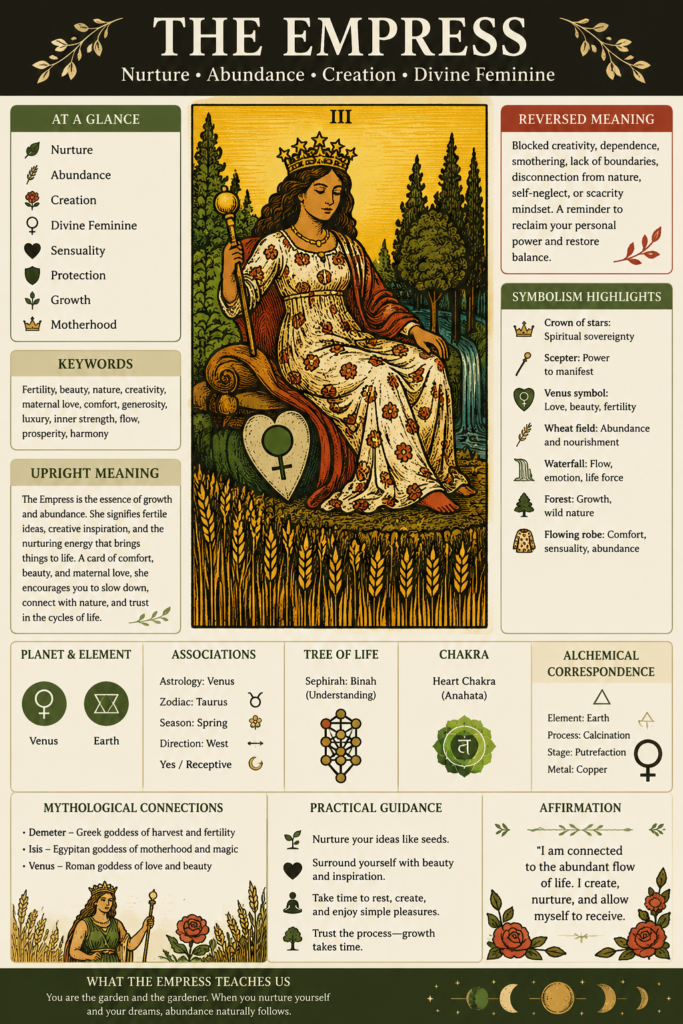
The Rider-Waite-Smith deck introduced one of the most influential changes in the card’s visual history. Arthur Edward Waite and Pamela Colman Smith retained the idea of sovereignty but relocated it from the court to the living world. Their Empress sits in a field of grain, surrounded by forest and flowing water, crowned with stars and adorned with symbols of Venus. This transformed the card from a political emblem into a visual theology of abundance. Authority remained, but it was now expressed through life-giving presence rather than imperial regalia alone.
The Thoth deck deepened the card further. Aleister Crowley and Lady Frieda Harris emphasized Venus, sacred generation, and the cosmic principle of love as the force that binds and produces form. Crowley’s Empress is more overtly esoteric than Waite’s, drawing on Qabalah, alchemy, and mythic symbolism. Here the card becomes not merely a queen of the natural world but a metaphysical principle of creative manifestation.
Seen historically, The Empress evolved from ruler to symbol, from symbol to archetype, and from archetype to contemplative image. That development helps explain why the card can speak simultaneously about earthly life, artistic creation, sensual beauty, motherhood, spiritual receptivity, and the ordering power of love. Each layer belongs to the card’s long history.
For readers who want to deepen their study of symbolism, archetypes, and Western esoteric traditions, The Hermetic Mirror offers a thoughtful course environment for reflective learning. It is especially relevant for students interested in how tarot, myth, symbolism, and contemplative traditions can enrich one another without collapsing into sensationalism.
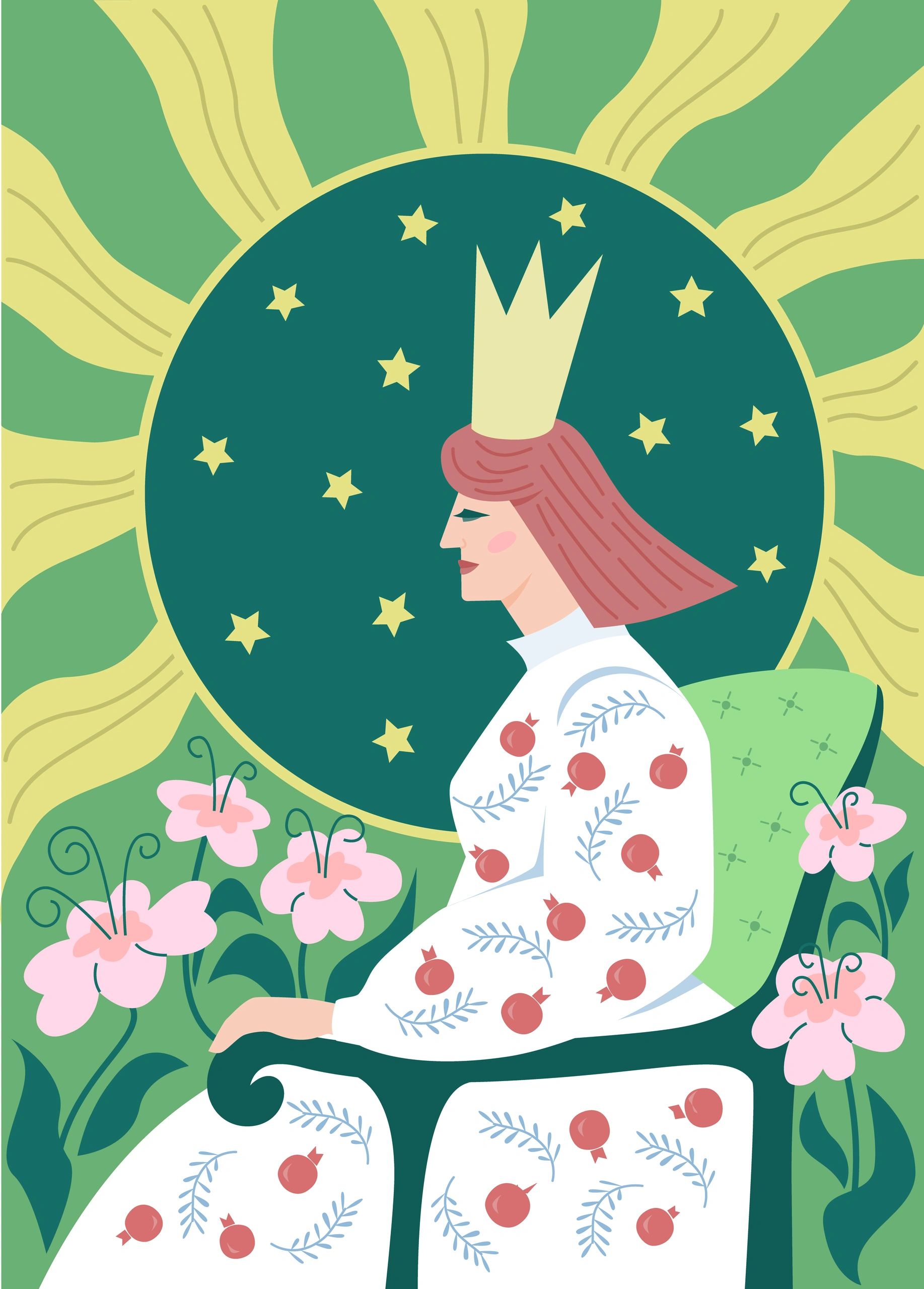
The Rider-Waite-Smith Empress is among the most beloved images in modern tarot because Pamela Colman Smith translated Waite’s esoteric intentions into a scene that feels immediately alive. Every detail contributes to The Empress tarot meaning: the crown of stars, the pomegranate-patterned gown, the wheat, the forest, the river, the Venus shield, and the soft but assured posture of the seated figure.
Cosmic and Fertility Symbols
The crown of twelve stars suggests cosmic order. It may evoke the zodiac, the months of the year, or the completeness of cyclical time. The Empress is not merely fertile in a personal sense. She participates in a larger rhythm of generation. Her creativity is aligned with pattern, season, and celestial order. Pollack often emphasizes that tarot images gain depth when we see them as part of a symbolic ecology rather than as isolated signs, and the starry crown does precisely that by placing The Empress within the wider cosmos (Pollack).
Embodied Authority and the Power of Three
The pomegranates on her gown are especially rich in meaning. In Western symbolism, pomegranates can suggest fertility, sensual fullness, sacred femininity, and the mysteries of life, death, and return. They also connect The Empress to Persephone and Demeter, themes we will revisit in the mythological section. Mary K. Greer encourages readers to attend to recurring symbolic motifs across decks and traditions, and the pomegranate is one of those motifs that opens multiple interpretive doors at once (Greer).
The field of wheat emphasizes cultivated abundance rather than wild excess. This is important. The Empress does not merely symbolize nature in its untamed form. She represents nature brought into relationship with care, rhythm, and stewardship. Grain is not just growth. It is growth tended toward nourishment. That distinction helps explain why the card often appears in readings about creative projects, home life, education, or work that requires patience and maturation.
The forest and flowing water in the background add another layer. Forest suggests the living mystery of the natural world, while water points to emotion, intuition, and the unseen currents that sustain visible life. The Empress therefore unites cultivated and uncultivated dimensions of being. She is both garden and wilderness, both form and flow.
The Venus shield at her side makes the card’s planetary association explicit. Venus here is not only romance. In classical and esoteric traditions, Venus governs attraction, harmony, beauty, proportion, pleasure, and relational intelligence. Benebell Wen notes that Venusian symbolism in tarot often concerns the power that draws things into meaningful relationship, whether in art, love, or social life (Wen). The Empress embodies that attractive and harmonizing force.
Her posture matters as much as her attributes. She is seated, receptive, and calm, yet not passive. Waite and Smith do not portray her as idle. She is established. Her authority is embodied rather than asserted. In contrast to more forceful archetypes, The Empress teaches that some of the most transformative forms of power are invitational, nourishing, and quietly formative.
Numerologically, the card’s number three suggests generation through relationship. One can symbolize unity or origin. Two introduces polarity or complementarity. Three often signifies the emergence of new form from the meeting of two principles. In that sense, The Empress as III is perfectly placed. She is the card of fruitful expression, the living third that arises from hidden mystery and active consciousness.
Waite’s own comments in The Pictorial Key to the Tarot are brief but suggestive. He describes the card in terms of fruitfulness, action, and the garden of the world. Later interpreters such as Pollack, Greer, and Wen expanded these hints into richer symbolic readings. Together, they help modern readers see that The Empress is not simply a card of comfort. She is a card of sacred embodiment and life-giving order.
Thoth Tarot Symbolism
In the Thoth Tarot, Crowley and Lady Frieda Harris present The Empress as a far more overtly esoteric figure. The card remains Venusian, but its symbolism is intensified through Qabalah, alchemy, sacred geometry, and mythic imagery. If the Rider-Waite-Smith Empress is a queen of cultivated abundance, the Thoth Empress is a cosmic matrix of generation.
Daleth and the Gate of Manifestation
Crowley associates the card with Venus and the Hebrew letter Daleth, meaning door. This is crucial. The Empress becomes a threshold through which life enters manifestation. Lon Milo DuQuette, in Understanding Aleister Crowley’s Thoth Tarot, explains that Daleth signifies passage, receptivity, and the opening through which force becomes form. The Empress is therefore not only fertile. She is the gate of incarnation, the principle by which possibility becomes embodied reality.
Venusian Love as Cosmic Process
Harris’s art emphasizes motion, radiance, and symbolic layering. The pelican, lotus, dove, and flowing forms all contribute to the card’s atmosphere of fecundity and sacrificial nourishment. The pelican is especially important in Christian and alchemical symbolism because it represents self-giving sustenance. Medieval legend held that the pelican fed its young with its own blood. Crowley uses this image in a broader esoteric sense, but it also creates a bridge to Christian symbolic interpretation.
The dove reinforces Venusian gentleness, love, and descending grace. The lotus suggests unfolding life, purity arising from depth, and the mystery of beauty emerging from hidden waters. Together these images make The Empress less domestic than in the Rider-Waite-Smith deck and more metaphysical. She is the principle of generative love active throughout the cosmos.
Crowley’s understanding of Venus is also broader than sentimental love. In The Book of Thoth, Venus concerns attraction, cohesion, delight, and the force by which multiplicity becomes harmonious form. The Empress thus represents the intelligence of union. She is the power that allows beauty, relation, and life to arise from differentiation.
Qabalistically, the card’s place on the Tree of Life deepens this interpretation. As Daleth, The Empress links Chokmah and Binah, wisdom and understanding. She is the door between dynamic impulse and structured form. DuQuette emphasizes that this path symbolism reveals The Empress as a mediating principle rather than a static personality. She is process, passage, and manifestation.
Compared with the Rider-Waite-Smith version, the Thoth Empress can feel less pastoral and more initiatory. She does not simply comfort. She reveals the hidden splendor of generation itself. For readers interested in esoteric tarot, this version deepens The Empress tarot meaning by showing that beauty is not superficial decoration. Beauty is one of the ways truth becomes perceptible.
The Card’s Archetypal Meaning
From a Jungian perspective, The Empress belongs to the realm of the Great Mother archetype, but that phrase must be handled carefully. Jung and later archetypal thinkers such as Edward Edinger and Stephan Hoeller understood archetypes not as stereotypes but as deep structures of psychic life. The Great Mother includes nourishment, protection, fertility, and belonging, but also engulfment, overprotection, and possessiveness when distorted.
Mature Expression of the Archetype
In its mature expression, The Empress symbolizes generative presence. She nourishes growth without controlling it. She creates conditions in which life can unfold. Also, she values embodiment, beauty, and relational depth. And she teaches receptivity without passivity and care without domination. This is why the card often resonates with artists, teachers, healers, gardeners, parents, and anyone whose work involves cultivation rather than conquest.
Shadow and Psychological Integration
Its shadow expression is equally important. The shadow Empress may smother rather than support. She may confuse love with possession, abundance with indulgence, comfort with stagnation, or beauty with vanity. Pollack’s work is especially helpful here because she consistently treats tarot archetypes as dynamic and morally complex rather than one-dimensional (Pollack). The Empress is not simply “nice.” She is powerful, and power always has a shadow.
Psychologically, The Empress can mark a stage in which a person learns to inhabit life more fully. That may mean trusting the body, honoring emotion, creating something meaningful, or learning how to receive care. For serious beginners, this is one of the most important dimensions of The Empress tarot meaning. The card is not only about what one produces. It is also about the capacity to dwell in life with enough openness that growth becomes possible.
Hoeller and other Jungian interpreters of symbolic systems often note that individuation requires a reconciliation with the neglected dimensions of the self. The Empress can therefore appear when a person must recover softness, sensual presence, imagination, or relational intelligence after a period of excessive abstraction or control. In that sense, she is not anti-intellectual. She is corrective. She reminds consciousness that life cannot be reduced to concepts alone.
Universal human experiences reflected in the card include gestation, creativity, belonging, nourishment, grief over barrenness, delight in beauty, and the longing to participate in something life-giving. These experiences are not limited by gender. The Empress is an archetype available to everyone because everyone must learn, in some form, how to cultivate life.
Mythological Connections
The Empress resonates with many mythological figures because myths repeatedly return to themes of fertility, sovereignty, beauty, descent, return, and sacred generation. No single goddess or queen exhausts the card’s meaning, but several illuminate it.
Goddesses of Fertility and Sovereignty
In Greek mythology, Demeter offers one of the clearest parallels. As goddess of grain, agriculture, and maternal grief, she embodies nourishment and the cycles of loss and renewal. Her relationship with Persephone deepens the symbolism of the pomegranate and reminds us that fertility is never merely cheerful abundance. It is bound to season, separation, and return. Aphrodite also belongs here, especially in relation to Venusian beauty, attraction, and generative desire, though The Empress is usually broader and more maternal than Aphrodite alone.
Biblical and Recurring Mythic Patterns
In Egyptian mythology, Isis provides another powerful lens. Isis is queenly, magical, maternal, and restorative. She gathers what has been broken, protects life, and mediates between death and renewal. Her symbolic richness aligns well with The Empress as a figure of sacred continuity and generative intelligence.
Norse mythology offers figures such as Freyja and Frigg. Freyja brings associations of beauty, desire, fertility, and sovereignty, while Frigg adds wisdom, household order, and queenly presence. These parallels remind us that The Empress is not only a nature figure. She is also a figure of cultured and relational order.
Biblical symbolism complicates the picture in fruitful ways. While tarot is not a biblical system, readers from Christian or Christian Hermetic backgrounds often see Marian resonances in The Empress: receptivity, blessed fruitfulness, queenship, and the mystery of life received and borne. The woman clothed with the sun in Revelation and the wisdom imagery of Proverbs can also enrich reflection, though such parallels should be made symbolically rather than dogmatically.
Across traditions, recurring mythic patterns emerge. The life-giving feminine is linked to land, season, beauty, nourishment, and the continuity of culture. She may also be linked to grief, sacrifice, and the cost of sustaining life. These patterns deepen The Empress tarot meaning by showing that abundance is never merely accumulation. It is participation in a cycle that includes care, vulnerability, and renewal.
Alchemical Symbolism
Alchemy offers a profound symbolic language for understanding The Empress because alchemy is concerned not only with transformation but with generation, conjunction, and the maturation of hidden potential. Adam McLean’s work on alchemical symbolism is especially useful here because he consistently shows how alchemical images describe inner development as much as material process (Study Course on Alchemical Symbolism).
The Fertile Vessel of Transformation
The Empress can be read in relation to the generative phases of the work rather than to a single stage alone. She is not the blackness of dissolution in the strictest sense, nor is she only the final reddening. Instead, she often represents the fertile matrix in which transformation can continue. She is the vessel, the garden, the field, the womb, the place where subtle processes are protected and nourished until they can emerge.
Venus, Nature, and Inner Ripening
Venus also has alchemical importance. In many symbolic systems, Venus signifies harmony, attraction, and the balancing force that allows conjunction to occur. The Empress therefore reflects the alchemical truth that transformation requires relationship. Nothing develops in isolation. Elements must meet, combine, and be held in the right conditions.
The wheat in the Rider-Waite-Smith image can be read alchemically as well. Grain suggests the slow conversion of seed into nourishment. It is a symbol of latent life becoming useful form through time, season, and care. That pattern mirrors inner development. Ideas, virtues, and insights do not ripen instantly. They must be cultivated.
Alchemical texts often portray nature as a collaborator in the Great Work rather than as something to be dominated. The Empress embodies that principle beautifully. She teaches cooperation with process. She does not seize transformation. And she tends it. For modern readers, this may be one of the most practical alchemical lessons of the card: growth often depends less on force than on creating the right conditions for life to unfold.
In spiritual terms, The Empress can symbolize the soul becoming hospitable to transformation. She is the inner field made ready, the vessel made receptive, the heart made capable of bearing fruit. That is why the card belongs naturally within any serious study of symbolic and contemplative development.
Christian Hermetic Reflections
For readers interested in Christian Hermeticism, The Empress can be approached as a symbol of sacred receptivity, generative wisdom, and the beauty of creation without making dogmatic claims that exceed the card itself. Meditations on the Tarot is especially relevant here because it repeatedly treats the Major Arcana as contemplative images rather than predictive devices. In that spirit, The Empress becomes a meditation on how divine life is received, nurtured, and brought into expression.
Fruitfulness, Grace, and Sacred Receptivity
Christian symbolic tradition often links fruitfulness with grace, charity, and the soul’s cooperation with divine life. The Empress can therefore be read as an image of the soul made fertile by love. She does not create ex nihilo as God does. Rather, she receives and bears fruit. This distinction matters. It preserves the symbolic dignity of the card while avoiding exaggerated claims about personal power.
Hermetic Contemplation of Created Beauty
Marian symbolism may also illuminate the card for some readers. Mary, as a figure of receptivity, blessed fruitfulness, and contemplative assent, offers a meaningful parallel, especially when The Empress is understood as the sanctified capacity to receive and bring forth life. The parallel is symbolic, not identical. Still, it helps Christian readers see that receptivity is not weakness. It is a mode of profound participation.
The pelican image in the Thoth deck creates another bridge. In Christian symbolism, the pelican signifies self-giving nourishment. That image enriches The Empress by reminding us that true nurture often includes sacrifice. To sustain life is costly. Love feeds.
Hermetically, The Empress can also be seen as the beauty of the created order itself. Renaissance Christian Hermetic thinkers often believed that nature was a book of symbols through which divine wisdom could be glimpsed. The Empress, enthroned in living abundance, becomes an icon of that vision. She teaches contemplation of creation not as mere resource but as revelation.
For contemplative readers, then, The Empress tarot meaning may include hospitality, fruitfulness, tenderness, stewardship, and the sanctification of embodied life. She invites gratitude for what grows slowly and asks whether our lives have become places where goodness can take root.
The Tree of Life and Hebrew Letter
In the Golden Dawn system, The Empress corresponds to the Hebrew letter Daleth, meaning door. She is assigned to Path 14 on the Tree of Life, linking Chokmah and Binah. This is one of the most illuminating esoteric keys to the card.
Daleth as door suggests threshold, passage, and receptivity. A door is not the source of what passes through it, yet without the door there is no entry. This symbolism aligns perfectly with The Empress as a figure of manifestation. She is the opening through which life, beauty, and form emerge.
The path between Chokmah and Binah is equally significant. Chokmah is often associated with dynamic wisdom or primal force, while Binah is associated with understanding, structure, and form. The Empress as Daleth mediates between these poles. She is not raw impulse, nor rigid structure. She is the living passage by which force becomes fruitful order.
Golden Dawn attributions therefore deepen The Empress tarot meaning considerably. The card is no longer only about fertility in a literal sense. It becomes a metaphysical principle of manifestation through receptivity. Beauty is the door. Love is the door. Form itself becomes a door through which wisdom enters the world.
In relation to neighboring paths and sephiroth, The Empress helps explain how life moves from transcendence into intelligible expression. She belongs to the architecture of becoming. That is why the card often feels both intimate and cosmic. It speaks to daily life, yet it also gestures toward the hidden structure of manifestation itself.
Astrological Correspondences
The Empress is traditionally associated with Venus. This is one of the most stable correspondences across modern esoteric tarot systems. Venus governs beauty, attraction, pleasure, harmony, relationship, and the power of cohesion. In classical astrology, Venus is not merely romantic. Venus is the principle by which life becomes agreeable, proportionate, and relationally meaningful.
Because Venus rules Taurus and Libra, some readers also connect The Empress with those signs. Taurus contributes sensuality, earthiness, embodiment, and appreciation of material beauty. Libra contributes harmony, aesthetic intelligence, and relational balance. Still, in Golden Dawn style correspondences, The Empress is planetary rather than zodiacal, so Venus remains the primary key.
Elementally, the card is often read through Earth because of its emphasis on fertility, growth, and manifestation. Yet Venus softens Earth with delight, beauty, and attraction. The result is not mere materiality but living abundance. This helps explain why The Empress can signify art, music, design, hospitality, gardens, nourishment, and emotionally intelligent relationships as readily as literal fertility.
Traditional occult correspondences deepen the interpretation further. Venus binds, harmonizes, and draws together. The Empress therefore reflects the force by which life organizes itself into beauty and relation. She is not the aggressive pursuit of desire. She is the magnetic intelligence of flourishing.
Chakra Correspondence
Although chakras belong to Indian spiritual traditions rather than to historical tarot, many contemporary readers find symbolic correspondences useful when approached respectfully. The Empress is most often associated with the Sacral Chakra because of its relation to creativity, sensuality, emotional flow, pleasure, and generative life. A secondary connection to the Heart Chakra is also meaningful because The Empress nourishes through love, care, and relational warmth.
Psychologically, the Sacral Chakra correspondence highlights the card’s connection to embodiment and creative vitality. The Empress asks whether we are alive to beauty, sensation, and the capacity to create. She can appear when that energy is flourishing, but also when it has been blocked by shame, overcontrol, or disconnection from the body.
Spiritually, the Heart Chakra resonance reminds us that creation without love becomes sterile. The Empress does not merely produce. She cherishes. Her abundance is relational. She sustains what she brings forth.
Together, these correspondences suggest that The Empress tarot meaning includes a healed relationship with embodiment, affection, pleasure, and creative flow. She invites readers to become more hospitable to life in both body and heart.
Upright Meaning
Upright, The Empress often signals a season of growth, nourishment, or creative ripening. Yet the card should not be reduced to easy promises. More deeply, it suggests that life is asking to be cultivated. Something may be ready to grow if given care, patience, and the right conditions.
In personal growth, The Empress can indicate a need to reconnect with the body, the senses, beauty, or emotional receptivity. In relationships, she may point toward warmth, affection, mutual support, and the creation of a more life-giving bond. And in career or vocation, she often favors work that involves design, teaching, hospitality, healing, art, cultivation, or the patient development of a meaningful project.
Creatively, the card is especially powerful. It suggests that ideas are ready to take form, but not through force alone. They require tending. Spiritually, The Empress may indicate a season in which contemplation becomes fruitful through embodiment, gratitude, and attention to the goodness of created life.
For readers who prefer reflective tarot over fortune-telling, the upright card asks a simple but demanding question: what in your life is asking to be nourished into maturity?
Reversed Meaning
Reversed, The Empress often points to blocked nourishment, distorted receptivity, or a troubled relationship with abundance. This does not mean the card becomes simply negative. Rather, it reveals where the Empress principle has become constricted, excessive, or misdirected.
One possibility is depletion. A person may be giving care without receiving it, creating without rest, or trying to sustain others while neglecting the conditions of their own flourishing. Another possibility is stagnation. Comfort may have turned into inertia, pleasure into avoidance, or care into overprotection.
Psychologically, the reversed card can indicate shame around embodiment, difficulty receiving love, creative blockage, or alienation from the senses. In shadow form, it may also suggest possessiveness, vanity, indulgence, or the attempt to control growth rather than support it.
Seen constructively, the reversal invites repair. Where has life become inhospitable? What needs gentler stewardship? What would it mean to receive nourishment without guilt, or to release forms of care that have become controlling? In this way, the reversed Empress remains a card of growth, but growth through honest rebalancing.
Practical Reflection Questions
What in my life is asking to be nurtured rather than forced?
Where am I already experiencing abundance, even if I have overlooked it?
How do I relate to beauty, pleasure, and embodiment?
What creative project needs patient cultivation?
Do I know how to receive care as well as offer it?
Where has comfort become stagnation?
What does healthy abundance look like in this season of my life?
How might I create more beauty or hospitality in my daily environment?
What relationship in my life needs more tenderness and less control?
How do I respond to slowness, ripening, and processes I cannot rush?
What beliefs have shaped my relationship with the body?
Where am I being invited to trust the intelligence of growth?
What would it mean to cultivate rather than merely consume?
How can I honor both sensual delight and spiritual depth?
What fruit do I hope my present efforts will eventually bear?
Meditation Exercise
Find a quiet place and sit comfortably. Breathe slowly and allow your attention to settle into the body. Imagine yourself entering a field at the edge of a forest. The air is warm. Grain moves gently in the wind. Nearby, you hear water flowing.
At the center of the field sits The Empress. She does not speak at first. She simply makes space for your presence. Notice her crown, her robe, the wheat, the trees, the river, and the sense of calm abundance around her.
Ask inwardly: What in me is ready to grow? What in me needs care? What have I tried to force that should instead be tended? Remain with whatever arises. Do not rush to interpret. Let the image work slowly.
Now imagine The Empress placing a single seed in your hand. This seed represents a life-giving possibility: a practice, a relationship, a work of art, a healing process, or a way of being. Ask what conditions this seed requires. Listen for one practical act of cultivation you can begin this week.
When you are ready, thank the figure, return your awareness to the room, and write down what you received. The purpose of this meditation is not prediction. It is contemplative alignment with the slow wisdom of growth.
Related Cards
The Empress gains depth when read in relation to neighboring and symbolically related cards. The Fool represents untapped possibility, while The Empress shows possibility entering fertile form. The High Priestess guards hidden wisdom; The Empress brings hidden potential into embodied life. The Emperor, as her counterpart in many systems, represents structure, law, and ordering authority, while The Empress represents nurture, growth, and relational abundance.
Among the Minor Arcana, the Queens often echo aspects of the Empress principle, especially the Queen of Pentacles and Queen of Cups. The Queen of Pentacles reflects practical nurture, embodiment, and cultivated abundance. The Queen of Cups reflects emotional receptivity and intuitive care. Cards such as the Three of Cups and Nine of Pentacles can also resonate with Empress themes of flourishing, pleasure, and relational richness.
In the Thoth system, Venusian correspondences and the path of Daleth further connect The Empress to cards and symbols concerned with beauty, union, and manifestation. These relationships remind readers that The Empress tarot meaning is not isolated. It participates in a larger symbolic web.
What Modern Readers Can Learn from The Empress
Modern life often rewards speed, productivity, and control. The Empress offers a needed corrective. She teaches that not everything valuable can be rushed, measured, or forced. Some things must be cultivated. Some truths are learned through beauty, embodiment, affection, and patient attention.
A Corrective to Modern Haste
For contemporary readers, this may be the enduring wisdom of the card. The Empress reminds us that growth depends on conditions. Creativity needs rhythm. Relationships need care. Bodies need rest. Communities need hospitality. Spiritual life needs more than ideas. It needs incarnation.
Abundance as Sustainable Flourishing
She also challenges distorted ideas of abundance. Real abundance is not endless accumulation. It is the capacity to sustain life meaningfully. In a culture of excess and depletion, The Empress asks whether our forms of success are actually life-giving.
That is why the card remains relevant. It speaks to burnout, disembodiment, creative exhaustion, ecological concern, and the longing for a more humane way of living. The Empress does not offer escape from the world. She offers a wiser way of inhabiting it.
Frequently Asked Questions
What does The Empress tarot card mean?
The Empress usually signifies abundance, nurture, creativity, embodiment, and life-giving growth. At a deeper level, The Empress tarot meaning concerns the power to receive, cultivate, and bring forth life in meaningful form.
Is The Empress always about pregnancy or motherhood?
No. While the card can relate to literal fertility in some contexts, it more broadly symbolizes generative processes of all kinds, including artistic work, emotional growth, nourishing relationships, and the maturation of ideas.
What planet is associated with The Empress?
The Empress is traditionally associated with Venus, the planet of beauty, attraction, harmony, pleasure, and relational intelligence.
What is the Hebrew letter for The Empress?
In Golden Dawn correspondences, The Empress is linked to Daleth, the Hebrew letter meaning door. This deepens the card’s symbolism as a threshold of manifestation.
What does The Empress reversed mean?
Reversed, the card can suggest blocked creativity, depletion, overprotection, indulgence, difficulty receiving care, or a strained relationship with embodiment and abundance. It often points toward the need for rebalancing rather than simple negativity.
How is The Empress different from The High Priestess?
The High Priestess is often associated with hidden wisdom, silence, and inward mystery. The Empress expresses wisdom through fertility, embodiment, nurture, and visible growth. One conceals and guards; the other manifests and nourishes.
How is The Empress different from The Emperor?
The Emperor symbolizes structure, law, stability, and governing order. The Empress symbolizes growth, nurture, beauty, and relational abundance. Together they represent complementary modes of sustaining life.
What chakra is associated with The Empress?
Many readers associate The Empress with the Sacral Chakra because of its connection to creativity, sensuality, and generative energy. A secondary link to the Heart Chakra is also common because of the card’s nurturing and affectionate qualities.
What can modern readers learn from The Empress?
The card teaches the value of cultivation, embodiment, beauty, hospitality, and patient growth. It reminds readers that flourishing depends on care, rhythm, and meaningful relationship.
Where should beginners start if they want to study The Empress more deeply?
Beginners can start with strong foundational texts by Rachel Pollack, Mary K. Greer, Benebell Wen, Robert M. Place, and Arthur Edward Waite. It also helps to compare the Rider-Waite-Smith and Thoth versions of the card and to journal about personal responses to the imagery.
The Empress endures because she speaks to one of the most fundamental realities of human life: growth requires care. Across tarot history, she has been queen, mother, garden, threshold, Venusian principle, archetype, and contemplative image. Each of these layers contributes to her richness.
Read thoughtfully, The Empress tarot meaning is not a shallow promise of comfort or luxury. It is an invitation to cultivate what is life-giving, to honor the intelligence of embodiment, to receive beauty as a form of wisdom, and to participate more consciously in the mystery of becoming. She reminds us that abundance is not merely having more. It is bearing fruit that nourishes life.
For serious students of tarot, symbolism, and spiritual reflection, The Empress remains a profound teacher. She asks whether our lives have become hospitable to growth, whether our creativity is rooted in care, and whether we can recognize the sacred in what ripens slowly. Her lesson is contemplative rather than predictive. Attend to what is living. Tend what has been entrusted to you. Let wisdom become fruitful.
Works Cited: Pollack, Rachel. Seventy-Eight Degrees of Wisdom. Greer, Mary K. 21 Ways to Read a Tarot Card. Wen, Benebell. Holistic Tarot. DuQuette, Lon Milo. Understanding Aleister Crowley’s Thoth Tarot. Place, Robert M. The Tarot: History, Symbolism, and Divination. McLean, Adam. Study Course on Alchemical Symbolism. Tomberg, Valentin. Meditations on the Tarot. Waite, Arthur Edward. The Original Rider Waite: The Pictorial Key To The Tarot. Crowley, Aleister. The Book of Thoth.
The High Priestess is one of the most enigmatic and enduring figures in tarot. Seated between pillars, veiled yet present, silent yet commanding, she invites the reader into a mode of knowing that is different from analysis, argument, or outward display. If The Magician turns power outward through will and skill, The High Priestess turns awareness inward toward mystery, receptivity, memory, and hidden order. To study her well is to recognize that not all wisdom announces itself. Some truths wait behind symbols, dreams, scripture, myth, and the quiet movements of the soul.
The High Priestess tarot meaning remains central to serious tarot study because the card stands at the threshold between visible form and invisible depth. She is the second numbered card of the Major Arcana, yet she often feels older than the sequence itself. Readers encounter her as guardian, witness, initiatrix, contemplative, and keeper of the inner book. Her image has attracted occultists, mystics, historians, Jungian thinkers, Christian Hermetic readers, and symbolists because she embodies a paradox: she conceals in order to reveal. Her silence is not emptiness. It is gestation.
Within the structure of the deck, The High Priestess follows The Magician and precedes The Empress. This placement matters. After the first burst of conscious intention comes a pause, an inward turning, a descent into the hidden matrix from which meaningful action must arise. Rachel Pollack emphasizes that the early Major Arcana present not only external stages of development but also inner principles that must be integrated if the Fool’s journey is to mature (Pollack). Mary K. Greer likewise treats the card as a call to reflection, intuition, and symbolic literacy rather than passive vagueness (Greer). Benebell Wen expands this by situating the card within a broad esoteric framework that includes Kabbalah, sacred symbolism, and contemplative practice (Wen).
For readers who want a deeper symbolic education, Rose and Rune also recommends The Hermetic Mirror, a course that explores esoteric symbolism, contemplative interpretation, and the inner language of sacred images. It pairs especially well with serious study of The High Priestess because this card rewards patience, layered reading, and a willingness to sit with mystery rather than rush toward certainty.
This article contains affiliate links.
This guide approaches The High Priestess through multiple lenses: historical, symbolic, mythological, archetypal, psychological, esoteric, Christian Hermetic, alchemical, and practical. Rather than reducing the card to fortune-telling phrases, we will explore how her imagery developed, how Rider-Waite-Smith and Thoth traditions differ, how the card relates to the Tree of Life, astrology, and contemplative spirituality, and why modern readers continue to find in her an image of profound inward authority. Along the way, we will connect to related Rose and Rune resources, including Articles, Courses, and foundational tarot study such as Beginner’s Guide to Tarot, How Tarot Works as a Reflective Practice, and The Magician Tarot Meaning.
Traditional card number: II (2) Suit: Major Arcana Element: Water, though some systems emphasize lunar receptivity over a single classical element Planet: The Moon Zodiac sign: No single zodiac sign in the Golden Dawn system, though some modern readers connect the card with Cancer because of lunar symbolism Hebrew letter: Gimel (ג) Path on the Tree of Life: The path between Kether and Tiphereth in the Golden Dawn arrangement Chakra correspondence: Third Eye, with secondary resonance at the Crown Golden Dawn correspondence: Gimel, the Moon Thoth correspondence: Priestess, Gimel, the Moon Keywords: intuition, mystery, receptivity, contemplation, hidden knowledge, sacred memory, silence, gestation, discernment, symbolic wisdom Core themes: inner knowing, the unseen order behind appearances, the veil between worlds, spiritual listening, and the disciplined cultivation of insight
The number two introduces polarity, relation, reflection, and interiority. Where one asserts, two receives and mirrors. In the sequence of the Major Arcana, The High Priestess represents not passivity but depth. She teaches that consciousness matures not only by acting upon the world but also by learning how to listen, remember, and discern.
Historical Origins of the Card
To understand The High Priestess tarot meaning, it helps to begin with the card’s historical complexity. Unlike some tarot figures whose visual identity remained relatively stable, this card changed dramatically over time. In early decks, the figure often appeared not as a mystical priestess in the modern sense but as the Papess, a controversial and symbolically charged image that reflected medieval and Renaissance religious imagination.
In early Italian tarot, including fifteenth-century traditions, the card was commonly titled La Papessa. Historians have long debated the meaning of this figure. Some connect her to the medieval legend of Pope Joan, the apocryphal story of a woman who supposedly rose to the papacy in disguise. Others interpret the image more broadly as a satirical or allegorical figure shaped by the political and religious tensions of the time. Robert M. Place argues that early tarot imagery should be understood within the symbolic and cultural environment of Renaissance Europe rather than retrofitted too quickly into later occult systems (Place).
In the Tarot de Marseille tradition, the Papess remains seated, veiled in ecclesiastical authority, often holding a book. That book becomes one of the most enduring features of the card’s later evolution. Even before occult reinterpretation, the image already suggested literacy, hidden doctrine, and a guarded relationship to sacred knowledge. Yet the early card did not necessarily imply intuitive mysticism in the modern sense. Its meaning was more ambiguous, poised between authority, secrecy, transgression, and symbolic inversion.
The nineteenth-century occult revival transformed the card decisively. Writers such as Éliphas Lévi, members of the Hermetic Order of the Golden Dawn, and later Arthur Edward Waite reinterpreted the Papess through Kabbalah, esotericism, and symbolic theology. The figure ceased to be a controversial pseudo-papal image and became instead a guardian of hidden wisdom. By the time of the Rider-Waite-Smith deck in 1909, the card had become The High Priestess, a title that shifted emphasis from ecclesiastical anomaly to sacred interior authority.
This change matters. Waite and Pamela Colman Smith did not simply rename the card. They reimagined it. The new image drew on biblical symbolism, temple imagery, Kabbalah, lunar mysticism, and esoteric notions of the veil. The card’s center of gravity moved from historical satire or religious ambiguity toward contemplative mystery. In the Thoth deck, Crowley and Lady Frieda Harris continued this esoteric development, deepening the card’s lunar, qabalistic, and initiatory dimensions.
Tarot historians such as Michael Dummett, Ronald Decker, and Robert M. Place remind readers that these occult layers are later accretions, not original fifteenth-century meanings. Yet later meanings are not therefore invalid. Tarot evolved precisely because successive generations found in its images a symbolic language capable of carrying new insight. The High Priestess is one of the clearest examples of this evolution. She begins as the Papess, becomes an esoteric guardian, and now stands for many readers as an archetype of contemplative wisdom, symbolic literacy, and spiritual depth.
Rider-Waite-Smith Symbolism
The Rider-Waite-Smith High Priestess is among the most symbolically dense images in modern tarot. Pamela Colman Smith’s illustration, guided by Waite’s esoteric framework, presents a seated woman between two pillars marked B and J, usually read as Boaz and Jachin from the Temple of Solomon. Between them hangs a veil decorated with pomegranates. At her feet lies a crescent moon. She wears blue robes, a cross on her chest, and a crown associated with lunar cycles. In her lap rests a partially concealed scroll marked TORA.
The colors establish the card’s emotional and symbolic atmosphere. Blue dominates, suggesting depth, stillness, water, contemplation, and interiority. White accents imply purity, clarity, and sacred reserve. Unlike the vivid red and active gesture of The Magician, The High Priestess remains composed and inward. Her authority does not depend on movement. It depends on presence.
The pillars are among the card’s most discussed elements. In biblical tradition, Boaz and Jachin stood at the entrance to Solomon’s Temple (1 Kings 7:21). In esoteric interpretation, they come to signify polarity: mercy and severity, active and receptive, outer and inner, manifest and hidden. The High Priestess sits between them, not choosing one over the other but inhabiting the threshold where opposites are held in tension. Pollack notes that this middle position suggests a consciousness capable of containing contradiction without collapsing into simplification (Pollack).
The veil behind her is equally important. Decorated with pomegranates, it recalls the veil of the Temple and the hidden sanctuary beyond ordinary access. Pomegranates carry associations with fertility, sacred abundance, Persephone, and the mysteries of descent and return. The veil indicates that reality contains more than appears on the surface. Yet it also implies that access to deeper truth requires preparation. The High Priestess does not tear the veil open. She guards it.
The scroll marked TORA is partially hidden, and that partial concealment matters. Waite likely intended a layered allusion: Torah as sacred law, but also a broader suggestion that wisdom is both revealed and concealed. Knowledge is not absent. It is veiled, requiring study, reverence, and readiness. Greer often emphasizes that tarot is not merely about intuition in the vague modern sense but about learning how to read symbols, patterns, and contexts with disciplined attention (Greer). The scroll embodies that principle.
The crescent moon at her feet links the card to cycles, tides, dreams, memory, and reflected light. The moon does not generate its own radiance. It receives and reflects. This makes it a fitting emblem for the card’s mode of knowing. The High Priestess does not dominate reality by force. She receives what is subtle, hidden, and indirect. Wen highlights the card’s connection to esoteric literacy, noting that true intuitive knowledge is often cultivated through symbolic study rather than impulsive guesswork (Wen).
Numerologically, the card’s number two reinforces reflection, duality, and relation. Hidden symbolism also appears in the card’s posture. She is seated, stable, and frontal, suggesting judgment without haste. Her gaze meets the viewer, but she does not perform for the viewer. This is crucial. The High Priestess is not a spectacle. She is a presence before whom the reader must become quiet enough to perceive.
Thoth Tarot Symbolism
In the Thoth Tarot, Crowley titles the card The Priestess, not The High Priestess. The shift is subtle but meaningful. Crowley and Lady Frieda Harris intensify the card’s lunar, qabalistic, and initiatory dimensions while reducing some of the explicitly temple-like structure of the Rider-Waite-Smith image. The Thoth Priestess appears as a flowing, veiled, luminous figure associated with hidden currents, gestation, and the transmission of mystery.
Crowley’s system preserves the Golden Dawn attribution of the Moon and the Hebrew letter Gimel. In The Book of Thoth, he describes the Priestess as the feminine counterpart to the Magus, but not merely in a simplistic gendered sense. She is the matrix through which force becomes form, the hidden medium of transmission, and the guardian of the secret before articulation. Lon Milo DuQuette, in his commentary on the Thoth deck, emphasizes that the Priestess represents the current of inner knowing that precedes rational formulation. She is not anti-intellectual. She is pre-discursive and trans-discursive at once (DuQuette).
Compared with the Rider-Waite-Smith version, the Thoth Priestess feels less architectural and more fluid. The card emphasizes movement within stillness, hidden gestation, and the lunar current as a path of initiation. Astrological attribution remains lunar, but the card’s qabalistic associations become more explicit. The Priestess is not simply a keeper of secrets. She is the living process by which hidden wisdom becomes available to consciousness.
This changes the feel of The High Priestess tarot meaning when approached through Thoth. The Rider-Waite-Smith card often appears as a guardian at the threshold. The Thoth Priestess appears more like the threshold itself: a current, a passage, a veil of becoming. Crowley’s broader esoteric framework also intensifies the card’s initiatory role. She is linked not only to contemplation but to the transmission of mystery through symbol, image, and sacred silence.
For readers comparing systems, the difference is instructive. The Rider-Waite-Smith High Priestess often teaches discernment through symbolic stillness. The Thoth Priestess deepens that lesson by showing mystery as a living process. Both agree that wisdom cannot be reduced to surface appearances. Both insist that the unseen is not unreal. It is formative.
The Card’s Archetypal Meaning
From a Jungian and archetypal perspective, The High Priestess represents the deep feminine principle of inward knowing, symbolic receptivity, and psychic mediation. She is related to what Jung called the anima in certain contexts, though she cannot be reduced to that single category. More broadly, she belongs to the family of archetypes that include the wise woman, the sibyl, the veiled goddess, the contemplative virgin, and the guardian of hidden wisdom.
Her mature expression includes discernment, patience, interior authority, and the capacity to listen beneath noise. She knows that not every truth should be forced into premature speech. She honors incubation. And she trusts symbolic process. In psychological terms, she often appears when the conscious mind must learn to receive material from dreams, intuition, memory, or the unconscious without immediately flattening it into explanation.
Her shadow expression can take several forms. One is passivity masquerading as wisdom: withholding action not from discernment but from fear. Another is obscurity for its own sake, the use of mystery as a defense against vulnerability or clarity. A third is dissociation from embodied life, as though inwardness alone were enough. Pollack repeatedly warns against reducing feminine archetypes in tarot to sentimental clichés or vague intuition. The High Priestess is not merely dreamy. She is exacting in her own way (Pollack).
Jung’s work on symbols and the collective unconscious helps explain why this card resonates so strongly. Human beings do not live by rational analysis alone. Dreams, myths, images, and religious symbols shape psychic life in ways that often precede conscious understanding. The High Priestess stands for the faculty that can remain with such material long enough for meaning to ripen. In this sense, she is deeply relevant to individuation. She teaches the ego to become less domineering and more receptive to the deeper patterns of the psyche.
Stephan Hoeller and other Jungian interpreters of symbolic traditions often emphasize gnosis as inner knowing born of encounter rather than mere information. The High Priestess belongs to that mode of knowing. She does not abolish reason. She places reason in a larger field where symbol, contemplation, and inward listening also matter.
Mythological Connections
The High Priestess gathers together a wide range of mythological parallels. In Greek mythology, she resonates with Persephone, Artemis, Hecate, and Athena in different ways. Persephone reflects the mystery of descent, hidden cycles, and knowledge gained through the underworld. Hecate brings the liminal aspect of the card: crossroads, moonlight, thresholds, and occult knowing. Artemis contributes virgin sovereignty and untamed inward authority. Athena adds wisdom, though The High Priestess is less strategic than contemplative.
In Egyptian symbolism, Isis is perhaps the strongest parallel. Isis is veiled wisdom, sacred motherhood, magical literacy, and initiatory knowledge. The famous phrase “I am all that has been, is, and shall be, and no mortal has lifted my veil” became deeply influential in Western esoteric imagination, even if its reception history is complex. The High Priestess often feels Isiac because she unites concealment with revelation.
Norse mythology offers subtler parallels through figures associated with fate, memory, and hidden knowledge, including the Norns. Though not a direct equivalent, the Norns share with The High Priestess an association with the unseen patterning of life. They do not merely predict. They participate in the weaving of destiny.
Biblical symbolism enters through temple imagery, the veil, wisdom literature, and Marian resonances. The card is not reducible to Christian symbolism, yet Christian readers often perceive in her echoes of Sophia, contemplative receptivity, and the hidden heart that “ponders” rather than proclaims. The pomegranates, veil, and sacred book all support this layered scriptural atmosphere.
Across mythic traditions, the recurring pattern is clear: there exists a feminine figure who mediates hidden wisdom, guards thresholds, and teaches that truth is not always immediate. The High Priestess belongs to that lineage.
Alchemical Symbolism
Although The High Priestess is not as overtly alchemical as Temperance or Death, the card has profound alchemical relevance. She belongs especially to the hidden stages of the work: dissolution, gestation, containment, and the inward preparation without which transformation cannot proceed. Adam McLean’s studies of alchemical imagery repeatedly show that transformation requires vessels, veils, and periods of obscurity. The work often begins in darkness, in secrecy, in the hidden matrix where opposites are not yet reconciled but are being prepared for union (McLean).
The High Priestess can be linked to the alchemical vessel, the vas, because she contains rather than disperses. She is also related to the lunar principle in alchemy: reflection, moisture, receptivity, and the subtle body of transformation. If The Magician corresponds more readily to the active spark, The High Priestess corresponds to the chamber in which that spark can be received, cooled, reflected upon, and transmuted.
In inner development, this means that not every stage of growth is visible. Some of the most important transformations occur in silence, in waiting, in dream life, in prayer, in study, and in the patient endurance of uncertainty. The card teaches that incubation is not failure. It is part of the work.
Christian Hermetic Reflections
Within Christian Hermetic reading, The High Priestess invites contemplation rather than dogma. Valentin Tomberg’s Meditations on the Tarot does not treat the card as a license for esoteric spectacle but as an invitation into sacred interiority, purity of attention, and reverent listening. In such a framework, the card may be approached through Marian symbolism, Sophia, the hidden heart, and the contemplative life.
One fruitful Christian symbolic parallel is the distinction between outer law and inward inscription. The partially veiled scroll suggests that sacred truth is not merely possessed; it must be interiorized. Another is the temple veil, which marks the boundary between ordinary perception and holy depth. The High Priestess does not abolish that boundary. She teaches reverence before it.
Hermetically, the card expresses the principle that reality is layered and that symbolic contemplation can become a path of purification. Yet Christian Hermetic reflection also guards against spiritual vanity. The High Priestess is not a collector of secrets. She is a witness to the truth that wisdom requires humility, patience, and inward silence. Her lesson is not elitism. It is receptivity.
The Tree of Life and Hebrew Letter
In the Golden Dawn system, The High Priestess corresponds to the Hebrew letter Gimel (ג), often translated as “camel.” The camel is a striking symbol because it suggests passage across difficult terrain, carrying what is necessary through the desert. This deepens the card’s meaning considerably. The High Priestess is not static mystery for its own sake. She is the path by which consciousness crosses the wilderness between transcendence and beauty.
On the Tree of Life, Gimel connects Kether and Tiphereth. In other words, the path links the Crown, pure divine unity, with Beauty, the harmonized center associated with the solar heart. This means the lunar path of The High Priestess mediates between transcendence and integrated consciousness. She is the subtle current through which higher light becomes inwardly receivable.
Golden Dawn attributions therefore make the card far more than a symbol of vague intuition. She is a precise path of transmission. Her relationship to neighboring paths also matters. She stands between the ungraspable source and the harmonized self, suggesting that contemplation, symbol, and inward purification are necessary if divine reality is to become meaningful within human life.
Astrological Correspondences
The traditional occult correspondence for The High Priestess is the Moon. This is one of the most fitting astrological attributions in tarot. The Moon governs cycles, tides, memory, dream life, fertility, reflection, psychic sensitivity, and the hidden rhythms that shape emotional and symbolic experience. Lunar consciousness is not irrational. It is indirect, imaginal, and responsive.
Some modern readers also connect the card with Cancer because of the Moon’s rulership there, though this is secondary to the primary lunar attribution. The element most often associated with the card is water, especially in the sense of psychic depth, receptivity, and inward movement. These correspondences influence interpretation by emphasizing that the card’s wisdom is cyclical rather than linear, reflective rather than declarative, and subtle rather than forceful.
Chakra Correspondence
The High Priestess is most naturally associated with the Third Eye chakra. This correspondence highlights perception beyond surface appearances, symbolic insight, dream awareness, and contemplative discernment. Psychologically, the Third Eye relates to pattern recognition, inner vision, and the ability to perceive meaning that is not immediately obvious. Spiritually, it points toward receptive awareness rather than domination.
Some readers also sense a secondary resonance with the Crown because the card mediates higher wisdom. Yet the Third Eye remains the strongest fit because The High Priestess is not pure transcendence. She is the faculty by which hidden meaning becomes inwardly visible.
Upright Meaning
Upright, The High Priestess suggests a period in which inward listening matters more than immediate action. The card often appears when something essential is still unfolding beneath the surface. It may indicate that the seeker already senses the truth but has not yet trusted it. It may also suggest that more observation, study, prayer, or symbolic reflection is needed before a decision becomes clear.
In personal growth, the card points toward self-trust, contemplative discipline, and the recovery of inner authority. In relationships, it can indicate emotional depth, unspoken understanding, hidden dynamics, or the need for patience and honesty about what is not yet fully conscious. Or in career matters, it may suggest research, preparation, confidential work, education, or the importance of reading the deeper context before acting. In creativity, it favors incubation, dream work, symbolic development, and gestation before public expression. Spiritually, it is one of tarot’s clearest invitations to contemplation.
Reversed Meaning
Reversed, The High Priestess does not simply become “bad intuition.” More often, the reversal suggests blocked receptivity, ignored inner knowing, confusion between fantasy and discernment, or secrecy that has become unhealthy. The card may indicate that the seeker is cut off from inward guidance, or that silence has turned into avoidance.
At times the reversal points to information withheld, emotional opacity, spiritual bypassing, or a tendency to romanticize mystery rather than do the work of interpretation. It can also indicate the opposite problem: overexposure, saying too much too soon, or forcing clarity before insight has ripened. Growth lies in restoring disciplined receptivity. The question is not merely “What am I feeling?” but “What is truly being shown, and how do I test it wisely?”
Practical Reflection Questions
What truth am I sensing but not yet naming?
Where in my life do I need more silence?
What am I being asked to observe rather than control?
How do I distinguish intuition from fear?
What symbols, dreams, or recurring images have been asking for my attention?
Where has waiting become wise, and where has it become avoidance?
What hidden assumption shapes my current situation?
What does inward authority feel like in my body?
What sacred text, image, or practice is asking to be revisited?
How do I respond when I do not yet have certainty?
What part of me fears mystery?
What part of me hides behind mystery?
Where do I need stronger boundaries around my inner life?
What am I still incubating?
What would it mean to trust a quieter kind of knowing?
Meditation Exercise
Sit comfortably and let your breathing slow. Imagine yourself approaching a quiet temple at night. Two pillars stand before you. Between them hangs a veil embroidered with pomegranates. A calm figure sits before the veil, holding a hidden scroll. She does not speak. She simply waits.
Ask inwardly: “What am I ready to see?” Do not force an answer. Notice what arises: an image, a memory, a word, a feeling, or perhaps only silence. If silence comes, remain with it. Imagine the moonlight at her feet reflecting upward. Let that reflected light illuminate one question in your life. When you are ready, thank the figure, return slowly, and write down whatever emerged without judging it too quickly.
Related Cards
The High Priestess is deeply connected to neighboring Major Arcana cards. She follows The Magician, whose outward skill contrasts with her inward receptivity. She precedes The Empress, who gives embodied form to what The High Priestess holds in hidden gestation. And she also relates to The Hermit, another contemplative figure, though his wisdom is more individuated and active. The Moon shares her symbolic terrain of dream, uncertainty, and hidden process, while Justice and Temperance offer complementary forms of balance and discernment.
Among court cards, the Queens often carry aspects of her receptive authority, especially the Queen of Cups. Among the minors, the Two of Cups, Four of Swords, and Moon-related cards can echo parts of her symbolic field. In Thoth correspondences, her lunar path also deepens connections with cards concerned with reflection, hidden process, and the subtle transmission of force.
What Modern Readers Can Learn from The High Priestess
Modern life often rewards speed, visibility, and constant explanation. The High Priestess offers a corrective. She reminds readers that depth cannot always be rushed, that not every truth arrives in daylight, and that discernment requires intervals of silence. She teaches symbolic literacy in an age of distraction. And she also teaches that inwardness is not withdrawal from reality but a way of meeting reality more truthfully.
For students, artists, spiritual seekers, and reflective readers, her enduring wisdom lies in this: hidden things shape visible life. Dreams matter. Symbols matter. Memory matters. Prayer matters. Study matters. Waiting matters. The card remains relevant because human beings still need ways of honoring mystery without abandoning thought, and of cultivating intuition without surrendering discernment.
Explore More Study Paths
If you want to continue studying tarot, symbolism, and contemplative traditions, visit Articles or explore deeper learning through Courses.
The card generally signifies intuition, hidden knowledge, contemplation, symbolic insight, and the need to listen beneath surface appearances.
Is The High Priestess a positive card?
Usually yes, though her positivity is subtle. She often points toward wisdom, patience, and inner guidance rather than immediate external results.
What is The High Priestess tarot meaning in love?
In relationships, the card can indicate emotional depth, unspoken understanding, hidden feelings, or the need for honesty about what remains beneath the surface.
What does The High Priestess reversed mean?
Reversed, the card may suggest blocked intuition, secrecy, confusion, avoidance, or difficulty distinguishing genuine inner guidance from projection or fear.
Why is The High Priestess associated with the Moon?
The Moon symbolizes cycles, reflection, dreams, memory, and subtle perception, all of which align closely with the card’s inward and symbolic mode of knowing.
What is the Hebrew letter of The High Priestess?
In the Golden Dawn system, the card corresponds to Gimel, the camel, a symbol of passage across difficult terrain and the transmission of what is essential.
How is The High Priestess different from The Magician?
The Magician acts, directs, and manifests. The High Priestess receives, discerns, and guards the hidden matrix from which meaningful action must arise.
Is The High Priestess about psychic powers?
Not primarily. The card is better understood as disciplined receptivity, symbolic literacy, contemplative depth, and trust in inward knowing.
What chakra corresponds to The High Priestess?
Most readers associate the card with the Third Eye chakra because of its connection to inner vision, discernment, and symbolic perception.
Why does The High Priestess still matter today?
She remains relevant because modern readers still need practices of silence, discernment, and symbolic depth in a culture shaped by speed and distraction.
The High Priestess endures because she embodies a form of wisdom that modern culture often neglects but never outgrows. She reminds us that the hidden is not the unreal, that silence can be fertile, and that the deepest forms of understanding often arrive indirectly through symbol, prayer, dream, memory, and contemplation. Her lesson is not to abandon thought but to deepen it through reverence for what exceeds immediate explanation.
In that sense, The High Priestess tarot meaning is not a single definition but a discipline of attention. She asks us to become quiet enough to perceive, patient enough to wait, and honest enough to recognize that some truths are received before they are spoken. She does not flatter the ego with quick certainty. And she offers something better: the possibility of inward clarity, symbolic depth, and spiritual maturity.
If you want to continue the journey, explore more on Articles or find guided learning through Courses.
Kabbalah is one of the most influential mystical traditions in Western spirituality. For centuries, it has shaped Jewish mysticism, Christian Hermeticism, ceremonial magic, alchemy, psychology, and modern symbolism. Yet despite its enormous influence, it often feels mysterious or inaccessible to beginners.
If you’ve ever wondered what the Tree of Life represents, why so many esoteric traditions refer to the ten Sephirot, or whether Kabbalah is a religion, a philosophy, or a mystical practice, this guide will introduce the essential ideas without overwhelming you.
Whether your interest comes from biblical studies, symbolism, tarot, Jungian psychology, or Western esotericism, understanding Kabbalah provides an invaluable foundation for exploring the symbolic traditions that continue to shape spiritual thought today.
This article contains affiliate links.
In This Guide
What is Kabbalah?
What does the word “Kabbalah” mean?
A brief history of Kabbalah
The major branches of Kabbalah
Core beliefs and concepts
The Tree of Life explained
The ten Sephirot
The Four Worlds
Kabbalah and symbolism
Kabbalah and tarot
Kabbalah and Christian Hermeticism
Common misconceptions
How beginners should study Kabbalah
Recommended books
Frequently Asked Questions
What Is Kabbalah?
Kabbalah (also spelled Cabala, Cabbala, or Qabalah depending on the tradition) is the mystical tradition of Judaism that seeks to understand God’s nature, the structure of creation, and humanity’s relationship with the Divine.
Unlike systematic theology, Kabbalah emphasizes direct spiritual insight through contemplation, symbolism, sacred texts, meditation, and the interpretation of hidden meanings.
Rather than asking only:
“What does Scripture say?”
Kabbalah also asks:
Why was reality created?
How does divine energy enter the world?
Why does evil exist?
What is the purpose of the soul?
How can human beings participate in spiritual restoration?
Its answers unfold through a rich symbolic language that includes numbers, letters, sacred geometry, the Hebrew alphabet, and perhaps its most famous image, the Tree of Life.
What Does “Kabbalah” Mean?
The Hebrew wordQabbalah(קַבָּלָה) literally means “receiving” or “that which has been received.”
The name reflects the belief that mystical wisdom passed from teacher to student through an unbroken tradition.
Historically, this did not mean secret knowledge available only to an elite few. Instead, it referred to teachings that required maturity and preparation because they dealt with profound theological questions.
Today, the word often serves as an umbrella term for several related mystical traditions that developed over many centuries.
A Brief History of Kabbalah
Understanding Kabbalah becomes much easier when viewed as a historical development rather than a single book or system.
Biblical Roots
Many themes later developed by Kabbalists already appear in the Hebrew Bible:
Jacob’s ladder
Ezekiel’s vision of the divine chariot
Isaiah’s throne vision
Creation in Genesis
Wisdom literature
These passages inspired generations of mystical interpretation.
Early Jewish Mysticism
Between the first and sixth centuries CE, Jewish mystics explored visionary experiences involving heavenly journeys and encounters with God’s throne.
These traditions became known as Merkabah Mysticism, named after Ezekiel’s heavenly chariot.
Medieval Kabbalah
The recognizable form of Kabbalah emerged in medieval Spain and southern France during the twelfth and thirteenth centuries.
During this period, scholars developed:
the Tree of Life
the doctrine of the Sephirot
symbolic interpretations of Scripture
mystical meditation practices
The publication of the Zohartransformed Kabbalah into one of Judaism’s most influential mystical traditions.
Lurianic Kabbalah
In the sixteenth century, Rabbi Isaac Luria introduced ideas that continue to influence modern Kabbalah:
Tzimtzum (Divine contraction)
Shevirat ha-Kelim (the breaking of the vessels)
Tikkun (restoration or repair)
These concepts explain why the world appears fractured and how human actions participate in healing creation.
The Major Branches of Kabbalah
Although people often speak of “Kabbalah” as one thing, several traditions developed from the same roots.
Jewish Kabbalah
This remains the original tradition and focuses on biblical interpretation, prayer, meditation, and mystical union with God.
Christian Kabbalah
During the Renaissance, Christian scholars adapted many Kabbalistic ideas into Christian theology.
Figures such as Giovanni Pico della Mirandola and Johannes Reuchlin believed Kabbalah revealed hidden truths about Christ while preserving its symbolic richness.
Many people first encounter Kabbalah through tarot.
Beginning with nineteenth-century Hermetic traditions, practitioners associated:
the twenty-two Hebrew letters
the twenty-two Major Arcana
the twenty-two paths of the Tree of Life
While these correspondences do not belong to traditional Jewish Kabbalah, they became enormously influential in Hermetic Qabalah and continue to shape many modern tarot systems.
If you’re new to tarot symbolism, our Tarot articles and courses provide a practical place to begin.
Kabbalah and Christian Hermeticism
One of the most fascinating developments in Western history occurred when Renaissance scholars integrated Kabbalah into Christian philosophy.
Rather than abandoning Christianity, they believed Kabbalistic symbolism illuminated biblical theology.
This fusion helped inspire:
Renaissance magic
alchemy
Rosicrucianism
Western occult philosophy
ceremonial magic
Today, many students interested in Christian Hermeticism eventually discover that Kabbalah provides much of its symbolic architecture.
Common Misconceptions About Kabbalah
“Kabbalah is magic.”
Not originally.
Traditional Jewish Kabbalah centers on contemplation, Scripture, prayer, ethics, and mystical theology.
Although later occult traditions incorporated magical practices, they represent only one historical development.
“Anyone can master Kabbalah quickly.”
Kabbalah rewards slow study.
Many concepts reveal deeper meanings only after repeated reflection.
“The Tree of Life is only about tarot.”
Tarot represents one relatively recent application.
The Tree existed centuries before modern tarot correspondences developed.
“Kabbalah belongs only to one religion.”
Historically, Kabbalah emerged within Judaism.
Over time, Christian and Hermetic traditions adopted and reinterpreted many of its symbolic ideas.
Understanding these distinctions helps avoid confusion.
How Beginners Should Study Kabbalah
The sheer amount of symbolism can feel intimidating.
Fortunately, beginners do not need to memorize every correspondence immediately.
A more advanced academic work exploring the diversity of Kabbalistic traditions.
Frequently Asked Questions
Is Kabbalah a religion?
No.
Kabbalah is a mystical tradition that developed within Judaism. Many people study its symbolism historically, academically, or philosophically without becoming practitioners.
Is Kabbalah the same as Hermetic Qabalah?
No.
Hermetic Qabalah grew out of Renaissance and nineteenth-century Western esoteric traditions and incorporates tarot, astrology, alchemy, and ceremonial magic alongside Kabbalistic concepts.
Do I need to know Hebrew?
No.
Learning the Hebrew alphabet eventually enriches your understanding, but many beginners start with English-language introductions before studying Hebrew.
Is the Tree of Life biblical?
The Tree of Life appears in Genesis, but the familiar diagram of the ten Sephirot developed much later within medieval Kabbalah.
Is Kabbalah compatible with Christianity?
Different Christian traditions answer this question differently.
Historically, many Renaissance Christian scholars embraced forms of Christian Kabbalah, while many churches remain cautious about later esoteric interpretations. Understanding the historical distinctions between Jewish Kabbalah, Christian Kabbalah, and Hermetic Qabalah helps readers evaluate each tradition on its own terms.
Where should I begin after reading this guide?
Start with the Tree of Life and the ten Sephirot. From there, explore related topics such as Christian Hermeticism, alchemy, tarot symbolism, and the Hebrew alphabet. Each offers another perspective on the symbolic framework that Kabbalah helped shape.
Final Thoughts
Kabbalah invites us to see the world as layered with meaning. Rather than separating the spiritual from the ordinary, it teaches that creation itself reflects divine wisdom through symbols, relationships, and patterns. Whether you approach it as a historian, a student of religion, a tarot reader, a psychologist, or simply a curious seeker, Kabbalah offers a profound framework for understanding how the visible and invisible worlds relate.
At Rose and Rune, we’ll continue exploring this symbolic tradition through in-depth guides on the Tree of Life, the Sephirot, Hebrew symbolism, Christian Hermeticism, tarot, alchemy, dreams, and mythology. Each article builds on the last, helping you develop a richer understanding of one of the Western world’s most enduring symbolic systems.
Among all the cards in the tarot, few announce possibility as boldly as The Magician. Standing between heaven and earth, one hand raised toward the sky and the other pointing to the ground, the figure appears to channel invisible forces into visible action. The image has become one of the most recognizable in Western esoteric symbolism, yet its meaning extends far beyond ideas of manifestation or personal power.
The Magician tarot meaning has fascinated artists, occultists, psychologists, mystics, and tarot readers for centuries because it sits at the beginning of the Fool’s journey. As the first numbered card of the Major Arcana, The Magician represents the moment when limitless potential begins to take shape. Where The Fool embodies possibility without direction, The Magician introduces awareness, intention, skill, and conscious participation in creation.
Many modern interpretations reduce the card to slogans about “manifesting your desires” or “using the law of attraction.” While intention and creative focus certainly belong within the card’s symbolism, they represent only one layer of a much richer tradition. Historically, The Magician has worn many faces. In the earliest tarot decks, he appeared as a street performer, a juggler, or an entertainer surrounded by curious objects. Later occult traditions transformed him into a symbol of divine will, sacred knowledge, and the human capacity to unite spiritual insight with practical action.
This evolution reflects the history of tarot itself. What began as a Renaissance card game gradually became a symbolic language capable of expressing philosophy, psychology, mythology, and contemplative spirituality. Each generation added new layers of meaning without entirely replacing what came before. The Magician therefore rewards careful study because the card contains traces of every stage of tarot’s development.
Arthur Edward Waite described the figure as one who possesses “the power and gifts of the spirit” directed toward conscious purpose (Waite 92). In the twentieth century, tarot scholars such as Rachel Pollack expanded this understanding by presenting The Magician as the awakening of individual consciousness and creative agency within the larger journey of the Major Arcana (Pollack 48-50). Mary K. Greer emphasizes the card’s role in intentional action and self-awareness, while Benebell Wen explores its connections to Hermetic philosophy, ceremonial magic, and psychological transformation (Greer 27-29; Wen 189-198).
The card also invites conversation with disciplines beyond tarot. Carl Jung’s work on archetypes provides insight into the Magician as an image of conscious transformation and individuation. Alchemical texts portray a similar movement from undifferentiated potential toward purposeful creation. Hermetic philosophy describes humanity as a bridge between the visible and invisible worlds. Christian contemplative traditions likewise explore the responsible use of wisdom, discernment, and human creativity under divine guidance. Each perspective illuminates different aspects of the same enduring symbol.
The image itself encourages contemplation rather than quick answers. Every object on the table, every flower beneath the figure’s feet, every gesture, color, and tool contributes to a carefully constructed symbolic language. The card asks readers not merely to predict future events but to examine how ideas become actions, how inspiration becomes craftsmanship, and how spiritual insight finds expression in everyday life.
Throughout this guide, we will examine The Magician from multiple perspectives. We will explore the card’s historical development from the earliest Tarot de Marseille traditions through the Rider-Waite-Smith and Thoth decks. We will examine its symbolic vocabulary, mythological echoes, Jungian significance, alchemical imagery, Christian Hermetic interpretations, astrological correspondences, and place upon the Tree of Life. Lastly, we will also consider how its wisdom can inform creativity, vocation, relationships, spiritual practice, and personal growth today.
Rather than treating The Magician as a card that simply predicts success or failure, we will approach it as a symbolic teacher. Its enduring value lies not in promising easy answers but in inviting deeper questions about consciousness, responsibility, and the mysterious partnership between inspiration and action.
In This Guide
This guide explores The Magician tarot meaning through history, symbolism, psychology, mythology, and contemplative spirituality.
The Magician occupies a unique position within the Major Arcana because it represents the first deliberate act of conscious creation. The card stands at the threshold between possibility and realization, illustrating the moment when inspiration becomes purposeful action.
Although different tarot traditions emphasize distinct aspects of the card, most agree that The Magician concerns skill, intention, communication, transformation, and the responsible use of personal power.
Traditional Card Number
I (1)
The number one symbolizes beginnings, unity, initiative, individuality, and the first expression of creative force. Numerologically, one represents the emergence of form from undifferentiated potential. As the first numbered Major Arcana card, The Magician begins the active phase of the Fool’s journey.
Suit
The Magician belongs to the Major Arcana rather than any of the four suits.
Element
Air
Many modern readers associate the card with Mercury rather than a single classical element. Within the Golden Dawn system, Mercury governs the card, while Mercury itself traditionally rules the airy functions of communication, intellect, language, learning, and mediation.
Planet
Mercury
Mercury governs speech, commerce, learning, writing, interpretation, adaptability, invention, and the transmission of knowledge. The planet’s symbolism aligns naturally with The Magician’s role as a mediator between unseen ideas and tangible expression.
Zodiac Sign
The Magician has no direct zodiac sign because the Golden Dawn attributes the card to Mercury rather than to one of the twelve zodiacal signs.
Hebrew Letter
Beth (ב)
Beth means “house.” Within Hermetic Qabalah, the letter symbolizes a vessel or dwelling through which divine wisdom enters manifestation. The symbolism of the house reminds readers that spiritual insight requires a suitable container if it is to become effective in the material world.
Path on the Tree of Life
Path 12
Beth connects Kether (the Crown) with Binah (Understanding).
This path symbolizes the first movement of pure divine potential toward structured wisdom. It suggests that true creative power begins in receptive understanding rather than personal ambition.
Chakra Correspondence
Many contemporary esoteric writers associate The Magician with the Throat Chakra (Vishuddha) because of its connection with communication, truthful expression, and creative manifestation through speech.
Some traditions instead emphasize the Solar Plexus Chakra because of its relationship to willpower and conscious action. Both perspectives illuminate different aspects of the card and will be explored later in this guide.
Golden Dawn Correspondence
Hebrew Letter: Beth
Planet: Mercury
Path 12 on the Tree of Life
Between Kether and Binah
These correspondences became highly influential after members of the Hermetic Order of the Golden Dawn integrated tarot into a comprehensive symbolic system during the late nineteenth century.
Thoth Correspondence
In the Thoth Tarot, Crowley retained the Golden Dawn attribution of Mercury and Beth while greatly expanding the card’s symbolic complexity. Rather than depicting a simple ritual magician, Crowley’s figure becomes an embodiment of perpetual creative motion, sacred language, and transformative intelligence.
Core Themes
Although every tarot tradition offers unique interpretations, several enduring themes unite them:
Conscious creation
Skill developed through practice
Communication between spiritual and material realities
Focused intention
Personal responsibility
Disciplined creativity
Learning and mastery
Transformation through awareness
The union of inspiration and action
These themes reveal why The Magician continues to resonate across psychological, mystical, artistic, and philosophical traditions. It reminds us that genuine transformation requires more than vision alone. Inspiration must eventually become practice, and ideas must take form through disciplined effort.
In the sections that follow, we will discover how centuries of artists, mystics, historians, and scholars have interpreted this remarkable figure, each uncovering new dimensions within one of tarot’s most enduring symbols.
To understand the deeper Magician tarot meaning, it helps to begin not with modern tarot reading but with the earliest surviving tarot cards. The Magician did not appear first as a mystical adept, an occult philosopher, or a ceremonial magician. Instead, he emerged from the lively culture of Renaissance Italy, where tarot functioned primarily as a sophisticated card game enjoyed by the nobility.
Over the next five centuries, artists, scholars, and esoteric thinkers gradually transformed this seemingly ordinary figure into one of the richest symbols in Western occultism. The Magician’s history illustrates how symbols evolve. New meanings accumulate over time without completely erasing older ones. Each historical period leaves its mark upon the card, allowing modern readers to appreciate multiple layers of interpretation simultaneously.
The Earliest Tarot Decks
Tarot originated in northern Italy during the fifteenth century. The earliest surviving examples, including the lavish Visconti-Sforza decks commissioned for the ruling families of Milan, date from the mid-1400s. These decks belonged to a game known as trionfi, later called tarocchi, and contained a series of trump cards that eventually became the Major Arcana.
Unlike later occult interpretations, these early cards carried no documented connection to Egyptian mysteries, Kabbalah, astrology, or ceremonial magic. Michael Dummett, one of the foremost historians of tarot, argued persuasively that tarot began as a card game before acquiring esoteric meanings centuries later (Dummett 7-13). Ronald Decker and Thierry Depaulis likewise caution against projecting nineteenth-century occult theories onto Renaissance imagery (Decker, Depaulis, and Dummett 26-39).
The earliest Magician therefore belonged to a world of courtly entertainment rather than occult philosophy.
The Mountebank and Street Performer
In many early Italian and later French decks, the card depicts a figure standing behind a table covered with small objects. Modern viewers often assume these represent magical tools, but contemporary audiences would have recognized a familiar type: the traveling entertainer, juggler, or mountebank.
This character occupied a colorful place in medieval and Renaissance society. He performed tricks, sold medicines, demonstrated sleight of hand, entertained crowds, and relied upon wit and persuasion to attract customers. His success depended less upon supernatural power than upon observation, dexterity, confidence, and persuasive speech.
The Italian name Bagatto or Bagatella reflects this humble status. Although scholars debate the precise origin of the word, it generally referred to someone associated with tricks, games, or small performances rather than profound spiritual authority. The French Tarot de Marseille later adopted the title Le Bateleur, often translated as “the Juggler” or “the Mountebank.”
Robert M. Place notes that this figure should not immediately be understood as either a fraud or an enlightened teacher. Instead, the image reflects a familiar social role that balanced entertainment, craftsmanship, commerce, and practical skill. The performer demonstrates ability through action rather than inherited authority (Place, The Tarot: History, Symbolism, and Divination 42-46).
This distinction remains important. Even today, The Magician speaks less about possessing secret powers than about learning to use one’s abilities with intention and discipline.
The Tarot de Marseille Tradition
By the seventeenth century, the Tarot de Marseille had become the dominant pattern across much of France and surrounding regions. Although individual woodcutters introduced minor variations, the overall image of Le Bateleur remained remarkably consistent.
The figure stands behind a table containing an assortment of objects. A small bag hangs from his belt. Various implements lie before him. One hand often holds a wand or baton while the other gestures toward the table. His posture suggests movement rather than stillness, as though he has paused briefly during a performance.
To modern readers, these objects may resemble ritual tools. Historically, however, they likely represented the equipment of the performer’s trade. Cups, knives, balls, coins, dice, or small containers all belonged naturally within the world of games and public demonstrations.
Yet symbols often exceed their original context.
As later generations revisited the image, the table itself acquired symbolic significance. Positioned between heaven and earth, it became a place where invisible ideas entered visible form. The assortment of objects suggested versatility, adaptability, and the ability to work with whatever materials lay at hand. Even before explicitly occult interpretations emerged, the visual composition hinted at themes of creativity and transformation.
Rachel Pollack observes that tarot images possess an unusual capacity to gather meaning across centuries because they remain suggestive rather than narrowly defined. Their ambiguity invites continual reinterpretation without losing contact with earlier traditions (Pollack 15-18).
The Magician provides one of the clearest examples of this symbolic openness.
A Figure Between Worlds
Several visual elements distinguish Le Bateleur from the other trumps.
Unlike kings, emperors, or popes, he holds no established office. Unlike Justice or Death, he represents no universal force beyond human control. Instead, he occupies an in-between position.
He stands.
He works.
And, he demonstrates.
His authority arises from practice rather than rank.
This liminal quality may explain why later occultists found the card so adaptable. The Magician already functioned as a mediator between ordinary experience and surprising possibility. A clever illusion can make audiences question the limits of perception. A skilled craftsman transforms simple materials into something extraordinary. A gifted speaker changes minds through language alone.
These ordinary forms of “magic” eventually became metaphors for spiritual transformation.
The Symbolism of the Table
One of the card’s most enduring visual features is the table itself.
In the earliest decks, the table serves an obvious practical purpose. It displays the performer’s tools for public demonstration. Yet even this simple object carries symbolic potential.
A table separates and connects.
It creates a space for work.
It gathers diverse objects into meaningful relationships.
And, it becomes a place where ideas assume tangible form.
Later esoteric traditions would reinterpret the table as an altar, a workbench of creation, or the meeting place of spiritual and material realities. These later readings do not necessarily reflect the intentions of Renaissance artists, but they demonstrate how enduring symbols invite fresh understanding across different historical periods.
Robert M. Place argues that tarot symbolism often grows through continuity rather than replacement. New interpretations expand older imagery instead of discarding it entirely (Place 39-44). The Magician’s table illustrates this process perfectly. A merchant’s display becomes an alchemist’s laboratory. A performer’s workspace becomes a sacred altar. The image remains recognizable even as its meaning deepens.
Skill Before Mystery
Modern discussions sometimes portray The Magician primarily as a mystical figure capable of manifesting reality through hidden knowledge. While later occult traditions certainly emphasize these themes, the historical image reminds readers of something equally valuable.
Mastery begins with practice.
The earliest Magician succeeds because he develops skill, observes carefully, communicates effectively, and works confidently with available tools. These qualities remain central even after the card acquires philosophical and esoteric significance.
Mary K. Greer notes that tarot consistently encourages active participation rather than passive prediction. The cards invite readers to cultivate awareness, make intentional choices, and develop their capacities through experience (Greer 23-30).
This perspective brings the historical Magician surprisingly close to the modern one. Whether viewed as a Renaissance performer or an initiate of Hermetic wisdom, the figure demonstrates that transformation requires disciplined engagement with reality.
The Threshold of Transformation
The historical Le Bateleur therefore occupies an important threshold within tarot’s development.
He begins as an entertainer.
He becomes a craftsman.
Also, he evolves into a philosopher.
He ultimately emerges as an image of conscious creation.
Understanding this progression protects modern readers from two common misunderstandings. First, it prevents us from imagining that tarot possessed elaborate occult meanings from its earliest origins. Second, it reminds us that later symbolic traditions are not arbitrary inventions. They developed through centuries of thoughtful engagement with an already evocative image.
In the nineteenth century, members of the Hermetic Order of the Golden Dawn would reinterpret The Magician through astrology, Kabbalah, Hermetic philosophy, and ceremonial magic. Arthur Edward Waite and Pamela Colman Smith would then redesign the card for the Rider-Waite-Smith deck, adding symbolic details that continue to shape tarot study today. Finally, Aleister Crowley and Lady Frieda Harris would produce an even more esoteric vision in the Thoth Tarot, presenting The Magician as an embodiment of Mercurial consciousness and creative transformation.
Each version builds upon the foundations established by the humble Renaissance performer standing behind his table.
Rather than abandoning history, these later artists entered into a centuries-long conversation with it. Their contributions transformed The Magician from a memorable character in a card game into one of the most profound symbolic figures in the Western esoteric tradition.
The Rider–Waite–Smith Magician: A New Visual Theology
Although the Tarot de Marseille established the essential iconography of the Magician, the publication of the Rider–Waite–Smith deck in 1909 fundamentally reshaped how modern readers understand the card. Nearly every contemporary tarot deck owes something to this design. Whether a deck follows it closely or deliberately rejects it, the Rider–Waite–Smith (RWS) Magician remains the visual and symbolic standard against which later interpretations are measured.
Arthur Edward Waite did not intend merely to reproduce traditional tarot imagery. He sought to communicate what he believed represented the cards’ deepest esoteric teachings. In The Pictorial Key to the Tarot, he explained that earlier decks concealed their highest mysteries beneath conventional imagery and that his revised symbolism attempted to reveal, rather than obscure, these spiritual principles (Waite 92–94).
This distinction matters because many popular books mistakenly credit Waite alone for the deck’s enduring symbolism. In reality, the Rider–Waite–Smith deck resulted from an extraordinary collaboration between Waite and artist Pamela Colman Smith. Waite provided extensive symbolic direction, but Smith transformed those ideas into one of the most influential artistic achievements of the twentieth century.
Smith contributed far more than technical illustration. Her theatrical background, imaginative style, and intuitive understanding of symbolism allowed her to create scenes that possessed emotional and psychological depth absent from earlier tarot decks. Most significantly, she illustrated every Minor Arcana card with narrative scenes rather than simple suit symbols. That innovation permanently changed tarot history. It made the deck far more accessible to beginners while simultaneously opening new avenues for symbolic and psychological interpretation.
The Magician particularly demonstrates Smith’s artistic contribution. Earlier versions often present a craftsman or street performer surrounded by objects of trade. Smith instead creates an image that feels simultaneously earthly and transcendent. Every object appears intentional. Every gesture contributes to a unified symbolic language. Rather than depicting someone who merely performs tricks, she presents an initiate consciously directing invisible spiritual forces into material reality.
The Upright Figure Between Heaven and Earth
The first feature that draws the eye is the Magician’s posture. He stands upright before a stone altar, his body calm and balanced. His right arm reaches upward while holding a white wand. His left hand points downward toward the earth.
This pose immediately distinguishes him from earlier conjurers. He no longer entertains an audience or displays clever dexterity. Instead, he serves as a living conduit between two worlds.
The gesture expresses one of Western esotericism’s oldest and most enduring principles: the correspondence between the spiritual and material realms. Rather than existing as separate realities, heaven and earth mirror one another through an ordered pattern established by divine wisdom. Human beings participate in that order when they consciously align thought, will, and action with higher truth.
Students often summarize this idea with the famous Hermetic phrase:
“As above, so below.”
Although the expression has become almost inseparable from modern tarot, the exact phrase does not appear anywhere on the Magician card itself. Instead, readers associate the gesture with the Emerald Tablet, traditionally attributed to Hermes Trismegistus. One widely known translation reads:
“That which is below is like that which is above, and that which is above is like that which is below.”
The saying describes the doctrine of correspondence that became foundational for Hermetic philosophy, Renaissance magic, alchemy, Rosicrucianism, and later occult traditions. The visible universe reflects invisible realities. Material forms reveal spiritual truths. Human beings occupy the meeting point between these two dimensions.
Waite intentionally evokes this tradition through the Magician’s body. The raised wand symbolizes reception of divine power, while the lowered hand directs that power into earthly manifestation. The figure neither creates spiritual energy nor possesses it independently. Instead, he channels it.
This distinction separates authentic Hermetic philosophy from popular misconceptions about “manifestation.” Modern self-help culture sometimes interprets the Magician as someone who bends reality through personal desire alone. Waite’s symbolism suggests something different. The Magician succeeds because his individual will aligns with a higher order rather than attempting to replace it.
That understanding reflects a long stream of Christian Hermetic thought as well. Renaissance Hermetic philosophers such as Marsilio Ficino and Giovanni Pico della Mirandola argued that humanity occupies a unique place within creation because people unite body and spirit. Human creativity therefore becomes most effective when exercised in harmony with divine wisdom rather than in rebellion against it. The Magician’s gesture visually expresses precisely this relationship.
The Gesture as Living Symbol
Jungian psychology offers another valuable perspective on the Magician’s posture. Carl Jung frequently observed that symbolic gestures communicate realities deeper than ordinary language can express. Images often reveal psychological truths before the conscious mind can fully articulate them.
From this perspective, the Magician’s raised and lowered arms symbolize the integration of opposites. Spirit and matter, conscious intention and unconscious inspiration, heaven and earth all become united within a single human figure. The image therefore portrays psychological wholeness rather than supernatural power alone.
The gesture also reminds readers that genuine transformation requires both inspiration and action. Vision without embodiment remains fantasy. Action without vision becomes mechanical labor. The Magician joins imagination with execution. He receives insight, then gives it concrete form.
For artists, writers, teachers, healers, and spiritual practitioners, this symbolism remains remarkably practical. Every creative act follows the same pattern. An idea first appears invisibly within imagination before becoming visible through disciplined work. The painter translates inspiration into pigment. The musician transforms inner hearing into sound. The writer turns fleeting intuition into words on a page.
The Magician therefore represents more than occult knowledge. He symbolizes the universal human capacity to participate consciously in creation itself.
Here’s the next section in the same scholarly style and structure.
The Wand, Infinity Symbol, Ouroboros, and the Language of Transformation
Every major element of the Rider–Waite–Smith Magician contributes to a carefully constructed symbolic system. Although the pose of “as above, so below” naturally draws the eye first, Waite and Smith surrounded the figure with additional visual signs that deepen the card’s meaning. The raised wand, the floating lemniscate, the serpent belt, and the contrasting garments all communicate the same central idea: true creative power arises when divine inspiration, disciplined will, and material action work together.
Rather than functioning as decorative details, these symbols reinforce one another. Together they portray the Magician as the conscious mediator between spirit and matter, heaven and earth, idea and manifestation.
The Wand: Divine Authority Directed Toward Earth
The Magician’s wand represents far more than magical power in the popular imagination. Held upright in the right hand and pointing toward heaven, it functions as a symbolic axis connecting the divine realm with the earthly world.
Historically, staffs and rods often signified legitimate authority. Moses’ staff demonstrated God’s power before Pharaoh. Aaron’s rod budded as a sign of divine election. Medieval bishops carried croziers as symbols of pastoral authority. In Hermetic and Renaissance magical traditions, the wand likewise represented directed will rather than supernatural spectacle. It became the instrument through which intention shaped reality.
Waite understood the wand in precisely this symbolic sense. The Magician does not generate power independently. Instead, he receives, channels, and directs a higher creative principle. His raised arm demonstrates receptivity before action. Only after the heavenly current descends does the opposite hand extend toward the earth.
This symbolism reflects a central Hermetic conviction: authentic creation imitates the order established by God. Human beings participate in creation by aligning themselves with divine wisdom rather than imposing personal desire upon the world. The wand therefore symbolizes disciplined cooperation with transcendent order.
From an alchemical perspective, the wand also evokes the element of Fire. Fire represents inspiration, illumination, purification, and active transformation. Before any physical work begins in the laboratory, the alchemist must first possess the inner fire of intention. Likewise, before the Magician manipulates the symbols on the table, he establishes the spiritual orientation represented by the raised wand.
Psychologically, the wand signifies focused attention. Jung frequently described psychic energy as something that requires conscious direction if it is to produce meaningful transformation. Left scattered, psychic energy dissipates. Directed toward a unified purpose, it becomes creative rather than chaotic (Jung 95–97).
The wand therefore represents disciplined consciousness. The Magician succeeds because he knows where to direct his attention.
The Infinity Symbol: Limitless Spiritual Potential
Floating above the Magician’s head appears one of the deck’s most recognizable symbols: the horizontal figure-eight known as the lemniscate.
Unlike many earlier tarot decks, which omit this symbol entirely, Pamela Colman Smith places it prominently above the Magician, visually crowning him with the sign of eternity. Its placement suggests that the source of the Magician’s effectiveness lies beyond the finite personality.
The lemniscate traditionally symbolizes infinity, continuity, and the eternal circulation of life. Rather than representing endless quantity, however, it signifies an unbroken movement between complementary realities. Spirit descends into matter. Matter returns toward spirit. The visible and invisible continually interact.
This dynamic echoes the Emerald Tablet’s teaching that heavenly and earthly realities mirror one another. The Magician stands beneath the infinity symbol because he consciously participates in this perpetual exchange.
Some esoteric commentators associate the lemniscate with the endless flow of divine energy through creation. Others connect it to the balance of opposites or the harmonious circulation of conscious and unconscious forces within the psyche. These interpretations need not compete. Each reflects the broader symbolic principle of continual movement rather than static perfection.
Pollack notes that the Magician embodies the ability to direct available energies rather than create them from nothing. The infinity symbol therefore reminds readers that creative resources remain inexhaustible when one stays connected to their transcendent source (Pollack 53–55).
Seen psychologically, the lemniscate suggests that human creativity does not arise solely from conscious thought. Ideas often emerge through an ongoing dialogue between conscious awareness and deeper unconscious processes. Artists, writers, inventors, and mystics frequently describe inspiration as something discovered rather than manufactured. The infinity symbol visually expresses that continuous exchange.
The Ouroboros Belt: The Circle of Transformation
Around the Magician’s waist rests another ancient esoteric emblem: a serpent biting its own tail.
Known as the ouroboros, this image appeared in ancient Egyptian symbolism, Hellenistic philosophy, Gnostic writings, and later alchemical manuscripts. Across these traditions, the serpent represents cyclical renewal, self-generation, eternity, and the continual transformation of life.
Its location on the Magician’s body carries symbolic significance. Encircling the waist, the serpent binds together the upper and lower halves of the figure. Just as the Magician unites heaven and earth through gesture, the ouroboros unites beginning and ending, creation and dissolution, death and rebirth.
Alchemy frequently employed the ouroboros to describe the opus itself. The Great Work proceeds through repeated cycles of dissolution, purification, and recombination. Nothing reaches perfection through a single act. Instead, transformation unfolds through recurring stages that gradually refine both substance and soul.
Adam McLean observes that alchemical imagery consistently presents the serpent as a symbol of continuous inner renewal rather than merely physical immortality. The circle does not imprison. It preserves the rhythm through which genuine change becomes possible.
From a Jungian perspective, the ouroboros represents psychic wholeness. Jung viewed the image as an archetype of the Self, expressing the psyche’s capacity for continual self-renewal and integration (Jung 320–324). The Magician wears this symbol because mastery requires ongoing transformation. One does not become spiritually mature through a single revelation but through repeated encounters with growth, failure, reflection, and renewal.
Unlike modern conceptions of mastery as permanent achievement, the ouroboros reminds readers that wisdom remains a living process.
The Red and White Robes: Spirit Clothed in Matter
The Magician’s clothing further develops this symbolic vocabulary. He wears a white inner robe covered by a flowing red outer cloak.
Throughout Western esoteric symbolism, white commonly represents purity, illumination, innocence, and spiritual consciousness. Red signifies vitality, action, sacrifice, desire, and the active force of life. Together they create a visual statement about the proper relationship between inner character and outward action.
The white garment remains closest to the body, suggesting that authentic action begins with inner purity of intention. The red robe appears externally, demonstrating that spiritual understanding should manifest through active engagement with the world rather than withdrawal from it.
Waite frequently emphasized that the highest forms of esotericism unite contemplation with practical service. Knowledge exists to become embodied. Wisdom becomes meaningful only when translated into action.
Alchemical traditions likewise associate white and red with successive stages of transformation. The whitening (albedo) symbolizes purification, illumination, and the cleansing of the soul. The reddening (rubedo) represents the completion of the Great Work, when perfected consciousness fully enters embodied life. Although Waite does not explicitly label the Magician with these alchemical stages, the color symbolism strongly resonates with established alchemical imagery.
Psychologically, the robes portray the integration of inner values with outward behavior. The mature individual no longer performs a social role disconnected from personal conviction. Instead, external action reflects internal integrity. The Magician therefore embodies congruence rather than performance.
This distinction explains why the card differs so sharply from modern stereotypes of illusionists or tricksters. Although skill and persuasion belong to the Magician’s domain, Waite’s figure ultimately symbolizes truthful manifestation. His power depends upon alignment between inward intention and outward expression.
Every symbolic element discussed thus far points toward the same conclusion. The raised wand channels divine inspiration. The infinity symbol depicts inexhaustible spiritual potential. The ouroboros reveals continual transformation. The red and white garments unite purity with purposeful action.
These ideas now converge upon the physical center of the composition: the table before the Magician. Upon it rest four seemingly simple objects that together summarize the entire symbolic architecture of the tarot itself.
I’ve continued the article at Part 2.1: Thoth Tarot Symbolism – Archetypal Meaning, maintaining the same scholarly tone, SEO focus, and citation style as the previous sections.
Thoth Tarot Symbolism: Archetypal Meaning
If the Rider–Waite–Smith Magician presents the archetype as the conscious individual directing divine power into the material world, the Thoth Magus expands that image into a far more cosmic principle. Rather than depicting a skilled practitioner standing before ritual tools, Aleister Crowley and Lady Frieda Harris portray the Magus as the universal force through which consciousness first becomes manifest. He does not merely use symbols. He generates them. And, he is language before speech, thought before form, and will before action.
For this reason, many tarot scholars regard the Thoth Magus as one of the most philosophically complex cards ever produced. Crowley’s version draws from Hermeticism, Kabbalah, Egyptian religion, alchemy, Greek mythology, astrology, and modern psychology simultaneously. Instead of simplifying these traditions into a single narrative, the card allows them to exist together as different expressions of one underlying principle: the creative Logos.
The Archetype of the Divine Messenger
One of the most striking differences between the Rider–Waite–Smith and Thoth versions lies in the identity of the central figure. While Waite’s Magician resembles a ceremonial magician or Renaissance adept, Crowley’s Magus embodies the ancient trickster-messenger gods.
The card most clearly reflects Hermes (Mercury), the Greek god of communication, commerce, invention, writing, magic, and boundaries. Hermes served as messenger between Olympus, Earth, and the Underworld. He crossed every border without belonging entirely to any realm. In Jungian terms, he represents the mediating function that connects opposites and allows transformation to occur.
Crowley deliberately identified the Magus with Hermes Trismegistus, the legendary sage credited with the Hermetic writings. In Hermetic philosophy, Hermes serves not merely as a deity but as the revealer of divine wisdom. He transmits knowledge from the invisible world into visible reality.
This role explains why the Magus becomes associated with language itself. Before anything can exist in human experience, it must first become distinguishable through symbols, concepts, or names. The Magus therefore represents the archetypal act of making meaning.
Robert M. Place notes that the magician historically functions as a mediator between worlds rather than a performer of supernatural feats. His primary task involves transmitting hidden knowledge through symbolic systems, rituals, and sacred language (Place 219–224). The Thoth Magus emphasizes this mediating role more strongly than perhaps any previous tarot image.
Mercury as the Principle of Consciousness
Crowley assigns the card to the planet Mercury, but his understanding extends far beyond astrology.
Mercury governs movement.
Mercury governs exchange.
And, Mercury governs intelligence.
Most importantly, Mercury governs communication between otherwise separate realities.
In alchemical literature, Mercurius appears as the mysterious substance that dissolves rigid forms so that new combinations become possible. Carl Jung devoted hundreds of pages to Mercurius because the figure continually appeared in dreams as the agent of psychological transformation. Jung described Mercurius as paradoxical, elusive, and impossible to reduce to simple categories. He unites spirit and matter, masculine and feminine, conscious and unconscious (Jung, Mysterium Coniunctionis 196–214).
Crowley’s Magus visually embodies this same paradox. He appears dynamic rather than stable. Symbols whirl around him in perpetual motion. Nothing remains fixed because consciousness itself exists as an ongoing creative process.
Rather than mastering reality from outside it, the Magus participates in the continual creation of reality.
This distinction reflects one of the central insights of Western esotericism: creation is never entirely finished. Every thought, word, and act participates in the ongoing unfolding of the cosmos.
The Logos and Creative Speech
Perhaps the deepest symbolic layer of the Thoth Magus concerns the concept of the Logos.
In Greek philosophy, the Logos referred to the rational principle ordering the universe. Later, the Gospel of John transformed this philosophical concept into one of Christianity’s foundational theological ideas:
“In the beginning was the Word, and the Word was with God, and the Word was God” (John 1:1, NIV).
Crowley interpreted the Magus through Hermetic rather than orthodox Christian theology, yet both traditions recognize speech as fundamentally creative.
Words do not merely describe reality.
They participate in making reality intelligible.
Hermetic texts repeatedly describe creation as the unfolding of divine Mind through divine Word. Adam McLean notes that Renaissance alchemists viewed sacred names, symbols, and letters as active forces rather than arbitrary signs. Language itself became an instrument of transformation because it reflected the hidden order of creation (McLean 42–51).
This understanding profoundly reshapes the meaning of the Magician.
The card no longer asks merely whether someone possesses talent or confidence.
Instead, it asks:
What realities are your words bringing into existence?
Every promise.
Every prayer.
Also, every story.
Every symbol.
Every identity.
All become acts of creative participation.
The Magus as Trickster
Unlike Waite’s composed ceremonial magician, Crowley’s Magus retains the unpredictable qualities of the mythological trickster.
Hermes stole Apollo’s cattle while still an infant.
He invented the lyre.
He deceived gods.
Also, he guided souls.
He negotiated peace.
He crossed forbidden boundaries.
Across cultures, trickster figures challenge rigid structures so that new possibilities can emerge. They expose hidden assumptions and reveal unexpected paths toward transformation.
Jung regarded the Trickster as one of humanity’s oldest archetypes because it represents the chaotic energy that precedes greater consciousness (The Archetypes and the Collective Unconscious 255–272). Although often disruptive, the trickster ultimately serves psychological growth.
The Thoth Magus preserves this ambiguity.
Creative intelligence can illuminate.
It can also manipulate.
Language can heal.
It can equally deceive.
Ideas possess tremendous power because they shape perception itself.
This moral ambiguity distinguishes Crowley’s Magus from the more ethically stable Rider–Waite–Smith figure. The card presents intelligence as fundamentally neutral. Wisdom depends upon how that intelligence becomes directed.
Christian Hermetic Reflections
Readers approaching tarot from a Christian Hermetic perspective often find the Thoth Magus challenging because Crowley’s broader religious views differ sharply from traditional Christianity.
Yet the symbolic structure of the card still contains ideas that resonate with earlier Christian mystical traditions.
Church Fathers such as Justin Martyr and Clement of Alexandria described Christ as the eternal Logos through whom creation came into being. Medieval Christian mystics likewise viewed humanity as participating in divine creativity through reason, language, and imagination, while insisting that such creativity remained subordinate to God rather than independent of Him.
From this perspective, the Magus can symbolize humanity’s God-given vocation to cultivate, create, teach, write, invent, and communicate truth. The danger arises only when human will attempts to replace divine wisdom instead of cooperating with it.
The card therefore becomes a meditation on stewardship rather than domination.
The question shifts from “How much power do I possess?” to “How faithfully do I use the gifts entrusted to me?”
This interpretation aligns more closely with Christian Hermetic traditions than with modern occult individualism.
Psychological Interpretation
From a Jungian perspective, the Thoth Magus represents the emergence of conscious agency.
Here the archetype symbolizes the moment an individual realizes that thoughts influence behavior, language shapes identity, and imagination participates in psychological development.
This realization carries tremendous responsibility.
The stories people tell about themselves become self-fulfilling.
The symbols they embrace organize experience.
The words they repeat gradually shape personality.
The Magus therefore invites conscious participation in one’s own psychological formation.
Rather than drifting through inherited narratives, individuals become active authors of meaning.
For Jung, this marks an important step in individuation. Consciousness begins integrating previously unconscious potentials through symbolic engagement rather than remaining controlled by them (Jung, Symbols of Transformation 63–78).
Seen this way, the Magus represents the birth of intentional consciousness itself.
He reminds us that every civilization, religion, scientific theory, work of literature, and personal identity began as an invisible idea expressed through symbols.
The first act of creation is always an act of meaning.
Mythological Connections and Alchemical Symbolism
The Magician in Myth: The Divine Mediator
Although no single mythological figure completely embodies the Magician, the card gathers together traits found in numerous divine messengers, culture heroes, inventors, magicians, and intermediaries between heaven and earth. Throughout world mythology, these figures occupy a liminal position. They stand between worlds, translating divine wisdom into human knowledge and transforming hidden potential into visible reality.
This intermediary role helps explain why the Magician appears as Card I of the Major Arcana. Before the Fool can truly begin the spiritual journey, consciousness must awaken to its own creative capacity. Myth repeatedly tells this story through figures who bring language, fire, sacred tools, or spiritual knowledge to humanity.
Hermes: Patron of Magic and Hermetic Wisdom
The figure most closely associated with the Magician is Hermes, the Greek messenger of the gods. Hermes governs communication, eloquence, commerce, boundaries, travel, invention, and sacred knowledge. More importantly for Western esotericism, Hermes became identified with the Egyptian god Thoth during the Hellenistic period, giving rise to the legendary sage Hermes Trismegistus (“Hermes the Thrice-Great”).
The writings attributed to Hermes Trismegistus became foundational texts of Hermetic philosophy during late antiquity and the Renaissance. These works teach that humanity reflects the divine order of the cosmos and that spiritual knowledge allows the practitioner to cooperate consciously with creation.
The famous Hermetic maxim,
“That which is above is like that which is below.”
became one of the defining principles of Western esotericism and appears visually in the Magician’s raised and lowered hands. Rather than suggesting domination over nature, the gesture expresses correspondence between different levels of reality. Divine order flows into earthly existence through conscious participation.
This Hermetic framework deeply influenced Renaissance magic, alchemy, Kabbalah, and eventually modern tarot symbolism (Faivre, Access to Western Esotericism 10–15; Hanegraaff 3–12).
Arthur Edward Waite viewed the Magician as a symbolic transmitter of spiritual power rather than a stage illusionist. Pamela Colman Smith’s illustration reinforces this understanding by placing the Magician between heaven and earth, directing divine energy toward the material plane (Waite 76).
Hermes Trismegistus and Christian Hermeticism
During the Renaissance, scholars such as Marsilio Ficino and Giovanni Pico della Mirandola believed the Hermetic writings preserved fragments of an ancient wisdom that anticipated Christian revelation. Although historians now know that the Hermetic texts date from the early centuries of the Common Era rather than ancient Egypt, their symbolic importance remained enormous.
Christian Hermetic thinkers viewed humanity as created in God’s image with the unique vocation of participating consciously in divine creativity. The Magician therefore represents more than occult power. He becomes an image of redeemed human agency.
In this interpretation, the wand points toward heaven because creative authority originates with God. The hand pointing toward earth signifies faithful stewardship rather than autonomous control. The Magician does not replace divine action. Instead, he cooperates with it.
This perspective helps explain why many Christian Hermetic writers distinguished sacred magic from superstition. True wisdom aligned the human will with divine providence rather than attempting to manipulate supernatural forces for selfish ends (Yates 47–58).
Thoth: Divine Intelligence and Sacred Writing
The Egyptian god Thoth also contributes significantly to the Magician’s symbolism. Thoth served as the divine scribe, patron of writing, mathematics, astronomy, measurement, and magical knowledge. Ancient Egyptians credited him with preserving cosmic order through language itself.
Because Thoth governed both writing and sacred speech, later Hermetic traditions viewed him as the guardian of esoteric wisdom.
This connection becomes particularly significant in the Thoth Tarot, where Aleister Crowley explicitly renamed the Magician “The Magus” and emphasized Mercury’s role as divine intelligence manifested through language, symbols, and creative expression (Crowley 69–77).
For readers interested in symbolic rather than purely divinatory interpretations, the Thoth deck reminds us that words themselves possess transformative power. Every spoken intention, every written text, and every meaningful symbol participates in shaping reality.
Odin and the Rune Master
The Magician also shares striking similarities with Odin from Norse mythology.
Unlike many warrior gods, Odin willingly sacrifices comfort and certainty in pursuit of wisdom. He hangs upon Yggdrasil, pierced by his own spear, for nine nights before discovering the runes. This act represents the acquisition of sacred knowledge through voluntary transformation rather than conquest.
The runes themselves function as more than an alphabet. They embody living principles that reveal hidden relationships within creation.
Like the Magician, Odin becomes a mediator between invisible wisdom and practical action. Knowledge carries responsibility. Insight must become effective action.
For students of symbolic traditions, this parallel highlights one of the Magician’s central lessons: wisdom exists to be embodied rather than merely accumulated.
Prometheus and the Gift of Fire
The Greek Titan Prometheus offers another illuminating comparison.
Prometheus steals fire from Olympus and gives it to humanity, enabling civilization, craftsmanship, and technological development. Fire symbolizes more than physical warmth. It represents consciousness itself.
The Magician similarly channels creative fire.
Both figures introduce transformative power into the human world. Both demonstrate that knowledge changes civilization. And, both remind us that power demands ethical responsibility.
Unlike Prometheus, however, the Magician receives rather than steals divine energy. The card emphasizes alignment over rebellion.
Merlin and the Wise Enchanter
Medieval legend contributes another familiar image through Merlin, advisor to King Arthur.
Merlin combines prophetic vision with practical guidance. He understands natural law while remaining deeply connected to mystery. Rather than using magic merely for spectacle, he directs it toward the unfolding of a larger providential purpose.
Many modern readers instinctively associate the Magician with Merlin because both figures unite wisdom, skill, creativity, and disciplined power.
Yet the comparison also reveals an important distinction. The tarot Magician possesses no elaborate magical props beyond simple symbolic tools. His greatest instrument remains conscious intention guided by higher wisdom.
The true magician transforms perception before transforming circumstances.
Alchemical Symbolism
The Great Work Begins
Among all Western esoteric traditions, alchemy perhaps provides the richest symbolic framework for understanding the Magician.
Although modern popular culture often imagines alchemy as an attempt to manufacture literal gold, historical alchemists pursued something much broader. They understood physical transformation as an image of spiritual transformation.
The alchemical Magnum Opus, or Great Work, described the gradual refinement of both matter and the human soul.
The Magician represents the beginning of that work.
He stands before the laboratory.
The tools await.
The raw materials have been gathered.
Nothing has yet been transformed, but every possibility exists.
Rachel Pollack observes that the Magician demonstrates conscious direction of energy before any lasting transformation can occur. Without intentional focus, the Great Work never truly begins (Pollack 57–61).
Prima Materia: Working with Raw Potential
Alchemy begins with the prima materia, the undifferentiated substance from which transformation emerges.
Psychologically, Carl Jung interpreted the prima materia as the unconscious itself. Human beings begin with immense but unformed potential.
Likewise, the Fool arrives carrying possibility.
The Magician begins shaping it.
This movement from potential into form parallels creativity itself. Every artistic work, scientific discovery, spiritual practice, or meaningful relationship starts as something unseen before becoming visible.
The Magician therefore symbolizes the moment when imagination first enters reality.
The Four Elements in Alchemy
The four implements upon the Magician’s table correspond not only to the tarot suits but also to the four classical elements central to alchemical thought:
Alchemy sought balance among these elemental forces rather than the dominance of any single one.
Likewise, the Magician succeeds because every aspect of the personality works together. Thought, emotion, action, and material reality become integrated into a unified creative act.
The table therefore functions almost like an alchemical workbench where psychological and spiritual integration begins.
Mercury: The Alchemical Principle
The Magician also corresponds to Mercury, perhaps the most important symbolic substance in alchemy.
Mercury represents movement, transformation, mediation, and union between opposites.
Unlike ordinary metals, alchemical Mercury refuses fixed definition. It remains fluid, adaptable, and transformative.
These same qualities characterize the Magician.
He moves between spirit and matter.
Between thought and action.
Between possibility and manifestation.
And, between heaven and earth.
Jung described Mercurius as one of the most complex symbols in alchemy because it simultaneously represents the beginning, the process, and the goal of transformation (Jung, Mysterium Coniunctionis 194–202).
The Magician embodies this paradox beautifully. He both initiates transformation and participates within it.
Solve et Coagula
A central alchemical principle states:
Solve et coagula.
“Dissolve and recombine.”
Transformation requires breaking apart old structures before creating new forms.
Although later Major Arcana cards depict these dissolutions more dramatically, the Magician introduces the process by consciously choosing creation over inertia.
Every meaningful act begins with intention.
Every work of art begins with a first mark.
Also, every spiritual discipline begins with a first practice.
Every transformed life begins with a first decision.
The Magician therefore reminds us that the Great Work rarely starts with dramatic miracles.
It begins by picking up the tools already lying before us.
Here’s the next section of your article in the same scholarly, long-form style.
Christian Hermetic Reflections
The Rider–Waite–Smith Magician occupies a unique place within Western esotericism because the card unites several streams of thought that many modern readers mistakenly separate. Medieval Christianity, Renaissance Hermeticism, Jewish Kabbalah, astrology, alchemy, and ceremonial magic all converge in this single image. Arthur Edward Waite did not present the Magician merely as a performer of wonders or a manipulator of hidden forces. He envisioned the figure as humanity standing between heaven and earth, participating in God’s creative order through wisdom, discipline, and rightly directed will.
For readers approaching tarot from a Christian Hermetic perspective, this distinction matters greatly. Christian Hermeticism has never viewed true magic as an attempt to overpower God or manipulate divine law. Instead, it understands the universe as an ordered creation whose hidden patterns reveal the wisdom of its Creator. Human beings, created in the image of God (Genesis 1:26-27), participate in that order by aligning intellect, imagination, speech, and action with divine wisdom.
The Magician therefore represents neither superstition nor occult sensationalism. Rather, the card depicts humanity’s vocation as steward, priest, artisan, and co-worker within creation. The Magician’s tools become symbols of human capacities entrusted by God, while the raised wand reminds the seeker that genuine authority always descends before it ascends.
The Christian Hermetic Understanding of Divine Wisdom
Christian Hermeticism emerged during the Renaissance through figures such as Marsilio Ficino, Giovanni Pico della Mirandola, Johannes Reuchlin, Heinrich Cornelius Agrippa, and later Robert Fludd. These scholars believed that ancient wisdom traditions, including Platonic philosophy, Hermetic writings, biblical revelation, and aspects of Jewish Kabbalah, ultimately pointed toward the same divine source.
Rather than rejecting Christianity, these thinkers sought to deepen it. They viewed the visible world as a symbolic reflection of invisible realities, echoing Paul’s statement that God’s invisible qualities may be perceived through creation (Romans 1:20).
Within this framework, the Magician symbolizes humanity’s God-given ability to perceive these hidden correspondences.
The Hermetic maxim Quod est superius est sicut quod est inferius (“That which is above is like that which is below”), found in the Emerald Tablet, does not encourage domination over nature. Instead, it expresses the belief that earthly realities mirror heavenly principles. Waite intentionally incorporated this idea into the Magician’s famous gesture, with one hand pointing upward while the other points toward the earth.
From a Christian Hermetic perspective, this gesture recalls Christ’s teaching in the Lord’s Prayer:
“Your kingdom come, your will be done, on earth as it is in heaven” (Matthew 6:10, NIV).
The Magician therefore serves as a symbolic mediator. Divine wisdom flows downward before human action flows upward. The figure becomes an image of faithful stewardship rather than personal power.
Logos and the Creative Word
One of the deepest Christian interpretations of the Magician centers upon the doctrine of the Logos.
John’s Gospel opens with one of Christianity’s most profound theological declarations:
“In the beginning was the Word, and the Word was with God, and the Word was God” (John 1:1, NIV).
The Greek Logos refers simultaneously to divine reason, creative speech, cosmic order, and Christ Himself.
Unlike many modern depictions of magic as arbitrary power, biblical creation occurs through spoken order.
God speaks.
Creation responds.
Light appears.
Chaos becomes cosmos.
This creative speech echoes throughout Hermetic philosophy, where language, symbols, numbers, and names possess formative power because they participate in deeper realities rather than merely describing them.
The Magician therefore represents disciplined speech.
Words create.
Ideas become actions.
Vision becomes reality.
The card reminds readers that every human act begins internally before becoming external. In Christian spirituality, this principle aligns with Christ’s teaching that actions arise from the condition of the heart (Matthew 15:18-19).
Thus, the Magician invites careful stewardship over thought, language, imagination, and intention.
Wisdom Rather Than Sorcery
Scripture consistently condemns attempts to manipulate spiritual powers apart from God (Deuteronomy 18:10-12). Because of these passages, some Christians understandably approach tarot with caution.
However, Christian Hermetic readers distinguish between illicit magical manipulation and symbolic contemplation.
Waite himself repeatedly emphasized that tarot should not be reduced to fortune telling. Instead, he viewed the cards as symbolic illustrations of universal spiritual principles (Waite 1910).
Within this understanding, the Magician resembles the biblical figure described in Proverbs.
Wisdom cries aloud.
Wisdom orders life.
Also, wisdom builds.
Wisdom understands creation because it originates with God.
The Magician therefore symbolizes cultivated wisdom rather than supernatural control. The card invites discernment, discipline, learning, and faithful use of one’s gifts.
Humanity as Co-Creator
Genesis presents humanity as bearing God’s image and receiving responsibility over creation (Genesis 1:26-28).
Christian Hermetic writers often interpreted this vocation symbolically.
Human beings cannot create ex nihilo as God does.
Yet they create through participation.
Artists shape beauty.
Writers shape language.
Teachers shape minds.
Builders shape cities.
Parents shape children.
The Magician becomes an archetype of this creative participation.
The four suits upon the table represent the materials of experience.
The raised wand symbolizes inspiration.
The downward hand represents practical embodiment.
Together they depict the continual movement from divine possibility into earthly manifestation.
For modern readers, this interpretation shifts the card away from supernatural spectacle and toward faithful craftsmanship. Every meaningful vocation contains something of the Magician.
Every act of disciplined creation reflects the divine image.
Tree of Life and Hebrew Letter
No tarot card illustrates the connection between the Major Arcana and the Tree of Life more clearly than the Magician.
Within the Hermetic Order of the Golden Dawn, the Magician corresponds to the Hebrew letter Beth (ב) and the twenty-second path connecting Kether (Crown) with Binah (Understanding).
Beth literally means “house.”
On the surface, this may seem like an unexpected association. Yet the symbolism becomes remarkably rich when viewed through Jewish and Christian mystical traditions.
A house serves as a dwelling place.
It receives.
It shelters.
And it contains life.
Likewise, the Magician becomes the symbolic house through which divine wisdom enters the world.
Beth as the House of Divine Presence
The Hebrew alphabet possesses symbolic as well as phonetic meaning.
Beth begins the Torah itself.
Genesis opens not with Aleph but with Beth:
Bereshit (“In the beginning…”).
Jewish commentators have long reflected upon this mystery. Why should Scripture begin with the second letter rather than the first?
One traditional interpretation suggests that creation itself represents God’s house.
The universe becomes the dwelling place in which divine wisdom unfolds.
Within Christian Hermetic thought, the Magician likewise stands at the threshold between unmanifest possibility and created reality.
Ideas become forms.
Spirit enters matter.
Potential becomes action.
This symbolism harmonizes naturally with John’s description of Christ as the Logos through whom all things were made (John 1:3).
The Path from Crown to Understanding
On the Tree of Life, Beth joins Kether with Binah.
Kether represents pure divine unity beyond human comprehension.
Binah represents understanding, structure, limitation, and form.
The Magician therefore symbolizes the first movement of divine potential toward intelligible creation.
In psychological language, inspiration begins to acquire shape.
In theological language, divine wisdom begins entering creation.
And in artistic language, vision becomes craft.
This path reflects one of the Magician’s central themes throughout tarot history.
The card concerns manifestation.
Not instant manifestation through wishful thinking.
Manifestation through disciplined embodiment.
Why This Matters
Many modern tarot books emphasize manifestation almost exclusively in material terms.
Traditional Hermetic teaching presents something much deeper.
Manifestation begins with alignment.
The Magician first aligns with divine order before shaping earthly reality.
The raised wand and downward hand visually repeat the movement represented on the Tree of Life itself.
The path descends before it rises.
Grace precedes effort.
Wisdom guides action.
Astrological Correspondences
Virtually every major esoteric tarot tradition assigns the Magician to the planet Mercury.
This association appears in the Golden Dawn, Waite’s symbolic framework, Crowley’s Book of Thoth, and numerous modern systems.
No planetary archetype better expresses the Magician’s essential character.
Mercury as Messenger
In classical mythology, Mercury (Hermes) served as messenger between gods and humanity.
He crossed boundaries.
He interpreted divine messages.
Also he guided travelers.
He carried knowledge between worlds.
These same themes appear visually within the Magician.
The figure stands between heaven and earth.
Ideas become words.
Words become action.
Knowledge becomes creation.
Mercury therefore governs translation rather than mere information.
The Magician transforms invisible insight into visible reality.
The Alchemical Mercury
Alchemical Mercury differs somewhat from the Roman god.
Rather than representing only a deity, Mercury symbolizes transformation itself.
Mercury dissolves rigid structures.
It connects opposites.
It mediates between sulfur and salt.
Adam McLean notes that alchemical Mercury frequently functions as the reconciling principle through which transformation becomes possible.
The Magician likewise joins apparent opposites:
Spirit and matter.
Heaven and earth.
Thought and action.
Potential and manifestation.
Psychological Mercury
From a Jungian perspective, Mercury resembles the trickster and psychopomp.
The archetype guides consciousness across thresholds.
It introduces paradox.
It encourages flexibility.
And it reveals hidden possibilities.
The Magician therefore asks an important question:
How can your current understanding become something greater?
Chakra Correspondence
Although chakras originate within Indian spiritual traditions rather than Western Hermeticism, many contemporary tarot practitioners find meaningful symbolic correspondences between the systems.
The Magician most naturally aligns with the Throat Chakra (Vishuddha), while maintaining secondary connections with the Crown Chakra.
The Throat Chakra
The Throat Chakra governs communication, truthful expression, creativity, intention, and manifestation through speech.
This symbolism closely parallels the Magician’s relationship with the Logos and the creative word.
Ideas become language.
Language shapes action.
Action transforms reality.
Healthy expression therefore becomes one of the Magician’s greatest gifts.
The card encourages speaking truth with clarity while ensuring that words reflect inner integrity.
Secondary Connection: Crown Chakra
Some traditions also associate the Magician with the Crown Chakra because the raised wand symbolizes reception of divine inspiration.
Before expression comes revelation.
Before creation comes listening.
The Magician therefore reminds readers that authentic creativity begins with receptivity rather than ego.
Upright Meaning
The upright Magician announces a moment when potential seeks expression.
The card often appears when knowledge, opportunity, preparation, and timing finally converge.
Unlike the Fool, who steps into the unknown through innocence, the Magician acts through conscious intention.
This card asks:
What gifts already lie within your hands?
The Magician suggests that the necessary resources already exist.
Skill must replace hesitation.
Action must replace endless preparation.
In relationships, the card often represents honest communication, mutual initiative, intellectual compatibility, and purposeful partnership.
In career readings, it commonly signifies leadership, entrepreneurship, education, writing, teaching, public speaking, craftsmanship, and projects requiring focused expertise.
Spiritually, the Magician encourages alignment between belief and action.
Knowledge without practice remains incomplete.
The card therefore calls the seeker toward integrity, discipline, and faithful stewardship of personal gifts.
Reversed Meaning
The reversed Magician does not necessarily indicate evil or deception, although those possibilities sometimes arise within particular reading contexts.
More often, the reversal signals misdirected energy.
Potential remains unused.
Talent becomes scattered.
Knowledge substitutes for action.
The shadow Magician may manipulate language rather than speak truth.
He may create illusion instead of wisdom.
He may confuse cleverness with understanding.
Psychologically, the reversed Magician often appears when individuals underestimate their abilities or become trapped by perfectionism.
Ideas never leave the notebook.
Plans never become reality.
Fear disguises itself as preparation.
Alternatively, the reversed Magician can represent charisma without integrity.
Words persuade while concealing motives.
Promises exceed substance.
The card therefore calls for discernment.
Christian readers may see here a warning against pride, manipulation, or relying upon personal ability apart from God’s wisdom.
Hermetic readers recognize the same principle through another lens.
Power divorced from wisdom becomes distortion.
Creation divorced from truth becomes illusion.
The Magician ultimately reminds us that true mastery begins not with control over others but with faithful governance of oneself.
Part 4: Living the Magician
Practical Reflection Questions
Tarot reaches its deepest value when readers move beyond memorizing meanings and begin reflecting on how each card mirrors their own lives. The Magician invites active participation rather than passive observation. He asks what gifts remain unused, what intentions require clearer focus, and where scattered energy might become purposeful action.
Whether approached psychologically, spiritually, or devotionally, these questions encourage meaningful engagement with the card.
Self-Reflection
Where in my life do I possess more ability than I currently recognize?
What resources have I overlooked because they seem ordinary?
Am I waiting for external permission before acting?
What fear prevents me from using my talents?
Which ideas deserve disciplined attention instead of endless planning?
How do my words shape the reality I experience?
Where does confidence become arrogance?
Am I creating from love, curiosity, and service, or from ego alone?
Journal Prompts
Write about a time when you underestimated your own abilities. What changed?
Identify the “tools on your table.” List the skills, relationships, education, experiences, and spiritual resources already available to you.
Imagine meeting the Magician as a mentor. What advice would he offer about your current situation?
Describe a dream that has remained unrealized. What practical first step could transform intention into action?
Reflect on the relationship between prayer and work. What responsibilities belong to God, and what responsibilities belong to you?
Contemplative Practice
Read Proverbs 16:3:
“Commit to the LORD whatever you do, and he will establish your plans” (New International Version, Prov. 16.3).
Then spend several minutes considering how divine guidance and human effort cooperate rather than compete.
The Magician reminds readers that inspiration becomes meaningful only through faithful action.
Meditation Exercise
Becoming the Magician
This contemplative visualization draws upon Jungian active imagination while remaining compatible with Christian contemplative practice. Rather than seeking occult experience, its purpose is symbolic reflection and spiritual discernment.
Find a quiet place and breathe slowly.
Imagine entering a peaceful garden.
Ahead stands a stone table.
Upon it rest four objects:
a wand
a cup
a sword
a pentacle
Spend time examining each object.
Ask yourself:
“What part of my life does this represent?”
Notice which tool draws your attention first.
Now look beyond the table.
The Magician stands before you.
He says nothing.
Instead, he gestures toward the tools.
He invites you to choose one.
Take the object into your hands.
Notice its weight.
Ask silently:
“What gift have I neglected?”
“What work have I postponed?”
And, “What truth must I now embody?”
Finally, imagine the Magician pointing upward and then downward.
Allow the ancient Hermetic maxim to arise naturally:
“As above, so below.”
End the meditation with prayer or silent gratitude, asking for wisdom to unite vision with faithful action.
Related Cards
No tarot archetype exists in isolation. The Magician forms part of an interconnected symbolic conversation throughout the Major Arcana.
The Fool (0)
The Fool represents infinite potential before conscious direction.
The Magician transforms possibility into intention.
If the Fool says, “Anything could happen,” the Magician replies, “Now I choose.”
The High Priestess (II)
Where the Magician expresses conscious knowledge, the High Priestess embodies hidden wisdom.
He speaks.
She listens.
He acts.
She receives.
Together they illustrate the necessary balance between outward action and inward contemplation (Pollack 54-57).
The Hermit (IX)
The Hermit turns inward to seek wisdom.
The Magician brings wisdom back into the world through creative action.
Strength (VIII or XI)
Depending upon the deck tradition, Strength demonstrates mastery over instinct.
The Magician demonstrates mastery over attention and will.
The World (XXI)
The World represents completed integration.
The Magician initiates the journey that ultimately reaches fulfillment in the final Major Arcana card.
Many readers notice that the first and last cards mirror each other.
The Magician begins conscious creation.
The World celebrates completed wholeness.
What Modern Readers Can Learn from The Magician
Modern life rewards constant activity while often neglecting intentional presence.
The Magician offers an alternative.
He teaches that effectiveness depends less upon acquiring more tools than upon learning to use existing ones wisely.
In an age saturated with information, the card reminds us that knowledge without application remains incomplete.
For professionals, the Magician encourages competence joined with integrity.
For artists, he celebrates disciplined creativity.
Also for students, he illustrates focused learning rather than scattered curiosity.
For spiritual seekers, he warns against confusing mystical fascination with genuine transformation.
Psychologically, the card teaches personal agency.
Jung observed that individuation requires conscious participation in one’s own development rather than passive surrender to unconscious forces (Jung, Archetypes 158-63).
Spiritually, Christian readers may understand the Magician as illustrating humanity’s vocation to cultivate creation under God’s authority rather than replacing divine authority. Human creativity reflects the image of the Creator but never becomes identical with Him (Gen. 1.26-28).
Ultimately, the Magician reminds readers that every meaningful life requires the integration of vision, discipline, humility, wisdom, and action.
The miracle does not lie in possessing extraordinary gifts.
It lies in faithfully using ordinary ones.
Frequently Asked Questions
What does The Magician tarot card mean?
The Magician represents conscious creation, focused intention, skilled action, confidence, communication, and the ability to transform potential into reality through disciplined effort.
Is The Magician a positive card?
Generally, yes. It often signals opportunity, competence, initiative, and personal empowerment. However, poorly expressed Magician energy may appear as manipulation, deception, ego inflation, or misuse of knowledge.
What zodiac sign is associated with The Magician?
The Magician traditionally corresponds with Mercury, the ruling planet of Gemini and Virgo. Mercury governs communication, intellect, learning, adaptability, commerce, and symbolic language (Crowley 72-74).
What Hebrew letter belongs to The Magician?
Most modern Hermetic traditions associate the card with Beth (ב), the second Hebrew letter, meaning “house.”
What chakra corresponds to The Magician?
Many contemporary readers associate the Magician primarily with the throat chakra because of its relationship to communication, manifestation through speech, and creative expression. Others also connect the card with the solar plexus chakra because of its emphasis upon personal will.
What does The Magician reversed mean?
Reversed meanings often include manipulation, scattered attention, unrealized talent, lack of confidence, misuse of intelligence, procrastination, or attempting to control situations through ego rather than wisdom.
Is The Magician connected with Christianity?
Historically, the card developed within Renaissance Hermeticism rather than Christianity alone. Nevertheless, Christian Hermetic writers often interpret the Magician as symbolizing humanity’s role as steward of creation under divine wisdom rather than independent magical authority.
Further Reading
Readers interested in exploring the Magician more deeply should begin with several foundational works that approach tarot from historical, psychological, symbolic, and esoteric perspectives.
Rachel Pollack’s Seventy-Eight Degrees of Wisdom remains one of the finest introductions to tarot symbolism and archetypal interpretation.
Mary K. Greer’s Tarot for Your Self emphasizes reflective practice through journaling and personal exploration.
Benebell Wen’s Holistic Tarot provides one of the most comprehensive modern reference works available.
Robert M. Place’s The Tarot: History, Symbolism, and Divination carefully distinguishes historical evidence from later occult developments.
Arthur Edward Waite’s The Pictorial Key to the Tarot offers valuable insight into the intentions behind the Rider-Waite-Smith deck.
Aleister Crowley’s The Book of Thoth explains the symbolic framework behind the Thoth Tarot, though readers should remember that it reflects Crowley’s own Thelemic philosophy rather than universal tarot tradition.
Students interested in Hermetic philosophy should also explore the Corpus Hermeticum and the Emerald Tablet, while those approaching tarot from a Christian perspective may benefit from studying Genesis, Proverbs, the Gospel of John, and writings on Christian contemplation and symbolic theology.
Final Thoughts
The Magician stands at the threshold of the Fool’s journey because every meaningful transformation begins with a decision to participate consciously in one’s own life.
Across six centuries of tarot history, his appearance has changed dramatically. The medieval street performer became the Renaissance philosopher, the Hermetic initiate, the Jungian archetype, and the contemporary symbol of creative agency. Yet one essential truth remains constant.
The Magician points toward the mysterious relationship between possibility and realization.
His raised wand and lowered hand remind us that wisdom must descend into action.
His four tools reveal that everything necessary for meaningful work already lies within reach.
And his garden suggests that disciplined cultivation produces lasting fruit.
From a Christian Hermetic perspective, the Magician ultimately reflects humanity’s vocation to cooperate with divine wisdom rather than compete against it. Created in the image of God, human beings possess remarkable creative capacities, yet those gifts flourish most fully when guided by humility, discernment, and love.
Whether encountered as a historical artifact, symbolic masterpiece, psychological mirror, or spiritual companion, the Magician continues to invite every reader toward conscious, faithful participation in the work of becoming fully human.
The real magic has never belonged to the card itself.
It belongs to the transformation that occurs when insight becomes action.
Works Cited
Crowley, Aleister. The Book of Thoth. Weiser Books, 1984.
Greer, Mary K. Tarot for Your Self: A Workbook for Personal Transformation. New World Library, 2002.
Jung, C. G. The Archetypes and the Collective Unconscious. Translated by R. F. C. Hull, 2nd ed., Princeton University Press, 1969.
Jung, C. G. Aion: Researches into the Phenomenology of the Self. Translated by R. F. C. Hull, Princeton University Press, 1979.
McLean, Adam, editor. The Hermetic Journal. Magnum Opus Hermetic Sourceworks, various issues.
New International Version. Holy Bible. Biblica, 2011.
Place, Robert M. The Tarot: History, Symbolism, and Divination. TarcherPerigee, 2005.
Pollack, Rachel. Seventy-Eight Degrees of Wisdom. Weiser Books, 1997.
The Corpus Hermeticum. Translated by Brian P. Copenhaver, Cambridge University Press, 1992.
The Emerald Tablet. In Hermetica: The Greek Corpus Hermeticum and the Latin Asclepius, translated by Brian P. Copenhaver, Cambridge University Press, 1992.
Waite, Arthur Edward. The Pictorial Key to the Tarot. Rider, 1911.
Wen, Benebell. Holistic Tarot: An Integrative Approach to Using Tarot for Personal Growth. North Atlantic Books, 2015.
The tarot did not begin as a tool for divination. It began as a beautifully illustrated card game in Renaissance Italy before centuries of artists, philosophers, mystics, psychologists, and scholars transformed it into one of the world’s richest symbolic traditions.
Rather than teaching fixed card meanings or fortune-telling techniques, this course traces how tarot symbolism developed across six centuries. You’ll examine the earliest surviving decks, discover how Renaissance art shaped the Major Arcana, and follow the evolution of tarot through the writings of influential figures such as Antoine Court de Gébelin, Etteilla, Éliphas Lévi, Arthur Edward Waite, Pamela Colman Smith, Aleister Crowley, Lady Frieda Harris, and Carl Jung.
Along the way, you’ll learn how mythology, alchemy, astrology, religion, psychology, and Western esoteric traditions contributed to the images that continue to fascinate millions of people today.
Each lesson combines historical research with practical symbol analysis. You’ll compare artwork from different periods, identify recurring motifs, and discover how the same card can carry very different meanings depending on its historical context. Instead of memorizing interpretations, you’ll learn to think like a historian by asking where a symbol came from, why it changed, and what it meant to the people who created it.
What you’ll be able to do
Trace the documented history of tarot from 15th-century Northern Italian card games through 20th-century occult and psychological traditions
Identify and interpret the symbolic innovations introduced by key figures — Lévi, Waite, Smith, Crowley, and Jung — and explain how each reshaped the deck’s visual language
Analyze a tarot card’s iconography using layered correspondence systems: Kabbalistic, astrological, elemental, and archetypal
Distinguish between historical fact and esoteric mythology (e.g., the Egyptian origin myth) using primary sources and critical thinking
Compare the Visconti-Sforza, Tarot de Marseille, Rider-Waite-Smith, and Thoth decks as distinct symbolic vocabularies shaped by their cultural moments
Build a personal symbol journal that applies tarot’s visual language to journaling, creative writing, or self-reflection — grounded in historical awareness
Whether you’re a tarot reader, writer, artist, researcher, or simply fascinated by symbolic traditions, The Tarot Historian provides a deeper understanding of the deck than most introductory courses. It offers a balanced, historically grounded approach that separates documented history from later tradition while appreciating both for their cultural significance.
By the end of the course, you won’t simply know what the cards mean. You’ll understand how they became one of history’s most enduring symbolic languages, and you’ll have the tools to continue exploring tarot through art, literature, mythology, psychology, and history with greater confidence and discernment.
If you’ve ever wondered why the Fool carries a bundle, why the High Priestess sits between two pillars, why the Wheel of Fortune has appeared in so many forms, or how the same deck came to inspire artists, occultists, psychologists, and storytellers alike, this course is your invitation to uncover the history behind the symbols.
Learn to read the hidden language the world is always speaking
Unlock the hidden language of symbols — through tarot, dreams, runes, and myth — and learn to read meaning everywhere life speaks in images. A grounded, Jungian-inspired practice for curious beginners.
Life is always speaking in symbols.
Dreams. Tarot cards. Runes. Myths. Coincidences that seem to carry meaning.
Distinguish universal archetypes from personal symbols and explain why the difference matters in interpretation
Read a tarot card intuitively using observation and archetypal thinking — without rote memorisation
Keep a structured symbol journal that tracks dreams, images, and tarot draws as a living personal document
Decode the symbolism in a dream sequence using Jungian active-imagination techniques
Interpret the core meanings of the Elder Futhark runes and apply them to reflective writing prompts
Assemble a personalized Symbol Dictionary that integrates tarot, runes, dreams, and mythology into a coherent lifelong practice
Most people move through life surrounded by symbols without realizing it. A dream image lingers long after waking. A tarot card seems strangely relevant. A myth told thousands of years ago still speaks to a modern struggle. A rune carved into stone carries meaning beyond its simple shape. The Symbolic Mind helps you learn how to approach these experiences with curiosity, insight, and discernment.
This course does not require prior knowledge of psychology, tarot, mythology, or esoteric traditions. It provides a practical framework for understanding how symbols function across different systems and why they continue to appear in dreams, stories, spiritual traditions, and everyday life. Drawing inspiration from Jungian psychology, archetypal studies, and symbolic interpretation, you will learn how to observe symbols more carefully, recognize recurring patterns, and develop your own reflective practice.
By the end of the course, you will have a deeper appreciation for the symbolic dimension of human experience and a set of tools you can continue using long after the lessons are complete. The goal is not to provide rigid answers but to help you ask better questions and engage more thoughtfully with the images and symbols that shape your inner and outer world.