Introduction
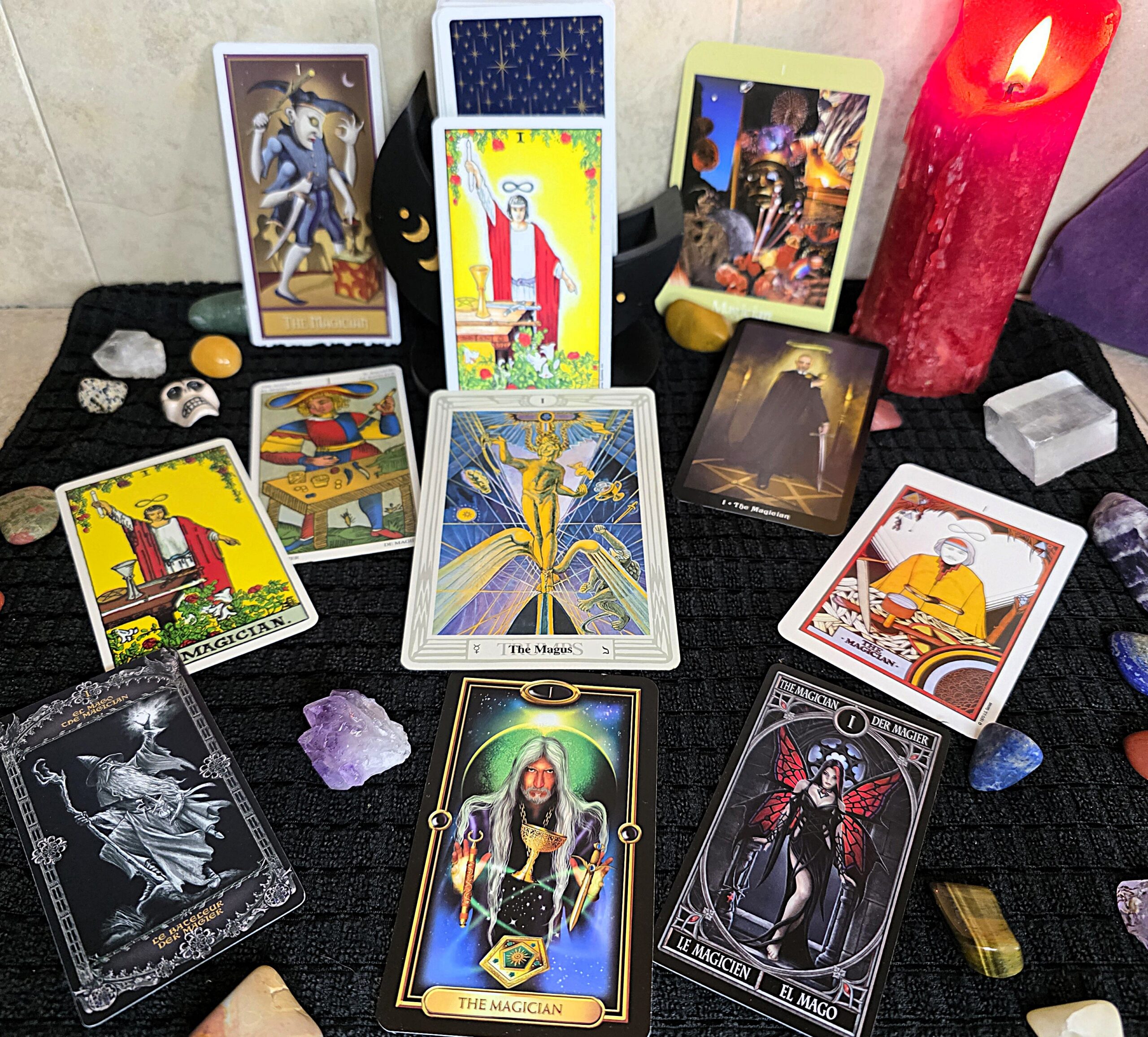
Among all the cards in the tarot, few announce possibility as boldly as The Magician. Standing between heaven and earth, one hand raised toward the sky and the other pointing to the ground, the figure appears to channel invisible forces into visible action. The image has become one of the most recognizable in Western esoteric symbolism, yet its meaning extends far beyond ideas of manifestation or personal power.
The Magician tarot meaning has fascinated artists, occultists, psychologists, mystics, and tarot readers for centuries because it sits at the beginning of the Fool’s journey. As the first numbered card of the Major Arcana, The Magician represents the moment when limitless potential begins to take shape. Where The Fool embodies possibility without direction, The Magician introduces awareness, intention, skill, and conscious participation in creation.
Many modern interpretations reduce the card to slogans about “manifesting your desires” or “using the law of attraction.” While intention and creative focus certainly belong within the card’s symbolism, they represent only one layer of a much richer tradition. Historically, The Magician has worn many faces. In the earliest tarot decks, he appeared as a street performer, a juggler, or an entertainer surrounded by curious objects. Later occult traditions transformed him into a symbol of divine will, sacred knowledge, and the human capacity to unite spiritual insight with practical action.
This evolution reflects the history of tarot itself. What began as a Renaissance card game gradually became a symbolic language capable of expressing philosophy, psychology, mythology, and contemplative spirituality. Each generation added new layers of meaning without entirely replacing what came before. The Magician therefore rewards careful study because the card contains traces of every stage of tarot’s development.
Arthur Edward Waite described the figure as one who possesses “the power and gifts of the spirit” directed toward conscious purpose (Waite 92). In the twentieth century, tarot scholars such as Rachel Pollack expanded this understanding by presenting The Magician as the awakening of individual consciousness and creative agency within the larger journey of the Major Arcana (Pollack 48-50). Mary K. Greer emphasizes the card’s role in intentional action and self-awareness, while Benebell Wen explores its connections to Hermetic philosophy, ceremonial magic, and psychological transformation (Greer 27-29; Wen 189-198).
The card also invites conversation with disciplines beyond tarot. Carl Jung’s work on archetypes provides insight into the Magician as an image of conscious transformation and individuation. Alchemical texts portray a similar movement from undifferentiated potential toward purposeful creation. Hermetic philosophy describes humanity as a bridge between the visible and invisible worlds. Christian contemplative traditions likewise explore the responsible use of wisdom, discernment, and human creativity under divine guidance. Each perspective illuminates different aspects of the same enduring symbol.
The image itself encourages contemplation rather than quick answers. Every object on the table, every flower beneath the figure’s feet, every gesture, color, and tool contributes to a carefully constructed symbolic language. The card asks readers not merely to predict future events but to examine how ideas become actions, how inspiration becomes craftsmanship, and how spiritual insight finds expression in everyday life.
Throughout this guide, we will examine The Magician from multiple perspectives. We will explore the card’s historical development from the earliest Tarot de Marseille traditions through the Rider-Waite-Smith and Thoth decks. We will examine its symbolic vocabulary, mythological echoes, Jungian significance, alchemical imagery, Christian Hermetic interpretations, astrological correspondences, and place upon the Tree of Life. Lastly, we will also consider how its wisdom can inform creativity, vocation, relationships, spiritual practice, and personal growth today.
Rather than treating The Magician as a card that simply predicts success or failure, we will approach it as a symbolic teacher. Its enduring value lies not in promising easy answers but in inviting deeper questions about consciousness, responsibility, and the mysterious partnership between inspiration and action.
In This Guide
This guide explores The Magician tarot meaning through history, symbolism, psychology, mythology, and contemplative spirituality.
- Introduction
- Card Overview
- Historical Origins of the Card
- Rider-Waite-Smith Symbolism
- Thoth Tarot Symbolism
- The Card’s Archetypal Meaning
- Mythological Connections
- Alchemical Symbolism
- Christian Hermetic Reflections
- The Tree of Life and Hebrew Letter
- Astrological Correspondences
- Chakra Correspondence
- Upright Meaning
- Reversed Meaning
- Practical Reflection Questions
- Meditation Exercise
- Related Cards
- What Modern Readers Can Learn from The Magician
- Frequently Asked Questions
- Further Reading
- Final Thoughts
Related Courses
- The Tarot Historian
- Thoth Tarot Decoded
- The Symbolic Mind
- The Hermetic Mind
- Kabbalah and The Tree of Life
- The Alchemical Library
- Thelema Unveiled
- Astrology 101
- Hebrew Foundations
Card Overview
The Magician occupies a unique position within the Major Arcana because it represents the first deliberate act of conscious creation. The card stands at the threshold between possibility and realization, illustrating the moment when inspiration becomes purposeful action.
Although different tarot traditions emphasize distinct aspects of the card, most agree that The Magician concerns skill, intention, communication, transformation, and the responsible use of personal power.
Traditional Card Number
I (1)
The number one symbolizes beginnings, unity, initiative, individuality, and the first expression of creative force. Numerologically, one represents the emergence of form from undifferentiated potential. As the first numbered Major Arcana card, The Magician begins the active phase of the Fool’s journey.
Suit
The Magician belongs to the Major Arcana rather than any of the four suits.
Element
Air
Many modern readers associate the card with Mercury rather than a single classical element. Within the Golden Dawn system, Mercury governs the card, while Mercury itself traditionally rules the airy functions of communication, intellect, language, learning, and mediation.
Planet
Mercury
Mercury governs speech, commerce, learning, writing, interpretation, adaptability, invention, and the transmission of knowledge. The planet’s symbolism aligns naturally with The Magician’s role as a mediator between unseen ideas and tangible expression.
Zodiac Sign
The Magician has no direct zodiac sign because the Golden Dawn attributes the card to Mercury rather than to one of the twelve zodiacal signs.
Hebrew Letter
Beth (ב)
Beth means “house.” Within Hermetic Qabalah, the letter symbolizes a vessel or dwelling through which divine wisdom enters manifestation. The symbolism of the house reminds readers that spiritual insight requires a suitable container if it is to become effective in the material world.
Path on the Tree of Life
Path 12
Beth connects Kether (the Crown) with Binah (Understanding).
This path symbolizes the first movement of pure divine potential toward structured wisdom. It suggests that true creative power begins in receptive understanding rather than personal ambition.
Chakra Correspondence
Many contemporary esoteric writers associate The Magician with the Throat Chakra (Vishuddha) because of its connection with communication, truthful expression, and creative manifestation through speech.
Some traditions instead emphasize the Solar Plexus Chakra because of its relationship to willpower and conscious action. Both perspectives illuminate different aspects of the card and will be explored later in this guide.
Golden Dawn Correspondence
- Hebrew Letter: Beth
- Planet: Mercury
- Path 12 on the Tree of Life
- Between Kether and Binah
These correspondences became highly influential after members of the Hermetic Order of the Golden Dawn integrated tarot into a comprehensive symbolic system during the late nineteenth century.
Thoth Correspondence
In the Thoth Tarot, Crowley retained the Golden Dawn attribution of Mercury and Beth while greatly expanding the card’s symbolic complexity. Rather than depicting a simple ritual magician, Crowley’s figure becomes an embodiment of perpetual creative motion, sacred language, and transformative intelligence.
Core Themes
Although every tarot tradition offers unique interpretations, several enduring themes unite them:
- Conscious creation
- Skill developed through practice
- Communication between spiritual and material realities
- Focused intention
- Personal responsibility
- Disciplined creativity
- Learning and mastery
- Transformation through awareness
- The union of inspiration and action
These themes reveal why The Magician continues to resonate across psychological, mystical, artistic, and philosophical traditions. It reminds us that genuine transformation requires more than vision alone. Inspiration must eventually become practice, and ideas must take form through disciplined effort.
In the sections that follow, we will discover how centuries of artists, mystics, historians, and scholars have interpreted this remarkable figure, each uncovering new dimensions within one of tarot’s most enduring symbols.





Historical Origins of the Card
To understand the deeper Magician tarot meaning, it helps to begin not with modern tarot reading but with the earliest surviving tarot cards. The Magician did not appear first as a mystical adept, an occult philosopher, or a ceremonial magician. Instead, he emerged from the lively culture of Renaissance Italy, where tarot functioned primarily as a sophisticated card game enjoyed by the nobility.
Over the next five centuries, artists, scholars, and esoteric thinkers gradually transformed this seemingly ordinary figure into one of the richest symbols in Western occultism. The Magician’s history illustrates how symbols evolve. New meanings accumulate over time without completely erasing older ones. Each historical period leaves its mark upon the card, allowing modern readers to appreciate multiple layers of interpretation simultaneously.
The Earliest Tarot Decks
Tarot originated in northern Italy during the fifteenth century. The earliest surviving examples, including the lavish Visconti-Sforza decks commissioned for the ruling families of Milan, date from the mid-1400s. These decks belonged to a game known as trionfi, later called tarocchi, and contained a series of trump cards that eventually became the Major Arcana.
Unlike later occult interpretations, these early cards carried no documented connection to Egyptian mysteries, Kabbalah, astrology, or ceremonial magic. Michael Dummett, one of the foremost historians of tarot, argued persuasively that tarot began as a card game before acquiring esoteric meanings centuries later (Dummett 7-13). Ronald Decker and Thierry Depaulis likewise caution against projecting nineteenth-century occult theories onto Renaissance imagery (Decker, Depaulis, and Dummett 26-39).
The earliest Magician therefore belonged to a world of courtly entertainment rather than occult philosophy.
The Mountebank and Street Performer
In many early Italian and later French decks, the card depicts a figure standing behind a table covered with small objects. Modern viewers often assume these represent magical tools, but contemporary audiences would have recognized a familiar type: the traveling entertainer, juggler, or mountebank.
This character occupied a colorful place in medieval and Renaissance society. He performed tricks, sold medicines, demonstrated sleight of hand, entertained crowds, and relied upon wit and persuasion to attract customers. His success depended less upon supernatural power than upon observation, dexterity, confidence, and persuasive speech.
The Italian name Bagatto or Bagatella reflects this humble status. Although scholars debate the precise origin of the word, it generally referred to someone associated with tricks, games, or small performances rather than profound spiritual authority. The French Tarot de Marseille later adopted the title Le Bateleur, often translated as “the Juggler” or “the Mountebank.”
Robert M. Place notes that this figure should not immediately be understood as either a fraud or an enlightened teacher. Instead, the image reflects a familiar social role that balanced entertainment, craftsmanship, commerce, and practical skill. The performer demonstrates ability through action rather than inherited authority (Place, The Tarot: History, Symbolism, and Divination 42-46).
This distinction remains important. Even today, The Magician speaks less about possessing secret powers than about learning to use one’s abilities with intention and discipline.
The Tarot de Marseille Tradition
By the seventeenth century, the Tarot de Marseille had become the dominant pattern across much of France and surrounding regions. Although individual woodcutters introduced minor variations, the overall image of Le Bateleur remained remarkably consistent.
The figure stands behind a table containing an assortment of objects. A small bag hangs from his belt. Various implements lie before him. One hand often holds a wand or baton while the other gestures toward the table. His posture suggests movement rather than stillness, as though he has paused briefly during a performance.
To modern readers, these objects may resemble ritual tools. Historically, however, they likely represented the equipment of the performer’s trade. Cups, knives, balls, coins, dice, or small containers all belonged naturally within the world of games and public demonstrations.
Yet symbols often exceed their original context.
As later generations revisited the image, the table itself acquired symbolic significance. Positioned between heaven and earth, it became a place where invisible ideas entered visible form. The assortment of objects suggested versatility, adaptability, and the ability to work with whatever materials lay at hand. Even before explicitly occult interpretations emerged, the visual composition hinted at themes of creativity and transformation.
Rachel Pollack observes that tarot images possess an unusual capacity to gather meaning across centuries because they remain suggestive rather than narrowly defined. Their ambiguity invites continual reinterpretation without losing contact with earlier traditions (Pollack 15-18).
The Magician provides one of the clearest examples of this symbolic openness.
A Figure Between Worlds
Several visual elements distinguish Le Bateleur from the other trumps.
Unlike kings, emperors, or popes, he holds no established office. Unlike Justice or Death, he represents no universal force beyond human control. Instead, he occupies an in-between position.
He stands.
He works.
And, he demonstrates.
His authority arises from practice rather than rank.
This liminal quality may explain why later occultists found the card so adaptable. The Magician already functioned as a mediator between ordinary experience and surprising possibility. A clever illusion can make audiences question the limits of perception. A skilled craftsman transforms simple materials into something extraordinary. A gifted speaker changes minds through language alone.
These ordinary forms of “magic” eventually became metaphors for spiritual transformation.
The Symbolism of the Table
One of the card’s most enduring visual features is the table itself.
In the earliest decks, the table serves an obvious practical purpose. It displays the performer’s tools for public demonstration. Yet even this simple object carries symbolic potential.
A table separates and connects.
It creates a space for work.
It gathers diverse objects into meaningful relationships.
And, it becomes a place where ideas assume tangible form.
Later esoteric traditions would reinterpret the table as an altar, a workbench of creation, or the meeting place of spiritual and material realities. These later readings do not necessarily reflect the intentions of Renaissance artists, but they demonstrate how enduring symbols invite fresh understanding across different historical periods.
Robert M. Place argues that tarot symbolism often grows through continuity rather than replacement. New interpretations expand older imagery instead of discarding it entirely (Place 39-44). The Magician’s table illustrates this process perfectly. A merchant’s display becomes an alchemist’s laboratory. A performer’s workspace becomes a sacred altar. The image remains recognizable even as its meaning deepens.
Skill Before Mystery
Modern discussions sometimes portray The Magician primarily as a mystical figure capable of manifesting reality through hidden knowledge. While later occult traditions certainly emphasize these themes, the historical image reminds readers of something equally valuable.
Mastery begins with practice.
The earliest Magician succeeds because he develops skill, observes carefully, communicates effectively, and works confidently with available tools. These qualities remain central even after the card acquires philosophical and esoteric significance.
Mary K. Greer notes that tarot consistently encourages active participation rather than passive prediction. The cards invite readers to cultivate awareness, make intentional choices, and develop their capacities through experience (Greer 23-30).
This perspective brings the historical Magician surprisingly close to the modern one. Whether viewed as a Renaissance performer or an initiate of Hermetic wisdom, the figure demonstrates that transformation requires disciplined engagement with reality.
The Threshold of Transformation
The historical Le Bateleur therefore occupies an important threshold within tarot’s development.
He begins as an entertainer.
He becomes a craftsman.
Also, he evolves into a philosopher.
He ultimately emerges as an image of conscious creation.
Understanding this progression protects modern readers from two common misunderstandings. First, it prevents us from imagining that tarot possessed elaborate occult meanings from its earliest origins. Second, it reminds us that later symbolic traditions are not arbitrary inventions. They developed through centuries of thoughtful engagement with an already evocative image.
In the nineteenth century, members of the Hermetic Order of the Golden Dawn would reinterpret The Magician through astrology, Kabbalah, Hermetic philosophy, and ceremonial magic. Arthur Edward Waite and Pamela Colman Smith would then redesign the card for the Rider-Waite-Smith deck, adding symbolic details that continue to shape tarot study today. Finally, Aleister Crowley and Lady Frieda Harris would produce an even more esoteric vision in the Thoth Tarot, presenting The Magician as an embodiment of Mercurial consciousness and creative transformation.
Each version builds upon the foundations established by the humble Renaissance performer standing behind his table.
Rather than abandoning history, these later artists entered into a centuries-long conversation with it. Their contributions transformed The Magician from a memorable character in a card game into one of the most profound symbolic figures in the Western esoteric tradition.
The Rider–Waite–Smith Magician: A New Visual Theology
Although the Tarot de Marseille established the essential iconography of the Magician, the publication of the Rider–Waite–Smith deck in 1909 fundamentally reshaped how modern readers understand the card. Nearly every contemporary tarot deck owes something to this design. Whether a deck follows it closely or deliberately rejects it, the Rider–Waite–Smith (RWS) Magician remains the visual and symbolic standard against which later interpretations are measured.
Arthur Edward Waite did not intend merely to reproduce traditional tarot imagery. He sought to communicate what he believed represented the cards’ deepest esoteric teachings. In The Pictorial Key to the Tarot, he explained that earlier decks concealed their highest mysteries beneath conventional imagery and that his revised symbolism attempted to reveal, rather than obscure, these spiritual principles (Waite 92–94).
This distinction matters because many popular books mistakenly credit Waite alone for the deck’s enduring symbolism. In reality, the Rider–Waite–Smith deck resulted from an extraordinary collaboration between Waite and artist Pamela Colman Smith. Waite provided extensive symbolic direction, but Smith transformed those ideas into one of the most influential artistic achievements of the twentieth century.
Smith contributed far more than technical illustration. Her theatrical background, imaginative style, and intuitive understanding of symbolism allowed her to create scenes that possessed emotional and psychological depth absent from earlier tarot decks. Most significantly, she illustrated every Minor Arcana card with narrative scenes rather than simple suit symbols. That innovation permanently changed tarot history. It made the deck far more accessible to beginners while simultaneously opening new avenues for symbolic and psychological interpretation.
The Magician particularly demonstrates Smith’s artistic contribution. Earlier versions often present a craftsman or street performer surrounded by objects of trade. Smith instead creates an image that feels simultaneously earthly and transcendent. Every object appears intentional. Every gesture contributes to a unified symbolic language. Rather than depicting someone who merely performs tricks, she presents an initiate consciously directing invisible spiritual forces into material reality.
The Upright Figure Between Heaven and Earth
The first feature that draws the eye is the Magician’s posture. He stands upright before a stone altar, his body calm and balanced. His right arm reaches upward while holding a white wand. His left hand points downward toward the earth.
This pose immediately distinguishes him from earlier conjurers. He no longer entertains an audience or displays clever dexterity. Instead, he serves as a living conduit between two worlds.
The gesture expresses one of Western esotericism’s oldest and most enduring principles: the correspondence between the spiritual and material realms. Rather than existing as separate realities, heaven and earth mirror one another through an ordered pattern established by divine wisdom. Human beings participate in that order when they consciously align thought, will, and action with higher truth.
Students often summarize this idea with the famous Hermetic phrase:
“As above, so below.”
Although the expression has become almost inseparable from modern tarot, the exact phrase does not appear anywhere on the Magician card itself. Instead, readers associate the gesture with the Emerald Tablet, traditionally attributed to Hermes Trismegistus. One widely known translation reads:
“That which is below is like that which is above, and that which is above is like that which is below.”
The saying describes the doctrine of correspondence that became foundational for Hermetic philosophy, Renaissance magic, alchemy, Rosicrucianism, and later occult traditions. The visible universe reflects invisible realities. Material forms reveal spiritual truths. Human beings occupy the meeting point between these two dimensions.
Waite intentionally evokes this tradition through the Magician’s body. The raised wand symbolizes reception of divine power, while the lowered hand directs that power into earthly manifestation. The figure neither creates spiritual energy nor possesses it independently. Instead, he channels it.
This distinction separates authentic Hermetic philosophy from popular misconceptions about “manifestation.” Modern self-help culture sometimes interprets the Magician as someone who bends reality through personal desire alone. Waite’s symbolism suggests something different. The Magician succeeds because his individual will aligns with a higher order rather than attempting to replace it.
That understanding reflects a long stream of Christian Hermetic thought as well. Renaissance Hermetic philosophers such as Marsilio Ficino and Giovanni Pico della Mirandola argued that humanity occupies a unique place within creation because people unite body and spirit. Human creativity therefore becomes most effective when exercised in harmony with divine wisdom rather than in rebellion against it. The Magician’s gesture visually expresses precisely this relationship.
The Gesture as Living Symbol
Jungian psychology offers another valuable perspective on the Magician’s posture. Carl Jung frequently observed that symbolic gestures communicate realities deeper than ordinary language can express. Images often reveal psychological truths before the conscious mind can fully articulate them.
From this perspective, the Magician’s raised and lowered arms symbolize the integration of opposites. Spirit and matter, conscious intention and unconscious inspiration, heaven and earth all become united within a single human figure. The image therefore portrays psychological wholeness rather than supernatural power alone.
The gesture also reminds readers that genuine transformation requires both inspiration and action. Vision without embodiment remains fantasy. Action without vision becomes mechanical labor. The Magician joins imagination with execution. He receives insight, then gives it concrete form.
For artists, writers, teachers, healers, and spiritual practitioners, this symbolism remains remarkably practical. Every creative act follows the same pattern. An idea first appears invisibly within imagination before becoming visible through disciplined work. The painter translates inspiration into pigment. The musician transforms inner hearing into sound. The writer turns fleeting intuition into words on a page.
The Magician therefore represents more than occult knowledge. He symbolizes the universal human capacity to participate consciously in creation itself.
Here’s the next section in the same scholarly style and structure.
The Wand, Infinity Symbol, Ouroboros, and the Language of Transformation
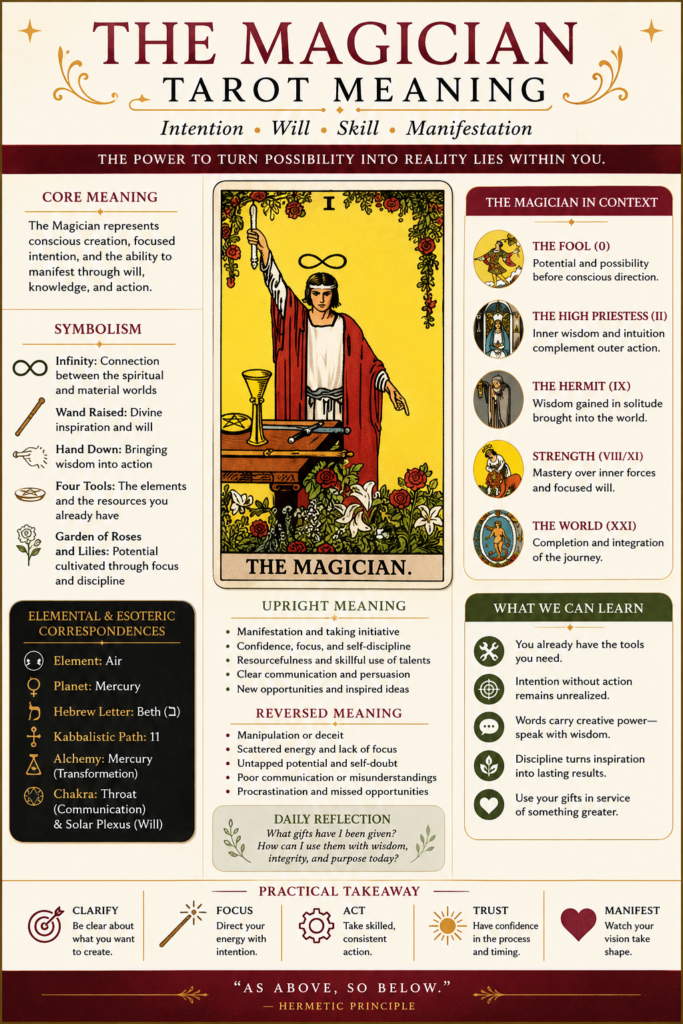
Every major element of the Rider–Waite–Smith Magician contributes to a carefully constructed symbolic system. Although the pose of “as above, so below” naturally draws the eye first, Waite and Smith surrounded the figure with additional visual signs that deepen the card’s meaning. The raised wand, the floating lemniscate, the serpent belt, and the contrasting garments all communicate the same central idea: true creative power arises when divine inspiration, disciplined will, and material action work together.
Rather than functioning as decorative details, these symbols reinforce one another. Together they portray the Magician as the conscious mediator between spirit and matter, heaven and earth, idea and manifestation.
The Wand: Divine Authority Directed Toward Earth
The Magician’s wand represents far more than magical power in the popular imagination. Held upright in the right hand and pointing toward heaven, it functions as a symbolic axis connecting the divine realm with the earthly world.
Historically, staffs and rods often signified legitimate authority. Moses’ staff demonstrated God’s power before Pharaoh. Aaron’s rod budded as a sign of divine election. Medieval bishops carried croziers as symbols of pastoral authority. In Hermetic and Renaissance magical traditions, the wand likewise represented directed will rather than supernatural spectacle. It became the instrument through which intention shaped reality.
Waite understood the wand in precisely this symbolic sense. The Magician does not generate power independently. Instead, he receives, channels, and directs a higher creative principle. His raised arm demonstrates receptivity before action. Only after the heavenly current descends does the opposite hand extend toward the earth.
This symbolism reflects a central Hermetic conviction: authentic creation imitates the order established by God. Human beings participate in creation by aligning themselves with divine wisdom rather than imposing personal desire upon the world. The wand therefore symbolizes disciplined cooperation with transcendent order.
From an alchemical perspective, the wand also evokes the element of Fire. Fire represents inspiration, illumination, purification, and active transformation. Before any physical work begins in the laboratory, the alchemist must first possess the inner fire of intention. Likewise, before the Magician manipulates the symbols on the table, he establishes the spiritual orientation represented by the raised wand.
Psychologically, the wand signifies focused attention. Jung frequently described psychic energy as something that requires conscious direction if it is to produce meaningful transformation. Left scattered, psychic energy dissipates. Directed toward a unified purpose, it becomes creative rather than chaotic (Jung 95–97).
The wand therefore represents disciplined consciousness. The Magician succeeds because he knows where to direct his attention.
The Infinity Symbol: Limitless Spiritual Potential
Floating above the Magician’s head appears one of the deck’s most recognizable symbols: the horizontal figure-eight known as the lemniscate.
Unlike many earlier tarot decks, which omit this symbol entirely, Pamela Colman Smith places it prominently above the Magician, visually crowning him with the sign of eternity. Its placement suggests that the source of the Magician’s effectiveness lies beyond the finite personality.
The lemniscate traditionally symbolizes infinity, continuity, and the eternal circulation of life. Rather than representing endless quantity, however, it signifies an unbroken movement between complementary realities. Spirit descends into matter. Matter returns toward spirit. The visible and invisible continually interact.
This dynamic echoes the Emerald Tablet’s teaching that heavenly and earthly realities mirror one another. The Magician stands beneath the infinity symbol because he consciously participates in this perpetual exchange.
Some esoteric commentators associate the lemniscate with the endless flow of divine energy through creation. Others connect it to the balance of opposites or the harmonious circulation of conscious and unconscious forces within the psyche. These interpretations need not compete. Each reflects the broader symbolic principle of continual movement rather than static perfection.
Pollack notes that the Magician embodies the ability to direct available energies rather than create them from nothing. The infinity symbol therefore reminds readers that creative resources remain inexhaustible when one stays connected to their transcendent source (Pollack 53–55).
Seen psychologically, the lemniscate suggests that human creativity does not arise solely from conscious thought. Ideas often emerge through an ongoing dialogue between conscious awareness and deeper unconscious processes. Artists, writers, inventors, and mystics frequently describe inspiration as something discovered rather than manufactured. The infinity symbol visually expresses that continuous exchange.
The Ouroboros Belt: The Circle of Transformation
Around the Magician’s waist rests another ancient esoteric emblem: a serpent biting its own tail.
Known as the ouroboros, this image appeared in ancient Egyptian symbolism, Hellenistic philosophy, Gnostic writings, and later alchemical manuscripts. Across these traditions, the serpent represents cyclical renewal, self-generation, eternity, and the continual transformation of life.
Its location on the Magician’s body carries symbolic significance. Encircling the waist, the serpent binds together the upper and lower halves of the figure. Just as the Magician unites heaven and earth through gesture, the ouroboros unites beginning and ending, creation and dissolution, death and rebirth.
Alchemy frequently employed the ouroboros to describe the opus itself. The Great Work proceeds through repeated cycles of dissolution, purification, and recombination. Nothing reaches perfection through a single act. Instead, transformation unfolds through recurring stages that gradually refine both substance and soul.
Adam McLean observes that alchemical imagery consistently presents the serpent as a symbol of continuous inner renewal rather than merely physical immortality. The circle does not imprison. It preserves the rhythm through which genuine change becomes possible.
From a Jungian perspective, the ouroboros represents psychic wholeness. Jung viewed the image as an archetype of the Self, expressing the psyche’s capacity for continual self-renewal and integration (Jung 320–324). The Magician wears this symbol because mastery requires ongoing transformation. One does not become spiritually mature through a single revelation but through repeated encounters with growth, failure, reflection, and renewal.
Unlike modern conceptions of mastery as permanent achievement, the ouroboros reminds readers that wisdom remains a living process.
The Red and White Robes: Spirit Clothed in Matter
The Magician’s clothing further develops this symbolic vocabulary. He wears a white inner robe covered by a flowing red outer cloak.
Throughout Western esoteric symbolism, white commonly represents purity, illumination, innocence, and spiritual consciousness. Red signifies vitality, action, sacrifice, desire, and the active force of life. Together they create a visual statement about the proper relationship between inner character and outward action.
The white garment remains closest to the body, suggesting that authentic action begins with inner purity of intention. The red robe appears externally, demonstrating that spiritual understanding should manifest through active engagement with the world rather than withdrawal from it.
Waite frequently emphasized that the highest forms of esotericism unite contemplation with practical service. Knowledge exists to become embodied. Wisdom becomes meaningful only when translated into action.
Alchemical traditions likewise associate white and red with successive stages of transformation. The whitening (albedo) symbolizes purification, illumination, and the cleansing of the soul. The reddening (rubedo) represents the completion of the Great Work, when perfected consciousness fully enters embodied life. Although Waite does not explicitly label the Magician with these alchemical stages, the color symbolism strongly resonates with established alchemical imagery.
Psychologically, the robes portray the integration of inner values with outward behavior. The mature individual no longer performs a social role disconnected from personal conviction. Instead, external action reflects internal integrity. The Magician therefore embodies congruence rather than performance.
This distinction explains why the card differs so sharply from modern stereotypes of illusionists or tricksters. Although skill and persuasion belong to the Magician’s domain, Waite’s figure ultimately symbolizes truthful manifestation. His power depends upon alignment between inward intention and outward expression.
Every symbolic element discussed thus far points toward the same conclusion. The raised wand channels divine inspiration. The infinity symbol depicts inexhaustible spiritual potential. The ouroboros reveals continual transformation. The red and white garments unite purity with purposeful action.
These ideas now converge upon the physical center of the composition: the table before the Magician. Upon it rest four seemingly simple objects that together summarize the entire symbolic architecture of the tarot itself.
I’ve continued the article at Part 2.1: Thoth Tarot Symbolism – Archetypal Meaning, maintaining the same scholarly tone, SEO focus, and citation style as the previous sections.
Thoth Tarot Symbolism: Archetypal Meaning
If the Rider–Waite–Smith Magician presents the archetype as the conscious individual directing divine power into the material world, the Thoth Magus expands that image into a far more cosmic principle. Rather than depicting a skilled practitioner standing before ritual tools, Aleister Crowley and Lady Frieda Harris portray the Magus as the universal force through which consciousness first becomes manifest. He does not merely use symbols. He generates them. And, he is language before speech, thought before form, and will before action.
For this reason, many tarot scholars regard the Thoth Magus as one of the most philosophically complex cards ever produced. Crowley’s version draws from Hermeticism, Kabbalah, Egyptian religion, alchemy, Greek mythology, astrology, and modern psychology simultaneously. Instead of simplifying these traditions into a single narrative, the card allows them to exist together as different expressions of one underlying principle: the creative Logos.
The Archetype of the Divine Messenger
One of the most striking differences between the Rider–Waite–Smith and Thoth versions lies in the identity of the central figure. While Waite’s Magician resembles a ceremonial magician or Renaissance adept, Crowley’s Magus embodies the ancient trickster-messenger gods.
The card most clearly reflects Hermes (Mercury), the Greek god of communication, commerce, invention, writing, magic, and boundaries. Hermes served as messenger between Olympus, Earth, and the Underworld. He crossed every border without belonging entirely to any realm. In Jungian terms, he represents the mediating function that connects opposites and allows transformation to occur.
Crowley deliberately identified the Magus with Hermes Trismegistus, the legendary sage credited with the Hermetic writings. In Hermetic philosophy, Hermes serves not merely as a deity but as the revealer of divine wisdom. He transmits knowledge from the invisible world into visible reality.
This role explains why the Magus becomes associated with language itself. Before anything can exist in human experience, it must first become distinguishable through symbols, concepts, or names. The Magus therefore represents the archetypal act of making meaning.
Robert M. Place notes that the magician historically functions as a mediator between worlds rather than a performer of supernatural feats. His primary task involves transmitting hidden knowledge through symbolic systems, rituals, and sacred language (Place 219–224). The Thoth Magus emphasizes this mediating role more strongly than perhaps any previous tarot image.
Mercury as the Principle of Consciousness
Crowley assigns the card to the planet Mercury, but his understanding extends far beyond astrology.
Mercury governs movement.
Mercury governs exchange.
And, Mercury governs intelligence.
Most importantly, Mercury governs communication between otherwise separate realities.
In alchemical literature, Mercurius appears as the mysterious substance that dissolves rigid forms so that new combinations become possible. Carl Jung devoted hundreds of pages to Mercurius because the figure continually appeared in dreams as the agent of psychological transformation. Jung described Mercurius as paradoxical, elusive, and impossible to reduce to simple categories. He unites spirit and matter, masculine and feminine, conscious and unconscious (Jung, Mysterium Coniunctionis 196–214).
Crowley’s Magus visually embodies this same paradox. He appears dynamic rather than stable. Symbols whirl around him in perpetual motion. Nothing remains fixed because consciousness itself exists as an ongoing creative process.
Rather than mastering reality from outside it, the Magus participates in the continual creation of reality.
This distinction reflects one of the central insights of Western esotericism: creation is never entirely finished. Every thought, word, and act participates in the ongoing unfolding of the cosmos.
The Logos and Creative Speech
Perhaps the deepest symbolic layer of the Thoth Magus concerns the concept of the Logos.
In Greek philosophy, the Logos referred to the rational principle ordering the universe. Later, the Gospel of John transformed this philosophical concept into one of Christianity’s foundational theological ideas:
“In the beginning was the Word, and the Word was with God, and the Word was God” (John 1:1, NIV).
Crowley interpreted the Magus through Hermetic rather than orthodox Christian theology, yet both traditions recognize speech as fundamentally creative.
Words do not merely describe reality.
They participate in making reality intelligible.
Hermetic texts repeatedly describe creation as the unfolding of divine Mind through divine Word. Adam McLean notes that Renaissance alchemists viewed sacred names, symbols, and letters as active forces rather than arbitrary signs. Language itself became an instrument of transformation because it reflected the hidden order of creation (McLean 42–51).
This understanding profoundly reshapes the meaning of the Magician.
The card no longer asks merely whether someone possesses talent or confidence.
Instead, it asks:
What realities are your words bringing into existence?
Every promise.
Every prayer.
Also, every story.
Every symbol.
Every identity.
All become acts of creative participation.
The Magus as Trickster
Unlike Waite’s composed ceremonial magician, Crowley’s Magus retains the unpredictable qualities of the mythological trickster.
Hermes stole Apollo’s cattle while still an infant.
He invented the lyre.
He deceived gods.
Also, he guided souls.
He negotiated peace.
He crossed forbidden boundaries.
Across cultures, trickster figures challenge rigid structures so that new possibilities can emerge. They expose hidden assumptions and reveal unexpected paths toward transformation.
Jung regarded the Trickster as one of humanity’s oldest archetypes because it represents the chaotic energy that precedes greater consciousness (The Archetypes and the Collective Unconscious 255–272). Although often disruptive, the trickster ultimately serves psychological growth.
The Thoth Magus preserves this ambiguity.
Creative intelligence can illuminate.
It can also manipulate.
Language can heal.
It can equally deceive.
Ideas possess tremendous power because they shape perception itself.
This moral ambiguity distinguishes Crowley’s Magus from the more ethically stable Rider–Waite–Smith figure. The card presents intelligence as fundamentally neutral. Wisdom depends upon how that intelligence becomes directed.
Christian Hermetic Reflections
Readers approaching tarot from a Christian Hermetic perspective often find the Thoth Magus challenging because Crowley’s broader religious views differ sharply from traditional Christianity.
Yet the symbolic structure of the card still contains ideas that resonate with earlier Christian mystical traditions.
Church Fathers such as Justin Martyr and Clement of Alexandria described Christ as the eternal Logos through whom creation came into being. Medieval Christian mystics likewise viewed humanity as participating in divine creativity through reason, language, and imagination, while insisting that such creativity remained subordinate to God rather than independent of Him.
From this perspective, the Magus can symbolize humanity’s God-given vocation to cultivate, create, teach, write, invent, and communicate truth. The danger arises only when human will attempts to replace divine wisdom instead of cooperating with it.
The card therefore becomes a meditation on stewardship rather than domination.
The question shifts from “How much power do I possess?” to “How faithfully do I use the gifts entrusted to me?”
This interpretation aligns more closely with Christian Hermetic traditions than with modern occult individualism.
Psychological Interpretation
From a Jungian perspective, the Thoth Magus represents the emergence of conscious agency.
Here the archetype symbolizes the moment an individual realizes that thoughts influence behavior, language shapes identity, and imagination participates in psychological development.
This realization carries tremendous responsibility.
The stories people tell about themselves become self-fulfilling.
The symbols they embrace organize experience.
The words they repeat gradually shape personality.
The Magus therefore invites conscious participation in one’s own psychological formation.
Rather than drifting through inherited narratives, individuals become active authors of meaning.
For Jung, this marks an important step in individuation. Consciousness begins integrating previously unconscious potentials through symbolic engagement rather than remaining controlled by them (Jung, Symbols of Transformation 63–78).
Seen this way, the Magus represents the birth of intentional consciousness itself.
He reminds us that every civilization, religion, scientific theory, work of literature, and personal identity began as an invisible idea expressed through symbols.
The first act of creation is always an act of meaning.
Mythological Connections and Alchemical Symbolism
The Magician in Myth: The Divine Mediator
Although no single mythological figure completely embodies the Magician, the card gathers together traits found in numerous divine messengers, culture heroes, inventors, magicians, and intermediaries between heaven and earth. Throughout world mythology, these figures occupy a liminal position. They stand between worlds, translating divine wisdom into human knowledge and transforming hidden potential into visible reality.
This intermediary role helps explain why the Magician appears as Card I of the Major Arcana. Before the Fool can truly begin the spiritual journey, consciousness must awaken to its own creative capacity. Myth repeatedly tells this story through figures who bring language, fire, sacred tools, or spiritual knowledge to humanity.
Hermes: Patron of Magic and Hermetic Wisdom
The figure most closely associated with the Magician is Hermes, the Greek messenger of the gods. Hermes governs communication, eloquence, commerce, boundaries, travel, invention, and sacred knowledge. More importantly for Western esotericism, Hermes became identified with the Egyptian god Thoth during the Hellenistic period, giving rise to the legendary sage Hermes Trismegistus (“Hermes the Thrice-Great”).
The writings attributed to Hermes Trismegistus became foundational texts of Hermetic philosophy during late antiquity and the Renaissance. These works teach that humanity reflects the divine order of the cosmos and that spiritual knowledge allows the practitioner to cooperate consciously with creation.
The famous Hermetic maxim,
“That which is above is like that which is below.”
became one of the defining principles of Western esotericism and appears visually in the Magician’s raised and lowered hands. Rather than suggesting domination over nature, the gesture expresses correspondence between different levels of reality. Divine order flows into earthly existence through conscious participation.
This Hermetic framework deeply influenced Renaissance magic, alchemy, Kabbalah, and eventually modern tarot symbolism (Faivre, Access to Western Esotericism 10–15; Hanegraaff 3–12).
Arthur Edward Waite viewed the Magician as a symbolic transmitter of spiritual power rather than a stage illusionist. Pamela Colman Smith’s illustration reinforces this understanding by placing the Magician between heaven and earth, directing divine energy toward the material plane (Waite 76).
Hermes Trismegistus and Christian Hermeticism
During the Renaissance, scholars such as Marsilio Ficino and Giovanni Pico della Mirandola believed the Hermetic writings preserved fragments of an ancient wisdom that anticipated Christian revelation. Although historians now know that the Hermetic texts date from the early centuries of the Common Era rather than ancient Egypt, their symbolic importance remained enormous.
Christian Hermetic thinkers viewed humanity as created in God’s image with the unique vocation of participating consciously in divine creativity. The Magician therefore represents more than occult power. He becomes an image of redeemed human agency.
In this interpretation, the wand points toward heaven because creative authority originates with God. The hand pointing toward earth signifies faithful stewardship rather than autonomous control. The Magician does not replace divine action. Instead, he cooperates with it.
This perspective helps explain why many Christian Hermetic writers distinguished sacred magic from superstition. True wisdom aligned the human will with divine providence rather than attempting to manipulate supernatural forces for selfish ends (Yates 47–58).
Thoth: Divine Intelligence and Sacred Writing
The Egyptian god Thoth also contributes significantly to the Magician’s symbolism. Thoth served as the divine scribe, patron of writing, mathematics, astronomy, measurement, and magical knowledge. Ancient Egyptians credited him with preserving cosmic order through language itself.
Because Thoth governed both writing and sacred speech, later Hermetic traditions viewed him as the guardian of esoteric wisdom.
This connection becomes particularly significant in the Thoth Tarot, where Aleister Crowley explicitly renamed the Magician “The Magus” and emphasized Mercury’s role as divine intelligence manifested through language, symbols, and creative expression (Crowley 69–77).
For readers interested in symbolic rather than purely divinatory interpretations, the Thoth deck reminds us that words themselves possess transformative power. Every spoken intention, every written text, and every meaningful symbol participates in shaping reality.
Odin and the Rune Master
The Magician also shares striking similarities with Odin from Norse mythology.
Unlike many warrior gods, Odin willingly sacrifices comfort and certainty in pursuit of wisdom. He hangs upon Yggdrasil, pierced by his own spear, for nine nights before discovering the runes. This act represents the acquisition of sacred knowledge through voluntary transformation rather than conquest.
The runes themselves function as more than an alphabet. They embody living principles that reveal hidden relationships within creation.
Like the Magician, Odin becomes a mediator between invisible wisdom and practical action. Knowledge carries responsibility. Insight must become effective action.
For students of symbolic traditions, this parallel highlights one of the Magician’s central lessons: wisdom exists to be embodied rather than merely accumulated.
Prometheus and the Gift of Fire
The Greek Titan Prometheus offers another illuminating comparison.
Prometheus steals fire from Olympus and gives it to humanity, enabling civilization, craftsmanship, and technological development. Fire symbolizes more than physical warmth. It represents consciousness itself.
The Magician similarly channels creative fire.
Both figures introduce transformative power into the human world. Both demonstrate that knowledge changes civilization. And, both remind us that power demands ethical responsibility.
Unlike Prometheus, however, the Magician receives rather than steals divine energy. The card emphasizes alignment over rebellion.
Merlin and the Wise Enchanter
Medieval legend contributes another familiar image through Merlin, advisor to King Arthur.
Merlin combines prophetic vision with practical guidance. He understands natural law while remaining deeply connected to mystery. Rather than using magic merely for spectacle, he directs it toward the unfolding of a larger providential purpose.
Many modern readers instinctively associate the Magician with Merlin because both figures unite wisdom, skill, creativity, and disciplined power.
Yet the comparison also reveals an important distinction. The tarot Magician possesses no elaborate magical props beyond simple symbolic tools. His greatest instrument remains conscious intention guided by higher wisdom.
The true magician transforms perception before transforming circumstances.
Alchemical Symbolism
The Great Work Begins
Among all Western esoteric traditions, alchemy perhaps provides the richest symbolic framework for understanding the Magician.
Although modern popular culture often imagines alchemy as an attempt to manufacture literal gold, historical alchemists pursued something much broader. They understood physical transformation as an image of spiritual transformation.
The alchemical Magnum Opus, or Great Work, described the gradual refinement of both matter and the human soul.
The Magician represents the beginning of that work.
He stands before the laboratory.
The tools await.
The raw materials have been gathered.
Nothing has yet been transformed, but every possibility exists.
Rachel Pollack observes that the Magician demonstrates conscious direction of energy before any lasting transformation can occur. Without intentional focus, the Great Work never truly begins (Pollack 57–61).
Prima Materia: Working with Raw Potential
Alchemy begins with the prima materia, the undifferentiated substance from which transformation emerges.
Psychologically, Carl Jung interpreted the prima materia as the unconscious itself. Human beings begin with immense but unformed potential.
Likewise, the Fool arrives carrying possibility.
The Magician begins shaping it.
This movement from potential into form parallels creativity itself. Every artistic work, scientific discovery, spiritual practice, or meaningful relationship starts as something unseen before becoming visible.
The Magician therefore symbolizes the moment when imagination first enters reality.
The Four Elements in Alchemy
The four implements upon the Magician’s table correspond not only to the tarot suits but also to the four classical elements central to alchemical thought:
- Wand: Fire, inspiration, spirit, active will.
- Cup: Water, emotion, receptivity, intuition.
- Sword: Air, intellect, discrimination, language.
- Pentacle: Earth, manifestation, stability, embodiment.
Alchemy sought balance among these elemental forces rather than the dominance of any single one.
Likewise, the Magician succeeds because every aspect of the personality works together. Thought, emotion, action, and material reality become integrated into a unified creative act.
The table therefore functions almost like an alchemical workbench where psychological and spiritual integration begins.
Mercury: The Alchemical Principle
The Magician also corresponds to Mercury, perhaps the most important symbolic substance in alchemy.
Mercury represents movement, transformation, mediation, and union between opposites.
Unlike ordinary metals, alchemical Mercury refuses fixed definition. It remains fluid, adaptable, and transformative.
These same qualities characterize the Magician.
He moves between spirit and matter.
Between thought and action.
Between possibility and manifestation.
And, between heaven and earth.
Jung described Mercurius as one of the most complex symbols in alchemy because it simultaneously represents the beginning, the process, and the goal of transformation (Jung, Mysterium Coniunctionis 194–202).
The Magician embodies this paradox beautifully. He both initiates transformation and participates within it.
Solve et Coagula
A central alchemical principle states:
Solve et coagula.
“Dissolve and recombine.”
Transformation requires breaking apart old structures before creating new forms.
Although later Major Arcana cards depict these dissolutions more dramatically, the Magician introduces the process by consciously choosing creation over inertia.
Every meaningful act begins with intention.
Every work of art begins with a first mark.
Also, every spiritual discipline begins with a first practice.
Every transformed life begins with a first decision.
The Magician therefore reminds us that the Great Work rarely starts with dramatic miracles.
It begins by picking up the tools already lying before us.
Here’s the next section of your article in the same scholarly, long-form style.
Christian Hermetic Reflections
The Rider–Waite–Smith Magician occupies a unique place within Western esotericism because the card unites several streams of thought that many modern readers mistakenly separate. Medieval Christianity, Renaissance Hermeticism, Jewish Kabbalah, astrology, alchemy, and ceremonial magic all converge in this single image. Arthur Edward Waite did not present the Magician merely as a performer of wonders or a manipulator of hidden forces. He envisioned the figure as humanity standing between heaven and earth, participating in God’s creative order through wisdom, discipline, and rightly directed will.
For readers approaching tarot from a Christian Hermetic perspective, this distinction matters greatly. Christian Hermeticism has never viewed true magic as an attempt to overpower God or manipulate divine law. Instead, it understands the universe as an ordered creation whose hidden patterns reveal the wisdom of its Creator. Human beings, created in the image of God (Genesis 1:26-27), participate in that order by aligning intellect, imagination, speech, and action with divine wisdom.
The Magician therefore represents neither superstition nor occult sensationalism. Rather, the card depicts humanity’s vocation as steward, priest, artisan, and co-worker within creation. The Magician’s tools become symbols of human capacities entrusted by God, while the raised wand reminds the seeker that genuine authority always descends before it ascends.
The Christian Hermetic Understanding of Divine Wisdom
Christian Hermeticism emerged during the Renaissance through figures such as Marsilio Ficino, Giovanni Pico della Mirandola, Johannes Reuchlin, Heinrich Cornelius Agrippa, and later Robert Fludd. These scholars believed that ancient wisdom traditions, including Platonic philosophy, Hermetic writings, biblical revelation, and aspects of Jewish Kabbalah, ultimately pointed toward the same divine source.
Rather than rejecting Christianity, these thinkers sought to deepen it. They viewed the visible world as a symbolic reflection of invisible realities, echoing Paul’s statement that God’s invisible qualities may be perceived through creation (Romans 1:20).
Within this framework, the Magician symbolizes humanity’s God-given ability to perceive these hidden correspondences.
The Hermetic maxim Quod est superius est sicut quod est inferius (“That which is above is like that which is below”), found in the Emerald Tablet, does not encourage domination over nature. Instead, it expresses the belief that earthly realities mirror heavenly principles. Waite intentionally incorporated this idea into the Magician’s famous gesture, with one hand pointing upward while the other points toward the earth.
From a Christian Hermetic perspective, this gesture recalls Christ’s teaching in the Lord’s Prayer:
“Your kingdom come, your will be done, on earth as it is in heaven” (Matthew 6:10, NIV).
The Magician therefore serves as a symbolic mediator. Divine wisdom flows downward before human action flows upward. The figure becomes an image of faithful stewardship rather than personal power.
Logos and the Creative Word
One of the deepest Christian interpretations of the Magician centers upon the doctrine of the Logos.
John’s Gospel opens with one of Christianity’s most profound theological declarations:
“In the beginning was the Word, and the Word was with God, and the Word was God” (John 1:1, NIV).
The Greek Logos refers simultaneously to divine reason, creative speech, cosmic order, and Christ Himself.
Unlike many modern depictions of magic as arbitrary power, biblical creation occurs through spoken order.
God speaks.
Creation responds.
Light appears.
Chaos becomes cosmos.
This creative speech echoes throughout Hermetic philosophy, where language, symbols, numbers, and names possess formative power because they participate in deeper realities rather than merely describing them.
The Magician therefore represents disciplined speech.
Words create.
Ideas become actions.
Vision becomes reality.
The card reminds readers that every human act begins internally before becoming external. In Christian spirituality, this principle aligns with Christ’s teaching that actions arise from the condition of the heart (Matthew 15:18-19).
Thus, the Magician invites careful stewardship over thought, language, imagination, and intention.
Wisdom Rather Than Sorcery
Scripture consistently condemns attempts to manipulate spiritual powers apart from God (Deuteronomy 18:10-12). Because of these passages, some Christians understandably approach tarot with caution.
However, Christian Hermetic readers distinguish between illicit magical manipulation and symbolic contemplation.
Waite himself repeatedly emphasized that tarot should not be reduced to fortune telling. Instead, he viewed the cards as symbolic illustrations of universal spiritual principles (Waite 1910).
Within this understanding, the Magician resembles the biblical figure described in Proverbs.
Wisdom cries aloud.
Wisdom orders life.
Also, wisdom builds.
Wisdom understands creation because it originates with God.
The Magician therefore symbolizes cultivated wisdom rather than supernatural control. The card invites discernment, discipline, learning, and faithful use of one’s gifts.
Humanity as Co-Creator
Genesis presents humanity as bearing God’s image and receiving responsibility over creation (Genesis 1:26-28).
Christian Hermetic writers often interpreted this vocation symbolically.
Human beings cannot create ex nihilo as God does.
Yet they create through participation.
Artists shape beauty.
Writers shape language.
Teachers shape minds.
Builders shape cities.
Parents shape children.
The Magician becomes an archetype of this creative participation.
The four suits upon the table represent the materials of experience.
The raised wand symbolizes inspiration.
The downward hand represents practical embodiment.
Together they depict the continual movement from divine possibility into earthly manifestation.
For modern readers, this interpretation shifts the card away from supernatural spectacle and toward faithful craftsmanship. Every meaningful vocation contains something of the Magician.
Every act of disciplined creation reflects the divine image.
Tree of Life and Hebrew Letter
No tarot card illustrates the connection between the Major Arcana and the Tree of Life more clearly than the Magician.
Within the Hermetic Order of the Golden Dawn, the Magician corresponds to the Hebrew letter Beth (ב) and the twenty-second path connecting Kether (Crown) with Binah (Understanding).
Beth literally means “house.”
On the surface, this may seem like an unexpected association. Yet the symbolism becomes remarkably rich when viewed through Jewish and Christian mystical traditions.
A house serves as a dwelling place.
It receives.
It shelters.
And it contains life.
Likewise, the Magician becomes the symbolic house through which divine wisdom enters the world.
Beth as the House of Divine Presence
The Hebrew alphabet possesses symbolic as well as phonetic meaning.
Beth begins the Torah itself.
Genesis opens not with Aleph but with Beth:
Bereshit (“In the beginning…”).
Jewish commentators have long reflected upon this mystery. Why should Scripture begin with the second letter rather than the first?
One traditional interpretation suggests that creation itself represents God’s house.
The universe becomes the dwelling place in which divine wisdom unfolds.
Within Christian Hermetic thought, the Magician likewise stands at the threshold between unmanifest possibility and created reality.
Ideas become forms.
Spirit enters matter.
Potential becomes action.
This symbolism harmonizes naturally with John’s description of Christ as the Logos through whom all things were made (John 1:3).
The Path from Crown to Understanding
On the Tree of Life, Beth joins Kether with Binah.
Kether represents pure divine unity beyond human comprehension.
Binah represents understanding, structure, limitation, and form.
The Magician therefore symbolizes the first movement of divine potential toward intelligible creation.
In psychological language, inspiration begins to acquire shape.
In theological language, divine wisdom begins entering creation.
And in artistic language, vision becomes craft.
This path reflects one of the Magician’s central themes throughout tarot history.
The card concerns manifestation.
Not instant manifestation through wishful thinking.
Manifestation through disciplined embodiment.
Why This Matters
Many modern tarot books emphasize manifestation almost exclusively in material terms.
Traditional Hermetic teaching presents something much deeper.
Manifestation begins with alignment.
The Magician first aligns with divine order before shaping earthly reality.
The raised wand and downward hand visually repeat the movement represented on the Tree of Life itself.
The path descends before it rises.
Grace precedes effort.
Wisdom guides action.
Astrological Correspondences
Virtually every major esoteric tarot tradition assigns the Magician to the planet Mercury.
This association appears in the Golden Dawn, Waite’s symbolic framework, Crowley’s Book of Thoth, and numerous modern systems.
Mercury governs communication, intellect, learning, adaptability, commerce, symbolism, language, and mediation.
No planetary archetype better expresses the Magician’s essential character.
Mercury as Messenger
In classical mythology, Mercury (Hermes) served as messenger between gods and humanity.
He crossed boundaries.
He interpreted divine messages.
Also he guided travelers.
He carried knowledge between worlds.
These same themes appear visually within the Magician.
The figure stands between heaven and earth.
Ideas become words.
Words become action.
Knowledge becomes creation.
Mercury therefore governs translation rather than mere information.
The Magician transforms invisible insight into visible reality.
The Alchemical Mercury
Alchemical Mercury differs somewhat from the Roman god.
Rather than representing only a deity, Mercury symbolizes transformation itself.
Mercury dissolves rigid structures.
It connects opposites.
It mediates between sulfur and salt.
Adam McLean notes that alchemical Mercury frequently functions as the reconciling principle through which transformation becomes possible.
The Magician likewise joins apparent opposites:
Spirit and matter.
Heaven and earth.
Thought and action.
Potential and manifestation.
Psychological Mercury
From a Jungian perspective, Mercury resembles the trickster and psychopomp.
The archetype guides consciousness across thresholds.
It introduces paradox.
It encourages flexibility.
And it reveals hidden possibilities.
The Magician therefore asks an important question:
How can your current understanding become something greater?
Chakra Correspondence
Although chakras originate within Indian spiritual traditions rather than Western Hermeticism, many contemporary tarot practitioners find meaningful symbolic correspondences between the systems.
The Magician most naturally aligns with the Throat Chakra (Vishuddha), while maintaining secondary connections with the Crown Chakra.
The Throat Chakra
The Throat Chakra governs communication, truthful expression, creativity, intention, and manifestation through speech.
This symbolism closely parallels the Magician’s relationship with the Logos and the creative word.
Ideas become language.
Language shapes action.
Action transforms reality.
Healthy expression therefore becomes one of the Magician’s greatest gifts.
The card encourages speaking truth with clarity while ensuring that words reflect inner integrity.
Secondary Connection: Crown Chakra
Some traditions also associate the Magician with the Crown Chakra because the raised wand symbolizes reception of divine inspiration.
Before expression comes revelation.
Before creation comes listening.
The Magician therefore reminds readers that authentic creativity begins with receptivity rather than ego.
Upright Meaning
The upright Magician announces a moment when potential seeks expression.
The card often appears when knowledge, opportunity, preparation, and timing finally converge.
Unlike the Fool, who steps into the unknown through innocence, the Magician acts through conscious intention.
This card asks:
What gifts already lie within your hands?
The Magician suggests that the necessary resources already exist.
Skill must replace hesitation.
Action must replace endless preparation.
In relationships, the card often represents honest communication, mutual initiative, intellectual compatibility, and purposeful partnership.
In career readings, it commonly signifies leadership, entrepreneurship, education, writing, teaching, public speaking, craftsmanship, and projects requiring focused expertise.
Spiritually, the Magician encourages alignment between belief and action.
Knowledge without practice remains incomplete.
The card therefore calls the seeker toward integrity, discipline, and faithful stewardship of personal gifts.
Reversed Meaning
The reversed Magician does not necessarily indicate evil or deception, although those possibilities sometimes arise within particular reading contexts.
More often, the reversal signals misdirected energy.
Potential remains unused.
Talent becomes scattered.
Knowledge substitutes for action.
The shadow Magician may manipulate language rather than speak truth.
He may create illusion instead of wisdom.
He may confuse cleverness with understanding.
Psychologically, the reversed Magician often appears when individuals underestimate their abilities or become trapped by perfectionism.
Ideas never leave the notebook.
Plans never become reality.
Fear disguises itself as preparation.
Alternatively, the reversed Magician can represent charisma without integrity.
Words persuade while concealing motives.
Promises exceed substance.
The card therefore calls for discernment.
Christian readers may see here a warning against pride, manipulation, or relying upon personal ability apart from God’s wisdom.
Hermetic readers recognize the same principle through another lens.
Power divorced from wisdom becomes distortion.
Creation divorced from truth becomes illusion.
The Magician ultimately reminds us that true mastery begins not with control over others but with faithful governance of oneself.
Part 4: Living the Magician
Practical Reflection Questions
Tarot reaches its deepest value when readers move beyond memorizing meanings and begin reflecting on how each card mirrors their own lives. The Magician invites active participation rather than passive observation. He asks what gifts remain unused, what intentions require clearer focus, and where scattered energy might become purposeful action.
Whether approached psychologically, spiritually, or devotionally, these questions encourage meaningful engagement with the card.
Self-Reflection
- Where in my life do I possess more ability than I currently recognize?
- What resources have I overlooked because they seem ordinary?
- Am I waiting for external permission before acting?
- What fear prevents me from using my talents?
- Which ideas deserve disciplined attention instead of endless planning?
- How do my words shape the reality I experience?
- Where does confidence become arrogance?
- Am I creating from love, curiosity, and service, or from ego alone?
Journal Prompts
Write about a time when you underestimated your own abilities. What changed?
Identify the “tools on your table.” List the skills, relationships, education, experiences, and spiritual resources already available to you.
Imagine meeting the Magician as a mentor. What advice would he offer about your current situation?
Describe a dream that has remained unrealized. What practical first step could transform intention into action?
Reflect on the relationship between prayer and work. What responsibilities belong to God, and what responsibilities belong to you?
Contemplative Practice
Read Proverbs 16:3:
“Commit to the LORD whatever you do, and he will establish your plans” (New International Version, Prov. 16.3).
Then spend several minutes considering how divine guidance and human effort cooperate rather than compete.
The Magician reminds readers that inspiration becomes meaningful only through faithful action.
Meditation Exercise
Becoming the Magician
This contemplative visualization draws upon Jungian active imagination while remaining compatible with Christian contemplative practice. Rather than seeking occult experience, its purpose is symbolic reflection and spiritual discernment.
Find a quiet place and breathe slowly.
Imagine entering a peaceful garden.
Ahead stands a stone table.
Upon it rest four objects:
- a wand
- a cup
- a sword
- a pentacle
Spend time examining each object.
Ask yourself:
“What part of my life does this represent?”
Notice which tool draws your attention first.
Now look beyond the table.
The Magician stands before you.
He says nothing.
Instead, he gestures toward the tools.
He invites you to choose one.
Take the object into your hands.
Notice its weight.
Ask silently:
“What gift have I neglected?”
“What work have I postponed?”
And, “What truth must I now embody?”
Finally, imagine the Magician pointing upward and then downward.
Allow the ancient Hermetic maxim to arise naturally:
“As above, so below.”
End the meditation with prayer or silent gratitude, asking for wisdom to unite vision with faithful action.
Related Cards
No tarot archetype exists in isolation. The Magician forms part of an interconnected symbolic conversation throughout the Major Arcana.
The Fool (0)
The Fool represents infinite potential before conscious direction.
The Magician transforms possibility into intention.
If the Fool says, “Anything could happen,” the Magician replies, “Now I choose.”
The High Priestess (II)
Where the Magician expresses conscious knowledge, the High Priestess embodies hidden wisdom.
He speaks.
She listens.
He acts.
She receives.
Together they illustrate the necessary balance between outward action and inward contemplation (Pollack 54-57).
The Hermit (IX)
The Hermit turns inward to seek wisdom.
The Magician brings wisdom back into the world through creative action.
Strength (VIII or XI)
Depending upon the deck tradition, Strength demonstrates mastery over instinct.
The Magician demonstrates mastery over attention and will.
The World (XXI)
The World represents completed integration.
The Magician initiates the journey that ultimately reaches fulfillment in the final Major Arcana card.
Many readers notice that the first and last cards mirror each other.
The Magician begins conscious creation.
The World celebrates completed wholeness.
What Modern Readers Can Learn from The Magician
Modern life rewards constant activity while often neglecting intentional presence.
The Magician offers an alternative.
He teaches that effectiveness depends less upon acquiring more tools than upon learning to use existing ones wisely.
In an age saturated with information, the card reminds us that knowledge without application remains incomplete.
For professionals, the Magician encourages competence joined with integrity.
For artists, he celebrates disciplined creativity.
Also for students, he illustrates focused learning rather than scattered curiosity.
For spiritual seekers, he warns against confusing mystical fascination with genuine transformation.
Psychologically, the card teaches personal agency.
Jung observed that individuation requires conscious participation in one’s own development rather than passive surrender to unconscious forces (Jung, Archetypes 158-63).
Spiritually, Christian readers may understand the Magician as illustrating humanity’s vocation to cultivate creation under God’s authority rather than replacing divine authority. Human creativity reflects the image of the Creator but never becomes identical with Him (Gen. 1.26-28).
Ultimately, the Magician reminds readers that every meaningful life requires the integration of vision, discipline, humility, wisdom, and action.
The miracle does not lie in possessing extraordinary gifts.
It lies in faithfully using ordinary ones.
Frequently Asked Questions
What does The Magician tarot card mean?
The Magician represents conscious creation, focused intention, skilled action, confidence, communication, and the ability to transform potential into reality through disciplined effort.
Is The Magician a positive card?
Generally, yes. It often signals opportunity, competence, initiative, and personal empowerment. However, poorly expressed Magician energy may appear as manipulation, deception, ego inflation, or misuse of knowledge.
What zodiac sign is associated with The Magician?
The Magician traditionally corresponds with Mercury, the ruling planet of Gemini and Virgo. Mercury governs communication, intellect, learning, adaptability, commerce, and symbolic language (Crowley 72-74).
What Hebrew letter belongs to The Magician?
Most modern Hermetic traditions associate the card with Beth (ב), the second Hebrew letter, meaning “house.”
What chakra corresponds to The Magician?
Many contemporary readers associate the Magician primarily with the throat chakra because of its relationship to communication, manifestation through speech, and creative expression. Others also connect the card with the solar plexus chakra because of its emphasis upon personal will.
What does The Magician reversed mean?
Reversed meanings often include manipulation, scattered attention, unrealized talent, lack of confidence, misuse of intelligence, procrastination, or attempting to control situations through ego rather than wisdom.
Is The Magician connected with Christianity?
Historically, the card developed within Renaissance Hermeticism rather than Christianity alone. Nevertheless, Christian Hermetic writers often interpret the Magician as symbolizing humanity’s role as steward of creation under divine wisdom rather than independent magical authority.
Further Reading
Readers interested in exploring the Magician more deeply should begin with several foundational works that approach tarot from historical, psychological, symbolic, and esoteric perspectives.
Rachel Pollack’s Seventy-Eight Degrees of Wisdom remains one of the finest introductions to tarot symbolism and archetypal interpretation.
Mary K. Greer’s Tarot for Your Self emphasizes reflective practice through journaling and personal exploration.
Benebell Wen’s Holistic Tarot provides one of the most comprehensive modern reference works available.
Robert M. Place’s The Tarot: History, Symbolism, and Divination carefully distinguishes historical evidence from later occult developments.
Arthur Edward Waite’s The Pictorial Key to the Tarot offers valuable insight into the intentions behind the Rider-Waite-Smith deck.
Aleister Crowley’s The Book of Thoth explains the symbolic framework behind the Thoth Tarot, though readers should remember that it reflects Crowley’s own Thelemic philosophy rather than universal tarot tradition.
Students interested in Hermetic philosophy should also explore the Corpus Hermeticum and the Emerald Tablet, while those approaching tarot from a Christian perspective may benefit from studying Genesis, Proverbs, the Gospel of John, and writings on Christian contemplation and symbolic theology.
Final Thoughts
The Magician stands at the threshold of the Fool’s journey because every meaningful transformation begins with a decision to participate consciously in one’s own life.
Across six centuries of tarot history, his appearance has changed dramatically. The medieval street performer became the Renaissance philosopher, the Hermetic initiate, the Jungian archetype, and the contemporary symbol of creative agency. Yet one essential truth remains constant.
The Magician points toward the mysterious relationship between possibility and realization.
His raised wand and lowered hand remind us that wisdom must descend into action.
His four tools reveal that everything necessary for meaningful work already lies within reach.
And his garden suggests that disciplined cultivation produces lasting fruit.
From a Christian Hermetic perspective, the Magician ultimately reflects humanity’s vocation to cooperate with divine wisdom rather than compete against it. Created in the image of God, human beings possess remarkable creative capacities, yet those gifts flourish most fully when guided by humility, discernment, and love.
Whether encountered as a historical artifact, symbolic masterpiece, psychological mirror, or spiritual companion, the Magician continues to invite every reader toward conscious, faithful participation in the work of becoming fully human.
The real magic has never belonged to the card itself.
It belongs to the transformation that occurs when insight becomes action.
Works Cited
Crowley, Aleister. The Book of Thoth. Weiser Books, 1984.
Greer, Mary K. Tarot for Your Self: A Workbook for Personal Transformation. New World Library, 2002.
Jung, C. G. The Archetypes and the Collective Unconscious. Translated by R. F. C. Hull, 2nd ed., Princeton University Press, 1969.
Jung, C. G. Aion: Researches into the Phenomenology of the Self. Translated by R. F. C. Hull, Princeton University Press, 1979.
McLean, Adam, editor. The Hermetic Journal. Magnum Opus Hermetic Sourceworks, various issues.
New International Version. Holy Bible. Biblica, 2011.
Place, Robert M. The Tarot: History, Symbolism, and Divination. TarcherPerigee, 2005.
Pollack, Rachel. Seventy-Eight Degrees of Wisdom. Weiser Books, 1997.
The Corpus Hermeticum. Translated by Brian P. Copenhaver, Cambridge University Press, 1992.
The Emerald Tablet. In Hermetica: The Greek Corpus Hermeticum and the Latin Asclepius, translated by Brian P. Copenhaver, Cambridge University Press, 1992.
Waite, Arthur Edward. The Pictorial Key to the Tarot. Rider, 1911.
Wen, Benebell. Holistic Tarot: An Integrative Approach to Using Tarot for Personal Growth. North Atlantic Books, 2015.