
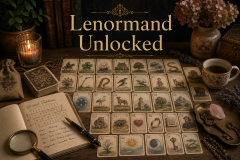
Lenormand is one of the most practical and straightforward divination systems in use today. While many people discover it after learning tarot, Lenormand follows its own unique approach. It uses simple images, direct meanings, and combinations of cards to answer questions about everyday life.
For beginners, Lenormand can feel surprisingly different from other symbolic systems. The cards often seem simple at first glance. A rider. A clover. A dog. A key. A ship. Yet these ordinary images create a remarkably detailed language when read together.
One reason many readers become devoted to Lenormand is its clarity. Rather than focusing primarily on psychological themes or spiritual lessons, Lenormand often describes events, situations, people, opportunities, obstacles, and outcomes with impressive specificity.
This beginner Lenormand guide introduces the foundations of the system without overwhelming you with advanced techniques. The goal is to help you understand what Lenormand is, how it works, and how to begin learning its symbolic language.
Whether you are entirely new to divination or coming from tarot, runes, or other symbolic traditions, this guide will help you take your first steps into the world of Lenormand.
This article contains affiliate links.

In This Guide
- What Lenormand is
- The history of Lenormand
- The structure of the deck
- How Lenormand differs from other systems
- Why card combinations matter
- Choosing your first deck
- How beginners can start learning
- Common mistakes new readers make
- Frequently asked questions
What Is Lenormand?
Lenormand is a card system that uses thirty-six symbolic images to answer questions and describe situations.
Unlike tarot, which often emphasizes archetypes, psychology, and spiritual themes, Lenormand tends to focus on practical realities.
The cards describe:
- People
- Events
- Opportunities
- Challenges
- Relationships
- Communication
- Travel
- Work
- Finances
- Everyday life
Each card has a relatively stable core meaning.
The real power of Lenormand emerges when cards combine into phrases and sentences.
Many readers describe Lenormand as a symbolic language rather than a collection of individual card meanings.
Who Was Mademoiselle Lenormand?
The deck takes its name from Marie Anne Lenormand, a famous French fortune teller who lived during the late eighteenth and early nineteenth centuries.
She gained considerable fame during her lifetime and reportedly read for influential political and social figures.
Interestingly, the modern Lenormand deck was not actually created by her.
The thirty-six-card system emerged after her death and became associated with her name because of her popularity.
Despite this historical detail, the name Lenormand has remained attached to the system ever since.
What Does a Lenormand Deck Contain?
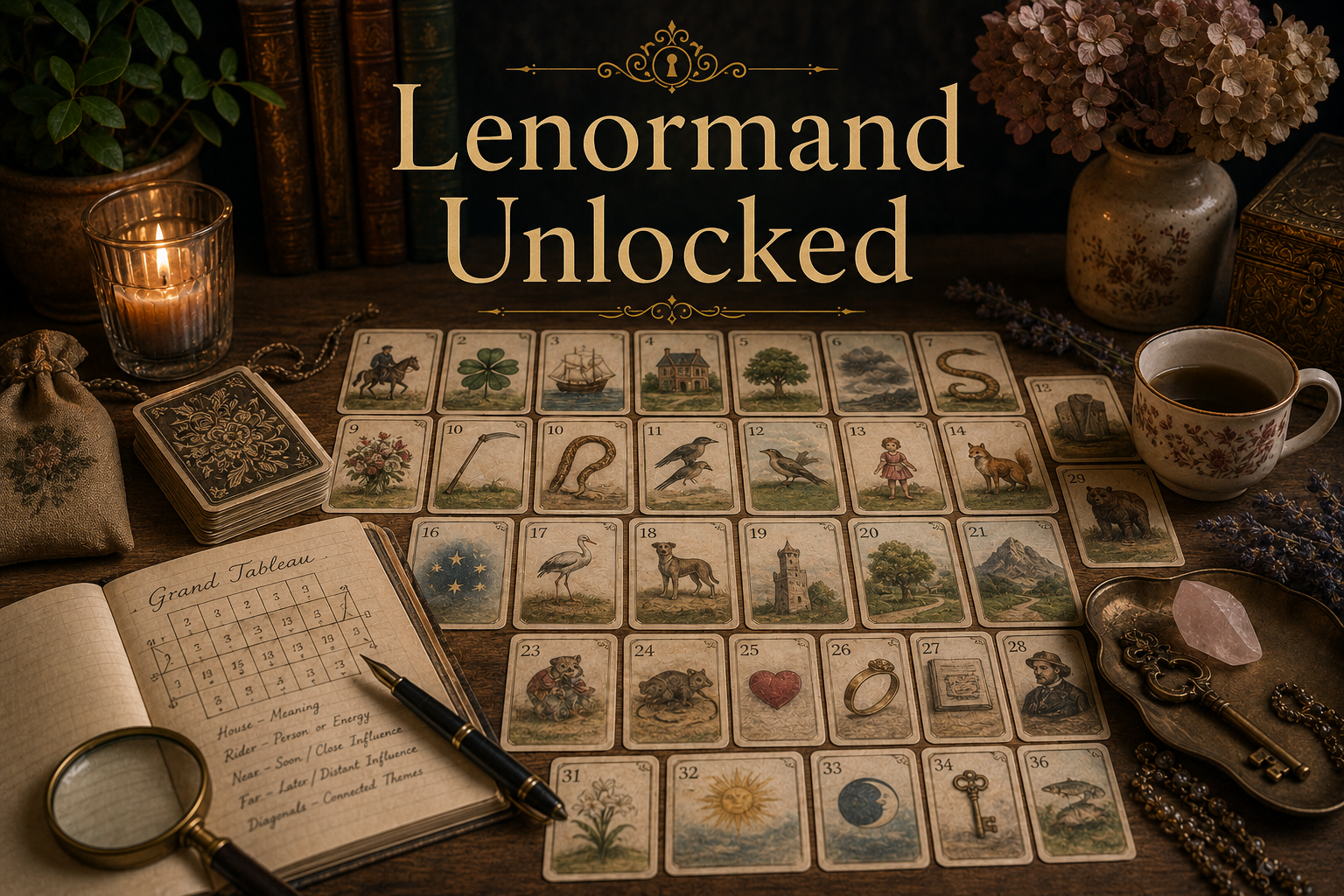
A standard Lenormand deck contains thirty-six cards.
Some of the most well-known cards include:
- Rider
- Clover
- Ship
- House
- Tree
- Dog
- Tower
- Garden
- Key
- Sun
- Moon
- Cross
Unlike tarot, there are no Major Arcana or Minor Arcana.
Every card plays an equal role within the system.
This simplicity makes Lenormand easier to learn structurally, although mastering card combinations takes practice.
Why Are the Images So Simple?
One of the first things beginners notice is the straightforward artwork.
A Lenormand card typically features a single image.
For example:
The Dog shows a dog.
The Ship shows a ship.
The Key shows a key.
The Garden shows a garden.
These simple images are intentional.
Lenormand relies on direct symbolism.
The images act as symbolic building blocks that combine to create larger meanings.
Because the symbols are relatively clear, the system often produces practical and concise readings.
Explore Our Courses



















Lenormand as a Language
Many experienced readers describe Lenormand as learning a new language.
Each card functions like a word.
When cards appear together, they create phrases.
For example:
- Dog + Book
- Rider + Letter
- Sun + Key
The meaning emerges through the interaction of the cards.
This characteristic makes Lenormand very different from systems that focus heavily on individual card interpretation.
Learning the language of combinations becomes one of the most important skills in Lenormand practice.
Why People Love Lenormand
Many readers appreciate Lenormand because of its practical nature.
The cards often provide clear descriptions rather than abstract concepts.
Questions about:
- Work
- Relationships
- Communication
- Travel
- Family
- Daily life
often fit naturally within the system.
Readers frequently describe Lenormand as direct, efficient, and surprisingly detailed.
This does not mean the cards lack depth.
Rather, the depth often emerges through precision rather than complexity.
How Lenormand Differs from Tarot
Because many beginners arrive from tarot, comparisons naturally arise.
Tarot often explores:
- Archetypes
- Inner development
- Spiritual lessons
- Psychological themes
Lenormand often focuses on:
- Situations
- Events
- Circumstances
- Practical outcomes
Neither system is better.
They simply emphasize different things.
Readers interested in tarot may enjoy:
A future article in this series will explore these differences in much greater detail.
Symbolism in Lenormand
Although Lenormand is direct, it remains a symbolic system.
The cards communicate through images.
Understanding symbolism helps readers interpret the cards more effectively.
For example:
The Anchor may suggest stability.
The Ship may suggest movement.
The Key may suggest importance or access.
The Garden may suggest public life or community.
Readers interested in the broader study of symbols may enjoy:
What Is Symbolism? A Beginner’s Introduction
A solid understanding of symbolism strengthens every aspect of Lenormand practice.
Why Context Matters
A common beginner mistake involves treating card meanings as fixed definitions.
In reality, context matters.
Consider the Snake.
Depending on surrounding cards, it might suggest:
- Complication
- Deception
- A difficult person
- A winding path
- Strategy
The neighboring cards help determine how the symbol functions.
This emphasis on context makes Lenormand both challenging and rewarding.
The Importance of Card Combinations
Many newcomers try to memorize all thirty-six cards individually.
While helpful, this only takes you part of the way.
The real skill lies in combining cards.
For example:
House + Tree
Book + Key
Sun + Rider
Each combination creates a different message.
Learning to read pairs is one of the most important steps in becoming comfortable with Lenormand.
Future articles will explore this process extensively.
Choosing Your First Lenormand Deck
The best beginner deck is usually one with clear imagery.
Avoid highly artistic or heavily modified decks at first.
Simple images help reinforce the symbolic language.
Many readers recommend traditional-style decks because they make learning easier.
Once you understand the system, exploring alternative artwork becomes much easier.
Do You Need Psychic Abilities?
No.
This question appears frequently among beginners.
Lenormand can be approached in many ways.
Some readers incorporate intuition heavily.
Others focus primarily on symbolism and structure.
Most combine both approaches.
The important point is that you do not need special abilities to begin learning.
Observation, practice, and familiarity with the cards matter far more than claims of psychic gifts.
How Beginners Can Start Learning
The most effective approach is gradual.
Start by becoming familiar with a few cards at a time.
Notice:
- The image
- The core meaning
- Common associations
- Possible interpretations
Then begin practicing simple combinations.
The goal is not memorization alone.
The goal is understanding how the symbolic language functions.
A Simple Daily Practice
One effective exercise involves drawing two cards each day.
Ask yourself:
How might these cards relate to one another?
What phrase could they create?
What situation might they describe?
This simple habit helps develop combination skills naturally.
Over time, reading card pairs becomes more intuitive.
Common Mistakes Beginners Make
Memorizing Without Practicing
Knowledge of individual meanings matters.
Practical reading matters more.
Ignoring Context
Cards rarely exist in isolation.
The surrounding cards influence interpretation.
Comparing Everything to Tarot
Lenormand works differently.
Allow it to be its own system.
Looking for One Perfect Meaning
Most cards possess a range of possible interpretations.
Context determines which meaning fits best.
Moving Too Quickly
Learning combinations takes time.
Patience produces better results than rushing.
Lenormand and Other Symbolic Systems
Many people who enjoy Lenormand also study:
- Tarot
- Runes
- Dream symbolism
- Mythology
- Alchemy
Each system explores meaning through symbols.
Readers interested in related symbolic traditions may enjoy:
and
How to Start Reading Dream Symbols
Although these systems differ significantly, they all encourage careful observation and symbolic thinking.
Why Lenormand Continues to Grow in Popularity
Over the past two decades, interest in Lenormand has grown dramatically.
Many readers appreciate its:
- Directness
- Practical focus
- Structured approach
- Precision
In an era filled with information, people often value systems that communicate clearly.
Lenormand offers exactly that.
Its symbols remain simple.
Its language remains elegant.
And its readings often feel surprisingly specific.
Learning More About Lenormand
Readers interested in studying Lenormand further may find valuable resources through Udemy and Lenormand Reader.
Frequently Asked Questions
What is Lenormand?
Lenormand is a thirty-six-card divination system that uses symbolic images and card combinations to describe situations, people, and events.
Is Lenormand the same as tarot?
No. Although both use cards, Lenormand and tarot function differently and emphasize different types of interpretation.
Is Lenormand easier than tarot?
The structure is simpler, but reading combinations effectively requires practice.
Do I need intuition to read Lenormand?
No. Many readers rely heavily on symbolism, structure, and observation.
How many cards are in a Lenormand deck?
A traditional Lenormand deck contains thirty-six cards.
What is the best way to learn Lenormand?
Begin with the individual cards, then focus on reading pairs and combinations.
Can I read Lenormand for myself?
Yes. Many people use Lenormand for personal reflection and practical guidance.
Final Thoughts
Lenormand offers a unique and elegant approach to symbolic reading.
Its thirty-six simple images combine into a rich language capable of describing people, situations, opportunities, and challenges with remarkable clarity.
The most important lesson for beginners is this:
Do not think of Lenormand as thirty-six separate meanings.
Think of it as a language.
The cards speak through combinations, context, and relationships.
As you spend time with the deck, the symbols begin connecting naturally. Patterns emerge. The language becomes familiar. What initially appears simple gradually reveals surprising depth.
That journey begins with a single card, a little curiosity, and a willingness to learn one symbol at a time.