Author: roseandrune

  • The Fool Tarot Meaning

    The Fool Tarot Meaning

    The Fool stands at the threshold of the tarot.

    He appears before kings and queens, before triumph and tragedy, before wisdom and folly. Numbered zero in most modern decks, The Fool exists both outside and within the sequence of the Major Arcana. He belongs everywhere and nowhere. He is the beginning of the journey, yet he may also represent its completion.

    No card better captures the paradoxical nature of tarot itself.

    At first glance, The Fool appears simple. A carefree traveler walks toward the edge of a cliff with a small bundle slung over his shoulder. A white dog leaps beside him. The sun shines overhead. Many beginners interpret the card as innocence, spontaneity, or new beginnings.

    Yet centuries of symbolism lie beneath that image.

    The Fool Tarot Meaning Beyond New Beginnings

    The Fool has been interpreted as the sacred madman, the divine child, the wandering pilgrim, the alchemical seeker, the spiritual initiate, the archetypal hero, and even the soul itself. Tarot scholars such as Rachel Pollack, Mary K. Greer, Benebell Wen, Robert M. Place, and Lon Milo DuQuette have each explored different dimensions of this deceptively simple card.

    In many ways, understanding The Fool tarot meaning requires understanding the entire tarot deck.

    The Fool embodies possibility before form. He represents the moment before certainty. He is openness itself.

    This article explores The Fool through historical, symbolic, mythological, psychological, archetypal, esoteric, alchemical, and Christian Hermetic lenses. Rather than reducing the card to a collection of keywords, we will examine why The Fool continues to fascinate tarot readers, mystics, psychologists, artists, and spiritual seekers alike.

    This article contains affiliate links.

    The Fool

    In This Guide

    • Card Overview
    • Historical Origins of The Fool
    • Rider-Waite-Smith Symbolism
    • Thoth Tarot Symbolism
    • Archetypal Meaning
    • Mythological Connections
    • Alchemical Symbolism
    • Christian Hermetic Reflections
    • Tree of Life and Hebrew Letter
    • Astrological Correspondences
    • Chakra Correspondence
    • Upright Meaning
    • Reversed Meaning
    • Reflection Questions
    • Meditation Exercise
    • Related Cards
    • Frequently Asked Questions
    • Further Reading

    Card Overview

    Traditional Number: 0

    Suit: Major Arcana

    Element: Air

    Planet: Uranus (modern occult attribution)

    Zodiac Sign: Traditionally none; often associated with Uranus and Aquarius

    Hebrew Letter: Aleph (א)

    Tree of Life Path: Path 11, connecting Kether and Chokmah

    Chakra Correspondence: Often associated with the Crown Chakra, though some systems place it in relation to the higher spiritual centers as a whole

    Golden Dawn Attribution: Aleph, Air

    Thoth Correspondence: Aleph, Air

    Core Themes:

    • Beginnings
    • Freedom
    • Potential
    • Innocence
    • Openness
    • Adventure
    • Faith
    • Risk
    • Spiritual emergence
    • The unknown

    Unlike many cards that describe specific situations, The Fool often represents a state of being. It describes a relationship to life itself.

    Rachel Pollack observes that The Fool represents unlimited potential before experience shapes identity (Pollack 11). In this sense, The Fool is not merely a traveler beginning a journey. He is possibility itself.

    Historical Origins of the Card

    The Fool in Early Tarot

    The Fool appears in some of the earliest surviving tarot decks from fifteenth-century Italy.

    Unlike many modern interpretations, the original Fool often appeared as a social outsider.

    In the Visconti-Sforza Tarot and related early decks, the figure frequently appears as a wandering beggar, fool, or madman. His clothing is torn. His appearance is disheveled. Sometimes children throw stones at him. In other versions, feathers protrude from his hair, suggesting eccentricity or madness.

    This early Fool reflects medieval attitudes toward both folly and wisdom.

    During the Middle Ages, the fool occupied a curious position within society. He stood outside conventional structures. Because he existed beyond normal expectations, he sometimes spoke truths others could not.

    This tension between foolishness and wisdom would remain central to the card’s evolution.

    The Fool and the Unnumbered Card

    One unusual feature of early tarot is that The Fool often lacked a number.

    While other trumps occupied specific positions, The Fool existed outside the sequence.

    Robert M. Place notes that this unusual status likely contributed to later esoteric interpretations of The Fool as transcendent, unbound, or existing beyond ordinary categories (Place 67).

    The card’s eventual designation as zero emerged much later.

    Zero itself carries symbolic significance.

    It represents emptiness and fullness simultaneously.

    It is nothing and everything.

    The mathematical symbolism of zero aligns remarkably well with later mystical interpretations of The Fool.

    The Fool and the Journey of the Major Arcana

    By the eighteenth and nineteenth centuries, occult writers began viewing the Major Arcana as a spiritual sequence.

    The Fool gradually transformed from a wandering social outcast into the protagonist of a symbolic journey.

    This interpretation reached its fullest expression in twentieth-century tarot scholarship.

    Many modern readers understand the Major Arcana as depicting stages of human development.

    The Fool becomes the traveler who encounters every archetype and challenge represented by the remaining cards.

    Though not strictly historical, this framework profoundly influenced contemporary tarot study.

    The Rider-Waite-Smith Transformation

    The publication of the Rider-Waite-Smith deck in 1909 dramatically reshaped The Fool.

    Arthur Edward Waite and Pamela Colman Smith transformed the card’s visual language.

    Gone was the ragged madman of earlier decks.

    In his place stood a youthful traveler bathed in sunlight.

    The figure appears optimistic, confident, and strangely serene.

    Waite described The Fool as representing the spirit seeking experience rather than mere foolishness (Waite 79).

    This shift altered how generations of readers understood the card.

    The Fool became less about social marginalization and more about spiritual possibility.

    The Influence of the Golden Dawn

    Much of the modern understanding of The Fool stems from teachings associated with the Hermetic Order of the Golden Dawn.

    The Golden Dawn connected The Fool with:

    • The Hebrew letter Aleph
    • The element Air
    • The beginning of spiritual manifestation
    • The path between Kether and Chokmah on the Tree of Life

    These associations continue to shape contemporary tarot interpretations.

    Benebell Wen notes that many modern correspondences commonly treated as ancient actually derive from Golden Dawn synthesis and nineteenth-century occult scholarship rather than medieval tarot traditions (Wen 220).

    Understanding this distinction helps readers appreciate both the historical and esoteric dimensions of the card.

    Explore Our Courses
    ChatGPT Image Jun 26, 2026, 04_57_25 PM
    PlayPause
    ChatGPT Image Jun 26, 2026, 04_57_25 PM
    image-slider-with-thumbnail1.jpeg
    image-slider-with-thumbnail2.jpeg
    ChatGPT Image Jun 26, 2026, 05_01_22 PM
    image-slider-with-thumbnail3.jpeg
    image-slider-with-thumbnail4.jpeg
    ChatGPT Image Jun 26, 2026, 04_51_54 PM
    image-slider-with-thumbnail5.jpeg
    image-slider-with-thumbnail6.jpeg
    ChatGPT Image Jun 27, 2026, 09_24_15 AM
    image-slider-with-thumbnail7.jpeg
    ChatGPT Image Jun 26, 2026, 04_54_23 PM
    ChatGPT Image Jun 26, 2026, 04_19_39 PM
    ChatGPT Image Jun 26, 2026, 04_28_19 PM
    ChatGPT Image Jun 26, 2026, 04_37_00 PM
    ChatGPT Image Jun 26, 2026, 05_04_59 PM
    ChatGPT Image Jun 26, 2026, 04_38_53 PM
    ChatGPT Image Jun 27, 2026, 09_13_22 AM
    ChatGPT Image Jun 26, 2026, 04_41_25 PM
    ChatGPT Image Jun 26, 2026, 04_44_22 PM
    ChatGPT Image Jun 30, 2026, 10_56_33 AM
    previous arrow
    next arrow

    Rider-Waite-Smith Symbolism

    Few tarot images contain as much symbolic density as Pamela Colman Smith’s Fool.

    Every element contributes to a carefully constructed symbolic narrative.

    The Youthful Traveler

    The central figure appears young.

    His face turns upward toward the sky rather than downward toward the path.

    This posture suggests trust, wonder, and openness.

    Unlike the cautious figures found elsewhere in the tarot, The Fool embraces uncertainty.

    Waite described him as representing the spirit in search of experience.

    The upward gaze reinforces this interpretation.

    The Fool focuses on possibility rather than danger.

    The White Sun

    The bright sun dominates the upper corner of the card.

    In many spiritual traditions, sunlight symbolizes consciousness, illumination, divine presence, and truth.

    The Fool begins his journey under full illumination.

    This detail challenges simplistic interpretations that portray him as ignorant.

    The Fool may lack experience, but he does not lack awareness.

    Pollack argues that The Fool’s innocence differs fundamentally from ignorance. Innocence remains open to experience rather than limited by assumptions (Pollack 13).

    The White Rose

    The Fool holds a white rose in his left hand.

    The rose carries rich symbolic meanings.

    White traditionally signifies purity, innocence, and spiritual aspiration.

    The rose itself often represents unfolding consciousness.

    Christian symbolism frequently associates the rose with divine love and spiritual beauty.

    Alchemical traditions connect the rose with transformation and spiritual flowering.

    In the context of The Fool, the white rose suggests pure intention.

    The traveler carries openness rather than fear.

    The Small Bundle

    The Fool carries a small bundle suspended from a staff.

    The bundle suggests that he possesses little.

    Unlike many figures in the tarot, he does not burden himself with possessions.

    Symbolically, the bundle may represent latent potential.

    Everything necessary for the journey exists within it, yet its contents remain hidden.

    Greer observes that The Fool often embodies trust in the process itself rather than reliance on accumulated knowledge or resources (Greer, 21 Ways to Read a Tarot Card 74).

    The White Dog

    Perhaps no element of the card generates more discussion than the small white dog.

    Interpretations vary widely.

    The dog may represent:

    • Instinct
    • Loyalty
    • Protection
    • Intuition
    • The animal soul

    Some readers see the dog warning The Fool of danger.

    Others see it encouraging him forward.

    Pollack suggests that the dog represents the instinctual energies accompanying the conscious self on its journey (Pollack 15).

    Whatever interpretation one adopts, the dog functions as a companion.

    The Fool does not travel alone.

    The Cliff Edge

    The cliff creates much of the card’s dramatic tension.

    The Fool approaches the edge without apparent concern.

    This image often leads beginners to interpret the card as recklessness.

    Yet the symbolism proves more subtle.

    The cliff represents uncertainty.

    Every meaningful journey requires stepping beyond familiar ground.

    The Fool cannot remain permanently within the safety of the known world.

    Growth requires risk.

    This theme connects The Fool to mythological initiation stories, spiritual pilgrimages, and psychological development.

    The Mountains

    Snow-covered mountains rise in the distance.

    Throughout spiritual literature, mountains symbolize transcendence, aspiration, and spiritual attainment.

    The mountains indicate where the journey may ultimately lead.

    Yet they remain far away.

    The Fool stands at the beginning.

    The destination remains unknown.

    This tension between potential and realization forms one of the card’s central themes.

    The Colors

    Pamela Colman Smith employed color with remarkable intentionality.

    White dominates several symbolic elements:

    • The sun
    • The rose
    • The dog’s fur
    • Portions of The Fool’s clothing

    White traditionally signifies purity, spirit, and openness.

    Yellow appears prominently as well.

    Yellow often symbolizes consciousness, illumination, intellect, and vitality.

    Together these colors reinforce themes of awakening and possibility.

    Numerology and Zero

    The number zero distinguishes The Fool from every other card in the Major Arcana.

    Zero represents:

    • Potential
    • Emptiness
    • Infinity
    • Beginning
    • Completion

    Unlike one, which marks the start of manifestation, zero exists before form emerges.

    The Fool therefore represents a state prior to differentiation.

    He contains every possibility because no single path has yet been chosen.

    This symbolic richness explains why The Fool continues to occupy such a central place in esoteric tarot traditions.

    The journey begins not with certainty, but with openness.

    And that openness remains one of The Fool’s greatest gifts.

    Thoth Tarot Symbolism

    While the Rider-Waite-Smith Fool emphasizes innocence and spiritual openness, Aleister Crowley’s Thoth Fool expands the card into a vast symbolic universe. Many tarot scholars regard the Thoth Fool as one of the most complex images in the entire deck.

    Crowley considered The Fool the most important card of the Major Arcana. In The Book of Thoth, he describes the card as representing pure potential, creative energy, divine madness, and the primal force from which all manifestation emerges (Crowley 45).

    Where the Rider-Waite-Smith Fool stands at the edge of a cliff, the Thoth Fool appears immersed within a whirlwind of creation itself.

    The Green Figure

    The Fool in the Thoth deck appears surrounded by vibrant green.

    Green traditionally symbolizes life, fertility, growth, and emergence.

    This color reflects the card’s association with unlimited creative potential.

    Rather than emphasizing a single beginning, Crowley presents The Fool as the living force behind all beginnings.

    The Crocodile

    One of the most striking additions is the crocodile near the Fool’s feet.

    Crowley associates the crocodile with ancient creative forces and primordial life.

    The image suggests energies emerging from the unconscious depths of existence.

    In psychological terms, the crocodile may represent instinctual forces that precede conscious awareness.

    In mythological terms, it evokes the ancient waters from which creation emerges.

    The Tiger

    A tiger tears at the Fool’s clothing.

    Rather than indicating danger, Crowley viewed the tiger as representing powerful life force.

    The image emphasizes that creation involves both beauty and wildness.

    Life cannot emerge without energy.

    The Fool carries this energy within him.

    Dionysian Imagery

    Crowley’s Fool contains numerous references to Dionysus, the Greek god associated with ecstasy, liberation, creativity, and divine madness.

    This connection highlights an important distinction between ordinary foolishness and sacred folly.

    The Fool transcends social convention.

    He follows a deeper rhythm.

    This theme appears repeatedly throughout mystical traditions.

    The Butterfly

    The butterfly floating near the Fool symbolizes transformation and rebirth.

    Its inclusion reinforces the card’s connection to becoming.

    The Fool is never static.

    He is always changing.

    The butterfly suggests that transformation remains one of the card’s central themes.

    Aleph and Air

    Like the Golden Dawn tradition from which many of its correspondences derive, the Thoth deck associates The Fool with:

    • The Hebrew letter Aleph
    • The element Air

    Crowley considered Air the most appropriate element because it permeates everything while remaining invisible.

    Air moves freely.

    It cannot be grasped or confined.

    The Fool shares these qualities.

    Lon Milo DuQuette’s Interpretation

    Lon Milo DuQuette frequently emphasizes that The Fool represents unlimited possibility rather than naïve ignorance.

    According to DuQuette, The Fool symbolizes consciousness before limitation.

    Before identities form.

    Before roles emerge.

    And before experience creates boundaries.

    This interpretation aligns closely with Crowley’s vision of the card as pure potential.

    The Thoth Fool therefore deepens many of the themes already present within the Rider-Waite-Smith tradition.

    Both images explore beginnings.

    The Thoth version simply pushes those beginnings into cosmic dimensions.

    The Card’s Archetypal Meaning

    Few tarot cards correspond more closely to Jungian archetypal patterns than The Fool.

    The card functions as an archetype of emergence.

    It represents the individual standing at the threshold of transformation.

    The Divine Child

    One of the most important archetypal expressions of The Fool is the Divine Child.

    Carl Jung identified the child archetype as a symbol of future possibility.

    The child represents what is not yet fully developed.

    It points toward growth, becoming, and unrealized potential.

    The Fool shares these qualities.

    He has not yet become anything specific.

    Because of this, he may become many things.

    The card reminds readers that possibility often appears before competence.

    Every expert was once a beginner.

    Every journey begins before mastery exists.

    The Sacred Fool

    The Fool also reflects a much older archetype.

    Across cultures, sacred fools appear as figures who seem foolish on the surface yet possess hidden wisdom.

    Examples include:

    • Court jesters
    • Holy fools
    • Zen masters
    • Trickster figures
    • Mystical wanderers

    Such figures challenge assumptions.

    They expose rigid thinking.

    They reveal truths others overlook.

    Rachel Pollack frequently highlights this paradoxical dimension of The Fool. The card embodies freedom from social expectations and conventional limitations (Pollack 18).

    The Hero Before the Journey

    Joseph Campbell’s work on mythological hero journeys offers another useful perspective.

    Before the hero slays dragons or discovers wisdom, he stands at the threshold.

    He receives the call to adventure.

    This moment corresponds closely to The Fool.

    The Fool has not yet faced challenges.

    The story has not yet unfolded.

    Yet the potential for transformation already exists.

    In many ways, The Fool is the hero before the first chapter begins.

    Shadow Expressions of The Fool

    Every archetype contains shadow possibilities.

    The Fool’s shadow may appear as:

    • Recklessness
    • Irresponsibility
    • Escapism
    • Immaturity
    • Refusal to learn from experience

    In shadow form, openness becomes carelessness.

    Freedom becomes avoidance.

    Optimism becomes denial.

    The card reminds readers that growth requires balancing spontaneity with awareness.

    Mature Expressions of The Fool

    At its highest expression, The Fool represents:

    • Trust
    • Courage
    • Authenticity
    • Openness
    • Curiosity
    • Spiritual receptivity

    The mature Fool remains willing to encounter life directly.

    He does not cling rigidly to certainty.

    He remains teachable.

    This quality often distinguishes wisdom from mere knowledge.

    Mythological Connections

    The Fool appears throughout world mythology in countless forms.

    The card does not correspond to one specific mythological figure.

    Instead, it reflects recurring mythic patterns.

    Greek Mythology

    In Greek mythology, The Fool shares qualities with both Dionysus and Hermes.

    Dionysus represents ecstatic liberation, creativity, and transcendence of social convention.

    Like The Fool, he disrupts ordinary expectations.

    Hermes serves as messenger, traveler, guide, and boundary-crosser.

    He moves freely between worlds.

    Like The Fool, Hermes inhabits liminal spaces.

    Neither fully belongs to one realm.

    Egyptian Mythology

    The Fool also resonates with aspects of Horus and the solar child.

    In Egyptian symbolism, divine children often represent emerging consciousness and spiritual renewal.

    The Fool similarly represents awakening potential.

    The journey has begun, but its outcome remains unwritten.

    Norse Mythology

    In Norse traditions, The Fool shares characteristics with Odin’s quest for wisdom.

    Although Odin ultimately becomes associated with profound knowledge, his journey requires risk.

    He sacrifices certainty.

    He embraces the unknown.

    The Fool likewise steps forward without guarantees.

    Wisdom emerges through experience.

    Biblical Symbolism

    Biblical literature presents an interesting tension regarding foolishness.

    The Book of Proverbs frequently warns against folly.

    Yet other passages challenge conventional definitions of wisdom.

    Paul writes of the “foolishness” of divine wisdom appearing foolish to worldly understanding.

    This paradox resembles The Fool’s symbolic role.

    The card invites readers to consider whether apparent foolishness sometimes conceals deeper insight.

    The Wandering Pilgrim

    Across countless traditions, the pilgrim serves as another expression of The Fool.

    The pilgrim leaves familiar surroundings.

    He travels without complete knowledge of what lies ahead.

    Faith becomes necessary.

    The Fool embodies this archetypal journey.

    Alchemical Symbolism

    Although many readers associate alchemy with cards such as Temperance or Death, The Fool contains important alchemical themes as well.

    Prima Materia

    Alchemists frequently described a mysterious original substance called the prima materia.

    Everything begins here.

    Before transformation occurs, the raw material must exist.

    The Fool resembles this stage.

    He represents undifferentiated possibility.

    Nothing has yet been refined.

    Nothing has yet been fixed.

    Yet everything necessary already exists in potential form.

    The Beginning of the Great Work

    The Fool corresponds to the earliest stages of the Great Work.

    Before purification.

    Before integration.

    And before illumination.

    The seeker must begin.

    This simple act often proves the most difficult.

    Many spiritual traditions emphasize that the first step requires courage.

    The Fool embodies that courage.

    Adam McLean and Spiritual Transformation

    Adam McLean frequently emphasizes that alchemy functions not merely as chemistry but as a symbolic language of transformation.

    Through this lens, The Fool becomes the soul before its transformative journey begins.

    The card represents openness to change.

    Without openness, transformation cannot occur.

    The Alchemy of Possibility

    One of the most important lessons of alchemy involves learning to work with uncertainty.

    The Fool teaches a similar lesson.

    He cannot know exactly what lies ahead.

    Yet he proceeds.

    The card reminds readers that transformation always begins before outcomes become visible.

    Christian Hermetic Reflections

    No work has influenced Christian Hermetic tarot interpretation more profoundly than Meditations on the Tarot: A Journey into Christian Hermeticism.

    Holy Folly

    The author describes a form of wisdom that transcends intellectual pride.

    The Fool becomes a symbol of spiritual humility.

    He does not claim mastery.

    He remains open to learning.

    Christian mystical traditions frequently emphasize this quality.

    True wisdom often begins with recognizing one’s limitations.

    The Poverty of Spirit

    The Fool’s minimal possessions evoke spiritual poverty in the positive sense described by many contemplative traditions.

    He carries little because he depends upon something greater than accumulated certainty.

    This theme appears throughout Christian mysticism.

    The seeker must sometimes release attachments in order to receive deeper insight.

    Faith and the Unknown

    The Fool steps forward without guarantees.

    This act resembles faith.

    Not blind belief, but willingness to proceed despite uncertainty.

    Christian Hermetic thinkers often emphasize that spiritual growth requires trust.

    The Fool embodies this principle beautifully.

    The Beginning of the Spiritual Journey

    In Christian Hermetic interpretation, The Fool often represents the soul standing at the beginning of its pilgrimage toward divine wisdom.

    The card invites humility, openness, and wonder.

    Rather than demanding answers, it encourages receptivity.

    The Fool as Openness to Grace

    Perhaps the deepest Christian Hermetic interpretation sees The Fool as a symbol of openness itself.

    Grace cannot enter a closed system.

    Transformation requires receptivity.

    The Fool remains receptive.

    His innocence is not ignorance.

    It is availability.

    And availability may be one of the card’s greatest spiritual teachings.

    The Tree of Life and Hebrew Letter

    The esoteric traditions of the Golden Dawn associate The Fool with the Hebrew letter Aleph and the path connecting Kether and Chokmah on the Tree of Life.

    The Tree of Life and Hebrew Letter

    Among the many esoteric correspondences associated with The Fool, few have influenced modern tarot interpretation as profoundly as its connection to the Hebrew letter Aleph and the Tree of Life.

    These associations emerged primarily through the work of nineteenth-century occultists, particularly the Hermetic Order of the Golden Dawn. While they do not originate in medieval tarot, they have become central to many contemporary esoteric interpretations.

    Aleph: The First Letter

    The Fool corresponds to the Hebrew letter Aleph (א).

    Aleph occupies a unique place within the Hebrew alphabet.

    It is the first letter, yet traditionally it carries no inherent sound of its own. Instead, it functions as a silent breath, a vessel through which sound emerges.

    This symbolism aligns remarkably well with The Fool.

    The Fool represents beginnings.

    Not a beginning that has already taken shape, but a beginning before form appears.

    Aleph symbolizes potential.

    The Fool symbolizes possibility.

    Both stand at the threshold of manifestation.

    Aleph and the Ox

    Ancient forms of Aleph resembled an ox head.

    The ox symbolized strength, vitality, endurance, and primal life force.

    This image adds another layer to The Fool’s meaning.

    Beneath the card’s apparent innocence lies tremendous creative power.

    The Fool may appear carefree, but he carries the energy necessary to begin the entire journey of the Major Arcana.

    Path Eleven on the Tree of Life

    In Golden Dawn Qabalah, The Fool occupies Path Eleven.

    This path connects:

    • Kether (The Crown)
    • Chokmah (Wisdom)

    Kether represents pure divine unity.

    Chokmah represents the first dynamic expression of creative wisdom.

    The Fool therefore occupies the bridge between pure potential and active creation.

    This placement reinforces one of the card’s most important themes.

    The Fool exists before differentiation.

    He stands at the point where possibility first begins moving toward manifestation.

    Why This Path Matters

    The placement between Kether and Chokmah suggests that The Fool is not merely a beginner.

    He represents the very principle of emergence.

    Every creative act begins here.

    Every spiritual journey begins here.

    And every transformation begins here.

    The Fool symbolizes the mysterious moment when possibility becomes movement.

    The Spiritual Dimension of Aleph

    Many esoteric writers emphasize that Aleph represents breath.

    Breath appears in numerous spiritual traditions as a symbol of life itself.

    The first breath.

    The breath of creation.

    The breath of inspiration.

    The Fool embodies this living openness.

    He is the breath before speech.

    The step before the path.

    The possibility before the choice.

    Astrological Correspondences

    Unlike many Major Arcana cards, The Fool does not correspond neatly to a zodiac sign.

    Instead, most modern occult systems associate The Fool with the element Air.

    Some contemporary writers also connect the card with Uranus.

    The Element of Air

    The Golden Dawn assigned Air to The Fool.

    This attribution initially surprises many readers.

    The Fool often appears passionate and adventurous, qualities frequently associated with Fire.

    Yet Air offers a deeper symbolic fit.

    Air is:

    • Invisible
    • Mobile
    • Unrestricted
    • Ever-changing

    Like the wind, The Fool cannot be confined.

    He moves freely.

    He follows possibility rather than certainty.

    Air also governs:

    • Thought
    • Inspiration
    • Imagination
    • Communication
    • New ideas

    The Fool often appears whenever fresh perspectives emerge.

    Uranus and Innovation

    Modern astrology frequently associates The Fool with Uranus.

    Although Uranus does not appear within traditional Golden Dawn correspondences, the connection has become popular.

    Uranus represents:

    • Innovation
    • Freedom
    • Individuality
    • Sudden change
    • Breakthroughs

    These themes align naturally with The Fool’s willingness to depart from established paths.

    Connections with Aquarius

    Some contemporary readers also associate The Fool with Aquarius because of Uranus’s modern rulership of that sign.

    While this connection remains secondary to the card’s elemental attribution, it highlights themes of originality, independence, and unconventional thinking.

    The Astrological Lesson

    From an astrological perspective, The Fool reminds us that growth often begins when we allow ourselves to move beyond familiar patterns.

    The card encourages intellectual flexibility and openness to possibility.

    Chakra Correspondence

    Unlike astrological and Qabalistic correspondences, chakra associations vary considerably among modern tarot systems.

    Several interpretations exist.

    Crown Chakra

    The most common correspondence links The Fool with the Crown Chakra.

    Located at the top of the head, the Crown Chakra relates to:

    • Spiritual awareness
    • Unity
    • Transcendence
    • Connection to the divine
    • Expanded consciousness

    This association fits The Fool’s position between Kether and Chokmah.

    The card points toward limitless possibility and spiritual openness.

    Psychological Significance

    Psychologically, the Crown Chakra represents the ability to remain open to experiences beyond ordinary assumptions.

    The Fool demonstrates this quality beautifully.

    He approaches life without excessive cynicism.

    He remains available to wonder.

    Spiritual Significance

    Spiritually, The Fool invites trust.

    Not blind trust.

    Rather, a willingness to participate in life without demanding complete certainty beforehand.

    This openness lies at the heart of many contemplative traditions.

    Energy and Movement

    The Fool’s energy remains fluid.

    Unlike cards associated with specific achievements or conclusions, The Fool continually moves.

    His chakra correspondence therefore emphasizes flow rather than fixation.

    Upright Meaning

    Modern tarot books often summarize The Fool with keywords such as “new beginnings” or “adventure.”

    While these descriptions contain truth, they only scratch the surface.

    The Fool’s upright meaning concerns the relationship between possibility and action.

    Personal Growth

    In personal development, The Fool often appears when life invites expansion.

    The card may signal:

    • Learning opportunities
    • New experiences
    • Personal reinvention
    • Emerging identities

    The Fool does not promise success.

    Rather, he encourages participation.

    Growth begins when we step forward.

    Relationships

    In relationships, The Fool may indicate openness and authenticity.

    The card often suggests:

    • Emotional honesty
    • New connections
    • Fresh perspectives
    • Vulnerability

    At its healthiest, The Fool approaches others without excessive defensiveness.

    Career and Vocation

    Professionally, The Fool often appears during periods of transition.

    Its presence may encourage:

    • Exploring new directions
    • Taking creative risks
    • Pursuing meaningful opportunities
    • Learning unfamiliar skills

    The card does not guarantee favorable outcomes.

    It highlights the value of beginning.

    Creativity

    The Fool possesses a deeply creative dimension.

    Artists, writers, musicians, and innovators frequently encounter Fool energy.

    Creative work requires entering uncertain territory.

    Every blank page contains Fool symbolism.

    Every first draft begins with The Fool.

    Spiritual Development

    Spiritually, The Fool represents receptivity.

    The card invites curiosity rather than certainty.

    Many contemplative traditions emphasize beginner’s mind, the capacity to encounter experience without rigid expectations.

    The Fool embodies this attitude.

    Reversed Meaning

    The Fool reversed deserves careful treatment.

    Many readers reduce reversals to negative opposites.

    A more nuanced approach reveals multiple possibilities.

    Fear of Beginning

    Sometimes The Fool reversed indicates hesitation.

    The opportunity exists.

    The path appears.

    Yet movement stalls.

    Fear becomes stronger than curiosity.

    Recklessness

    In other contexts, The Fool reversed suggests imbalance.

    Openness becomes impulsiveness.

    Trust becomes carelessness.

    The card may invite greater discernment.

    Escapism

    The reversed Fool occasionally points toward avoidance.

    Rather than engaging life directly, the individual may retreat into fantasy, distraction, or denial.

    Fragmented Potential

    The Fool contains immense creative energy.

    When reversed, that energy may become scattered.

    Ideas remain unrealized.

    Possibilities never become actions.

    Opportunity for Growth

    Like all reversals, The Fool reversed offers an invitation rather than a condemnation.

    The question becomes:

    What prevents movement?

    Understanding the answer often reveals the next step.

    Practical Reflection Questions

    The following questions work well for journaling, meditation, or contemplative tarot practice.

    • Where am I being invited to begin something new?
    • What risks feel meaningful right now?
    • What assumptions might I need to release?
    • What excites me despite uncertainty?
    • Where has caution become fear?
    • Where has freedom become avoidance?
    • What possibility keeps calling my attention?
    • How do I respond to the unknown?
    • What does trust mean to me?
    • What would I attempt if I knew I could learn along the way?
    • What part of me remains curious?
    • What old identity am I outgrowing?
    • What adventure feels necessary?
    • How can I approach life with greater openness?
    • What wisdom might emerge through experience rather than planning?

    Meditation Exercise

    Find a quiet place where you can sit comfortably.

    Take several slow breaths.

    Imagine yourself standing at the edge of a mountain path.

    The morning sun shines overhead.

    A gentle breeze moves across the landscape.

    You carry only what is necessary.

    Before you stretches a road you have never traveled.

    You cannot see the destination.

    You do not know every challenge.

    And you do not know every reward.

    Yet something within you recognizes that the journey matters.

    Notice what emotions arise.

    Curiosity.

    Excitement.

    Fear.

    Hope.

    Allow them to exist without judgment.

    Now imagine taking a single step forward.

    Not the entire journey.

    Only one step.

    Remain with that image for several minutes.

    When you are ready, open your eyes and record any insights that emerged.

    Related Cards

    The Magician

    The Magician follows The Fool in the Major Arcana sequence.

    If The Fool represents pure potential, The Magician represents directed intention.

    The Fool contains possibility.

    The Magician begins shaping it.

    The World

    Many readers view The Fool and The World as complementary.

    The Fool begins the journey.

    The World completes it.

    Yet completion often leads back to new beginnings.

    This cyclical relationship reflects the card’s association with zero.

    Page Cards

    The Pages of the Minor Arcana often share Fool-like qualities.

    They embody curiosity, learning, and emerging potential.

    The Thoth Princesses

    In the Thoth system, the Princess court cards carry strong Fool energy because they represent beginnings within their respective elements.

    What Modern Readers Can Learn from The Fool

    Modern culture often rewards certainty.

    Expertise.

    Planning.

    Control.

    The Fool reminds us that these qualities, while valuable, cannot replace openness.

    Every meaningful transformation begins before outcomes become clear.

    Every creative act begins with uncertainty.

    And every spiritual journey begins with a question.

    The Fool teaches that wisdom does not always emerge from knowing.

    Sometimes it emerges from being willing to begin.

    This lesson remains as relevant today as it was centuries ago.

    Frequently Asked Questions

    Is The Fool a positive card?

    Generally, yes. However, its positivity lies in possibility rather than guaranteed success.

    Why is The Fool numbered zero?

    Zero symbolizes unlimited potential and existence outside ordinary sequences.

    Is The Fool foolish?

    Not necessarily. The card often represents sacred innocence rather than ignorance.

    Why does The Fool stand near a cliff?

    The cliff symbolizes uncertainty and the risks inherent in growth.

    What does the dog represent?

    Interpretations vary, but common meanings include instinct, intuition, loyalty, and protection.

    Why is The Fool associated with Air?

    Air symbolizes freedom, movement, inspiration, and possibility.

    Is The Fool the beginning or the end of the journey?

    Both. The Fool begins the Major Arcana journey and, symbolically, remains present throughout it.

    What is the spiritual lesson of The Fool?

    To remain open to experience while cultivating trust, curiosity, and courage.

    Does The Fool predict travel?

    Sometimes, but its deeper meaning concerns movement into new experiences rather than literal travel alone.

    What does The Fool teach about growth?

    Growth requires stepping beyond certainty and engaging directly with life.

    Further Reading

    Nichols, Sallie. Jung and Tarot: An Archetypal Journey. Weiser Books, 1980.

    Place, Robert M. The Fool’s Journey: The History, Art, and Symbolism of the Tarot. TarcherPerigee, 2009.

    Huson, Paul. Mystical Origins of the Tarot. Destiny Books, 2004.

    See more recommended tarot books here.

    Final Thoughts

    The Fool remains one of the most beloved and misunderstood cards in tarot.

    At first glance, he appears simple.

    A traveler.

    A dog.

    A cliff.

    A bright sky.

    Yet beneath these images lies a profound meditation on possibility itself.

    The Fool stands before every journey, every transformation, every act of creativity, and every spiritual awakening. He reminds us that certainty is not the prerequisite for growth. Openness is.

    The card invites us to approach life with curiosity rather than cynicism, wonder rather than rigidity, courage rather than paralysis.

    In a world that often demands answers before action, The Fool offers a different wisdom.

    Begin anyway.

    Trust the path enough to take the first step.

    The journey will teach what certainty never can.

    Works Cited

    Crowley, Aleister. The Book of Thoth. Weiser Books, 1984.

    DuQuette, Lon Milo. Understanding Aleister Crowley’s Thoth Tarot. Weiser Books, 2003.

    Greer, Mary K. 21 Ways to Read a Tarot Card. Llewellyn Publications, 2006.

    Greer, Mary K. Tarot for Your Self. New Page Books, 2002.

    McLean, Adam. The Alchemical Mandala. Phanes Press, 1989.

    Place, Robert M. The Tarot: History, Symbolism, and Divination. TarcherPerigee, 2005.

    Pollack, Rachel. Seventy-Eight Degrees of Wisdom: A Book of Tarot. Weiser Books, 1997.

    Tomberg, Valentin. Meditations on the Tarot: A Journey into Christian Hermeticism. TarcherPerigee, 2002.

    Waite, Arthur Edward. The Pictorial Key to the Tarot. Rider, 1910.

    Wen, Benebell. Holistic Tarot: An Integrative Approach to Using Tarot for Personal Growth. North Atlantic Books, 2015.

  • An Introduction to Christian Hermetic Thought

    An Introduction to Christian Hermetic Thought

    Christian Hermeticism occupies a fascinating place at the crossroads of Christianity, philosophy, symbolism, mysticism, and spiritual reflection.

    For some readers, the phrase may sound unfamiliar. For others, it may evoke images of alchemy, hidden wisdom, Renaissance scholars, or esoteric traditions. The reality is both more complex and more interesting than many assume.

    Christian Hermetic thought represents an effort to explore spiritual truths through symbolism, contemplation, philosophy, and the study of sacred patterns. Rather than rejecting Christianity, many Christian Hermetic thinkers sought to deepen their understanding of Christian teachings by engaging with ancient wisdom traditions, symbolic interpretation, and contemplative practices.

    Throughout history, this approach has influenced theologians, philosophers, mystics, artists, alchemists, and spiritual seekers. Its influence can be found in Renaissance scholarship, Western esotericism, symbolic theology, and even modern discussions of archetypes and symbolism.

    This article introduces the foundations of Christian Hermetic thought and explores why it continues to attract interest today.

    Christian Hermetic thought

    In This Guide

    • What Christian Hermetic thought is
    • The origins of Hermeticism
    • Christianity and Hermetic philosophy
    • Renaissance Christian Hermeticism
    • Key themes in Christian Hermetic thought
    • Symbolism and sacred interpretation
    • Alchemy and spiritual transformation
    • Common misconceptions
    • Why Christian Hermetic thought remains relevant
    • Frequently asked questions

    What Is Christian Hermetic Thought?

    Christian Hermetic thought refers to a stream of spiritual and philosophical reflection that combines Christian theology with ideas associated with the Hermetic tradition.

    Rather than viewing faith and wisdom as separate pursuits, Christian Hermetic thinkers often sought harmony between revelation, reason, symbolism, and contemplation.

    Many viewed the created world as filled with signs that point toward deeper spiritual realities.

    They believed that careful reflection on scripture, nature, symbols, and spiritual experience could reveal insights into divine wisdom.

    This approach does not represent a single denomination or unified movement.

    Instead, it encompasses a variety of thinkers, traditions, and perspectives connected by shared interests in symbolism, contemplation, and spiritual understanding.

    What Is Hermeticism?

    To understand Christian Hermetic thought, it helps to understand Hermeticism itself.

    Hermeticism traces its origins to a collection of writings associated with Hermes Trismegistus, a legendary figure who combines elements of the Greek god Hermes and the Egyptian god Thoth.

    The writings attributed to Hermes became known collectively as the Hermetica.

    These texts explore topics such as:

    • Divine wisdom
    • Creation
    • Humanity’s relationship to God
    • Spiritual transformation
    • Knowledge of the self
    • Knowledge of the cosmos

    Although historians now understand these writings to have emerged during the early centuries of the Common Era, they exercised tremendous influence throughout later periods.

    The Renaissance Rediscovery

    Christian Hermetic thought flourished during the Renaissance.

    In 1463, the scholar Marsilio Ficino translated portions of the Corpus Hermeticum into Latin.

    Many Renaissance thinkers believed these texts contained ancient wisdom that predated classical philosophy.

    This belief encouraged scholars to explore possible connections between Hermetic teachings and Christianity.

    Although modern scholarship has revised many historical assumptions about the origins of the Hermetic texts, their influence on Renaissance thought remains undeniable.

    Explore Our Courses
    ChatGPT Image Jun 26, 2026, 04_57_25 PM
    PlayPause
    ChatGPT Image Jun 26, 2026, 04_57_25 PM
    image-slider-with-thumbnail1.jpeg
    image-slider-with-thumbnail2.jpeg
    ChatGPT Image Jun 26, 2026, 05_01_22 PM
    image-slider-with-thumbnail3.jpeg
    image-slider-with-thumbnail4.jpeg
    ChatGPT Image Jun 26, 2026, 04_51_54 PM
    image-slider-with-thumbnail5.jpeg
    image-slider-with-thumbnail6.jpeg
    ChatGPT Image Jun 27, 2026, 09_24_15 AM
    image-slider-with-thumbnail7.jpeg
    ChatGPT Image Jun 26, 2026, 04_54_23 PM
    ChatGPT Image Jun 26, 2026, 04_19_39 PM
    ChatGPT Image Jun 26, 2026, 04_28_19 PM
    ChatGPT Image Jun 26, 2026, 04_37_00 PM
    ChatGPT Image Jun 26, 2026, 05_04_59 PM
    ChatGPT Image Jun 26, 2026, 04_38_53 PM
    ChatGPT Image Jun 27, 2026, 09_13_22 AM
    ChatGPT Image Jun 26, 2026, 04_41_25 PM
    ChatGPT Image Jun 26, 2026, 04_44_22 PM
    ChatGPT Image Jun 30, 2026, 10_56_33 AM
    previous arrow
    next arrow

    Christianity and Hermetic Wisdom

    Christian Hermetic thinkers generally viewed wisdom as something that could be sought through multiple avenues.

    Scripture remained central.

    Yet many believed God also revealed truths through:

    • Nature
    • Symbolism
    • Reason
    • Philosophy
    • Contemplation

    This perspective encouraged the study of symbolic patterns within creation.

    The world itself became a kind of sacred text worthy of reflection.

    Many Christian Hermetic writers saw no contradiction between faith and the pursuit of wisdom.

    Instead, they viewed both as complementary.

    The Importance of Symbolism

    Few themes are more important to Christian Hermetic thought than symbolism.

    Symbols communicate truths that often resist simple explanation.

    A symbol points beyond itself.

    It invites contemplation rather than immediate conclusions.

    Christian Hermetic thinkers frequently interpreted:

    • Biblical imagery
    • Natural phenomena
    • Sacred geometry
    • Numbers
    • Rituals
    • Myths

    through symbolic lenses.

    Readers interested in the broader study of symbols may enjoy:

    What Is Symbolism? A Beginner’s Introduction

    Symbolic interpretation remains one of the defining characteristics of Christian Hermetic thought.

    The World as a Reflection of Divine Order

    A recurring theme within Christian Hermetic writings is the belief that creation reflects divine wisdom.

    This perspective sometimes appears through the phrase “as above, so below,” often associated with Hermetic literature.

    Although interpretations vary, many Christian Hermetic thinkers viewed the visible world as reflecting deeper spiritual realities.

    Nature becomes meaningful.

    Patterns become significant.

    The created order reveals traces of divine intelligence.

    This outlook encourages careful observation and contemplation.

    Christian Hermetic Thought and Alchemy

    One of the most famous areas of overlap involves alchemy.

    Popular culture often reduces alchemy to attempts to turn lead into gold.

    Historical alchemy was far more complex.

    Many alchemists viewed physical processes as symbolic representations of spiritual transformation.

    The purification of metals became a metaphor for the purification of the soul.

    Readers interested in this topic may enjoy:

    What Is Alchemy? Historical and Spiritual Perspectives

    For many Christian Hermetic thinkers, alchemy provided a symbolic language for discussing spiritual growth and renewal.

    The Search for Wisdom

    Wisdom occupies a central place within Christian Hermetic thought.

    The pursuit of wisdom differs from the pursuit of information.

    Information accumulates facts.

    Wisdom seeks understanding.

    Many Christian Hermetic writers emphasized:

    • Self-knowledge
    • Humility
    • Reflection
    • Discernment
    • Spiritual maturity

    These qualities were viewed as essential for genuine spiritual development.

    Contemplation and Inner Transformation

    Christian Hermetic thought often encourages contemplation.

    Contemplation involves attentive reflection rather than constant activity.

    It asks readers to slow down.

    To observe.

    To reflect.

    And to seek deeper understanding.

    This contemplative dimension distinguishes Christian Hermetic thought from purely intellectual approaches.

    Knowledge alone is not enough.

    Transformation matters.

    Christian Hermetic Thought and Archetypes

    Modern readers often notice parallels between Christian Hermetic symbolism and archetypal psychology.

    Carl Jung himself showed considerable interest in alchemy, symbolism, and religious imagery.

    Readers interested in archetypal patterns may enjoy:

    What Is an Archetype? A Jungian Introduction

    Although Jung and Christian Hermetic thinkers approached these subjects differently, both traditions recognize recurring symbolic patterns that appear across human experience.

    Myth, Symbol, and Sacred Narrative

    Christian Hermetic thought frequently engages with mythic and symbolic narratives.

    This does not necessarily mean treating myths as literal history.

    Rather, myths can communicate spiritual truths through symbolic storytelling.

    Readers interested in mythological themes may enjoy:

    Why Mythology Matters

    Many Christian Hermetic thinkers explored how sacred stories reveal deeper patterns of meaning.

    Tarot and Christian Hermetic Thought

    Some modern readers first encounter Christian Hermetic ideas through tarot literature.

    The most famous example is Meditations on the Tarot: A Journey into Christian Hermeticism.

    This influential work uses the Major Arcana as starting points for profound reflections on Christianity, symbolism, philosophy, and spiritual development.

    Readers interested in tarot studies may enjoy:

    Recommended Books for Studying Tarot

    It is important to note that Christian Hermetic thought extends far beyond tarot itself.

    The tarot simply provides one symbolic framework among many.

    Common Misconceptions About Christian Hermetic Thought

    Christian Hermeticism Is a Religion

    Christian Hermetic thought is better understood as a philosophical and spiritual approach rather than a separate religion.

    It Rejects Christianity

    Historically, Christian Hermetic thinkers generally viewed themselves as engaging deeply with Christian ideas rather than rejecting them.

    It Is Primarily About Secret Knowledge

    While wisdom and insight are important themes, Christian Hermetic thought emphasizes spiritual transformation rather than hidden information alone.

    It Is Only About Alchemy

    Alchemy represents one aspect of the tradition, but symbolism, contemplation, theology, philosophy, and spiritual reflection are equally important.

    Why Christian Hermetic Thought Still Matters

    Modern readers continue exploring Christian Hermetic thought for several reasons.

    It offers a framework for integrating:

    • Faith
    • Symbolism
    • Philosophy
    • Contemplation
    • Personal growth

    Many people seek spiritual approaches that encourage both reflection and intellectual engagement.

    Christian Hermetic thought provides one possible path.

    Its emphasis on symbolism, wisdom, and transformation remains relevant in a world often dominated by speed and distraction.

    Learning More About Christian Hermetic Thought

    Readers interested in historical sources can explore the The Internet Sacred Text Archive’s Hermetic Collection and the The Gnostic Society Library’s Hermetic Texts.

    Both collections provide access to important Hermetic writings and historical resources for further study.

    Frequently Asked Questions

    What is Christian Hermetic thought?

    Christian Hermetic thought combines Christian spirituality with Hermetic philosophy, symbolism, contemplation, and the pursuit of wisdom.

    Who was Hermes Trismegistus?

    Hermes Trismegistus is a legendary figure associated with the writings known as the Hermetica.

    Is Christian Hermeticism a denomination?

    No. It is a philosophical and spiritual tradition rather than a church or denomination.

    What role does symbolism play?

    Symbolism plays a central role because it allows spiritual truths to be explored through images, patterns, stories, and metaphors.

    How is alchemy connected to Christian Hermeticism?

    Many Christian Hermetic thinkers interpreted alchemical processes as symbols of spiritual transformation.

    Is Christian Hermetic thought compatible with Christianity?

    Different Christians answer this question differently. Historically, many Christian Hermetic thinkers viewed their work as an extension of Christian reflection.

    Where should beginners start?

    A good starting point is learning about symbolism, Hermetic history, Christian mysticism, and the major themes found within the Hermetic tradition.

    Final Thoughts

    Christian Hermetic thought represents a rich and multifaceted tradition that brings together spirituality, symbolism, contemplation, philosophy, and the search for wisdom.

    Rather than offering simple answers, it encourages deeper questions.

    It invites readers to explore the relationship between visible and invisible realities, between symbols and meaning, between knowledge and transformation.

    Its influence can be seen in alchemy, mysticism, symbolic theology, archetypal thought, and modern spiritual reflection.

    Whether approached historically, philosophically, or spiritually, Christian Hermetic thought offers a fascinating perspective on the human search for wisdom.

    At its heart lies a simple yet profound conviction:

    The world contains meaning, and thoughtful reflection can help us perceive it more clearly.

  • What Are Runes? History, Meaning, and Use

    What Are Runes? History, Meaning, and Use

    Runes have fascinated people for centuries.

    Carved into stone monuments, engraved on weapons, inscribed on jewelry, and preserved in ancient manuscripts, runes provide a direct connection to the cultures of early Northern Europe. Their angular forms feel both simple and mysterious, inviting questions about their history, symbolism, and continued use.

    Today, people encounter runes in many different contexts. Some study them as a historical writing system. Others explore their symbolic meanings. Some use them for meditation, journaling, or personal reflection. Still others encounter runes through mythology, literature, fantasy novels, or modern spiritual traditions.

    Yet despite their popularity, many misconceptions surround runes.

    Some people assume runes were always used for fortune-telling. Others believe they belong entirely to myth and legend. The reality is both more interesting and more complex.

    Understanding what runes are requires examining their historical origins, cultural significance, symbolic meanings, and modern applications.

    This guide introduces the runes from a beginner’s perspective and explores why they continue to capture the imagination of so many people today.

    what are runes

    In This Guide

    • What runes are
    • The history of runic writing
    • The Elder Futhark
    • Runes and Norse mythology
    • Symbolic meanings of the runes
    • Historical uses of runes
    • Modern rune study
    • Common misconceptions
    • Why people still work with runes today
    • Frequently asked questions

    What Are Runes?

    At their most basic level, runes are letters.

    They belong to a family of alphabets used by Germanic peoples throughout parts of Northern Europe.

    Before becoming associated with divination or symbolism, runes served practical purposes.

    People used them to write names, mark possessions, create memorial inscriptions, record messages, and commemorate important events.

    The earliest known runic inscriptions date to approximately the second century CE.

    Over time, various runic alphabets developed across different regions and historical periods.

    Although runes functioned as letters, they also acquired symbolic and cultural significance.

    This combination of practical and symbolic use helps explain their enduring appeal.

    The Meaning of the Word Rune

    The word rune comes from an ancient Germanic root associated with secrecy, mystery, whispering, or hidden knowledge.

    This linguistic connection often contributes to the mystical reputation of runes.

    However, it is important not to assume that every historical use of runes involved magic or divination.

    Most surviving inscriptions appear practical and ordinary.

    Even so, the association between runes and hidden knowledge became an important part of later traditions.

    The Elder Futhark

    When most modern readers discuss runes, they are referring to the Elder Futhark.

    The Elder Futhark is the oldest known runic alphabet.

    It contains twenty-four characters.

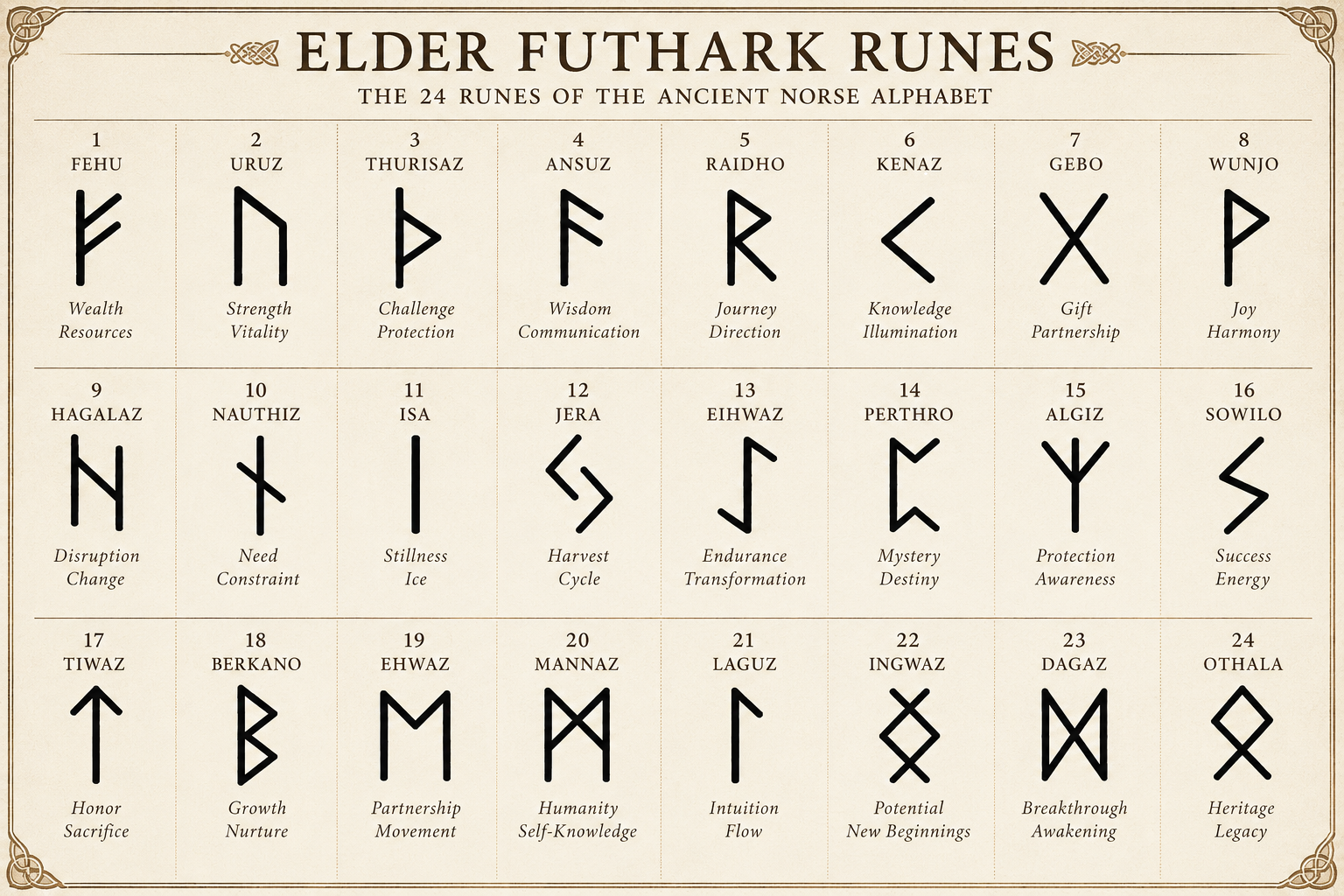
    Its name comes from the first six runes:

    • Fehu
    • Uruz
    • Thurisaz
    • Ansuz
    • Raidho
    • Kenaz

    Together, these sounds form the word Futhark, much like the word alphabet derives from alpha and beta.

    The Elder Futhark remained in use for several centuries before later runic systems developed.

    Because of its historical importance and symbolic richness, it remains the most widely studied rune system today.

    Explore Our Courses
    ChatGPT Image Jun 26, 2026, 04_57_25 PM
    PlayPause
    ChatGPT Image Jun 26, 2026, 04_57_25 PM
    image-slider-with-thumbnail1.jpeg
    image-slider-with-thumbnail2.jpeg
    ChatGPT Image Jun 26, 2026, 05_01_22 PM
    image-slider-with-thumbnail3.jpeg
    image-slider-with-thumbnail4.jpeg
    ChatGPT Image Jun 26, 2026, 04_51_54 PM
    image-slider-with-thumbnail5.jpeg
    image-slider-with-thumbnail6.jpeg
    ChatGPT Image Jun 27, 2026, 09_24_15 AM
    image-slider-with-thumbnail7.jpeg
    ChatGPT Image Jun 26, 2026, 04_54_23 PM
    ChatGPT Image Jun 26, 2026, 04_19_39 PM
    ChatGPT Image Jun 26, 2026, 04_28_19 PM
    ChatGPT Image Jun 26, 2026, 04_37_00 PM
    ChatGPT Image Jun 26, 2026, 05_04_59 PM
    ChatGPT Image Jun 26, 2026, 04_38_53 PM
    ChatGPT Image Jun 27, 2026, 09_13_22 AM
    ChatGPT Image Jun 26, 2026, 04_41_25 PM
    ChatGPT Image Jun 26, 2026, 04_44_22 PM
    ChatGPT Image Jun 30, 2026, 10_56_33 AM
    previous arrow
    next arrow

    Why Do Runes Look Angular?

    One of the most distinctive features of runes is their appearance.

    Unlike modern handwriting, runes consist primarily of straight lines.

    This design was practical.

    Many runic inscriptions were carved into:

    • Wood
    • Stone
    • Bone
    • Metal

    Straight lines are easier to carve than curves.

    The shape of the runes reflects the materials and tools used by the people who created them.

    Runes and Norse Mythology

    Many modern discussions of runes connect them with Norse mythology.

    This connection stems largely from the poem known as the Hávamál, preserved within the Poetic Edda.

    According to the story, the god Odin sacrificed himself by hanging upon the World Tree, Yggdrasil.

    Through this ordeal, he gained knowledge of the runes.

    The passage presents the runes as a form of wisdom acquired through sacrifice and insight.

    Whether interpreted literally, symbolically, or mythologically, this story contributed significantly to the cultural significance of runes.

    Readers interested in mythological themes may also enjoy:

    Why Mythology Matters

    The relationship between runes and mythology remains one of the most fascinating aspects of rune study.

    Runes as Symbols

    Each rune represents a sound.

    Yet each rune also came to be associated with concepts, objects, and symbolic meanings.

    For example:

    Fehu is often associated with wealth and resources.

    Raidho often relates to journeys and movement.

    Berkano often relates to growth and development.

    Dagaz often relates to transformation and breakthrough.

    These symbolic associations developed through historical rune poems and later interpretive traditions.

    Many modern practitioners focus heavily on these symbolic dimensions.

    Symbolism and Rune Study

    Understanding symbolism plays a major role in modern rune practice.

    The runes function as more than letters.

    They also serve as symbolic images that suggest themes, questions, and possibilities.

    Readers interested in symbolic interpretation may enjoy:

    What Is Symbolism? A Beginner’s Introduction

    The study of symbolism often deepens one’s understanding of rune meanings.

    Historical Uses of Runes

    Historical evidence suggests that runes served several purposes.

    Writing

    The primary function of runes was communication.

    Many inscriptions record names, ownership, dedications, and memorial messages.

    Memorial Stones

    Runestones became particularly important in Scandinavia.

    Families commissioned stones to honor the dead, commemorate achievements, and preserve memories.

    Decorative Purposes

    Runes often appeared on jewelry, weapons, tools, and other objects.

    Possible Magical Uses

    Some historical sources suggest that runes occasionally appeared in ritual or magical contexts.

    The evidence is complex and sometimes difficult to interpret.

    Scholars continue debating the extent and nature of these practices.

    Rune Meanings and Personal Reflection

    Modern rune study often emphasizes reflection rather than historical reconstruction.

    Many people use runes as prompts for contemplation.

    A rune may encourage questions such as:

    • What needs attention?
    • What challenge am I facing?
    • What opportunity is emerging?
    • What lesson am I learning?

    In this way, runes function similarly to other symbolic systems.

    The emphasis shifts from prediction toward reflection.

    Runes and Archetypes

    Many rune meanings overlap with archetypal themes.

    Growth.

    Transformation.

    Journey.

    Sacrifice.

    Wisdom.

    Protection.

    Renewal.

    These themes appear throughout mythology, dreams, stories, and spiritual traditions.

    Readers interested in archetypal psychology may enjoy:

    What Is an Archetype? A Jungian Introduction

    Archetypal thinking often enriches modern rune study.

    Runes and Other Symbolic Systems

    Many people who study runes also explore:

    • Tarot
    • Lenormand
    • Dream symbolism
    • Mythology
    • Alchemy

    Each system approaches meaning differently.

    Readers interested in tarot may enjoy:

    Beginner’s Guide to Tarot

    Those interested in card-based symbolic reading may also enjoy:

    Beginner’s Guide to Lenormand

    Although these systems differ substantially, they all rely on symbols and interpretation.

    How Modern People Use Runes

    Today, people engage with runes in many ways.

    Some study runic history and linguistics.

    Others focus on mythology.

    Some use runes for journaling and self-reflection.

    Others incorporate them into meditation practices.

    Still others use rune casting as a form of symbolic exploration.

    The diversity of modern approaches reflects the flexibility of the runes themselves.

    Common Misconceptions About Runes

    Runes Were Created for Fortune-Telling

    Historically, runes functioned first as writing systems.

    Their modern use in divination developed much later.

    Every Rune Has One Fixed Meaning

    Most runes possess a range of possible interpretations.

    Context remains important.

    Runes Belong Only to Norse Mythology

    Although strongly associated with Norse culture, runes appeared throughout various Germanic societies.

    Runes Are Inherently Magical

    Historical evidence shows both practical and symbolic uses.

    Reducing runes to magic alone oversimplifies their history.

    Why Runes Still Matter

    The continued popularity of runes reveals something important.

    People remain drawn to symbols.

    They seek meaningful ways to reflect on experience.

    Runes offer:

    • Simplicity
    • Symbolism
    • Historical depth
    • Mythological richness
    • Opportunities for reflection

    Their combination of history and symbolism gives them a unique place among traditional systems of meaning.

    Learning More About Runes

    Readers interested in scholarly research can explore resources provided by the National Museum of Denmark and the Runes Database at Uppsala University.

    These organizations provide valuable historical information about runic inscriptions, archaeology, and Scandinavian cultural history.

    Frequently Asked Questions

    What are runes?

    Runes are letters from ancient Germanic alphabets that later acquired symbolic and cultural significance.

    What is the Elder Futhark?

    The Elder Futhark is the oldest known runic alphabet and contains twenty-four runes.

    Did Vikings use runes?

    Yes. Vikings used later runic alphabets for inscriptions, memorials, and communication.

    Are runes a language?

    No. Runes are an alphabet used to write languages.

    Were runes used for divination historically?

    The strongest historical evidence points to their use as writing systems. Modern divinatory practices developed much later.

    Do runes have meanings beyond their sounds?

    Yes. Historical rune poems and later traditions associate runes with symbolic themes and concepts.

    Can beginners study runes?

    Absolutely. Learning the basic runes, their history, and their symbolic meanings provides an excellent foundation.

    Final Thoughts

    Originally created as practical writing systems, runes evolved into powerful cultural symbols that continue to inspire people today. Their angular forms connect modern readers to ancient traditions, while their symbolic meanings encourage reflection on enduring themes such as growth, wisdom, transformation, and journey.

    Whether approached historically, symbolically, spiritually, or academically, runes offer a rich field of study.

    They remind us that even the simplest marks carved into stone can carry stories, meanings, and mysteries across centuries.

    And perhaps that is part of their enduring appeal. They are at once letters, symbols, and invitations to deeper exploration.

  • How Tarot Works as a Reflective Practice

    How Tarot Works as a Reflective Practice

    Many people first encounter tarot through fortune-telling.

    They see spreads that promise answers about relationships, careers, finances, or the future. While predictive reading has long been part of tarot culture, it represents only one way of working with the cards.

    Another approach has gained increasing attention over the past several decades.

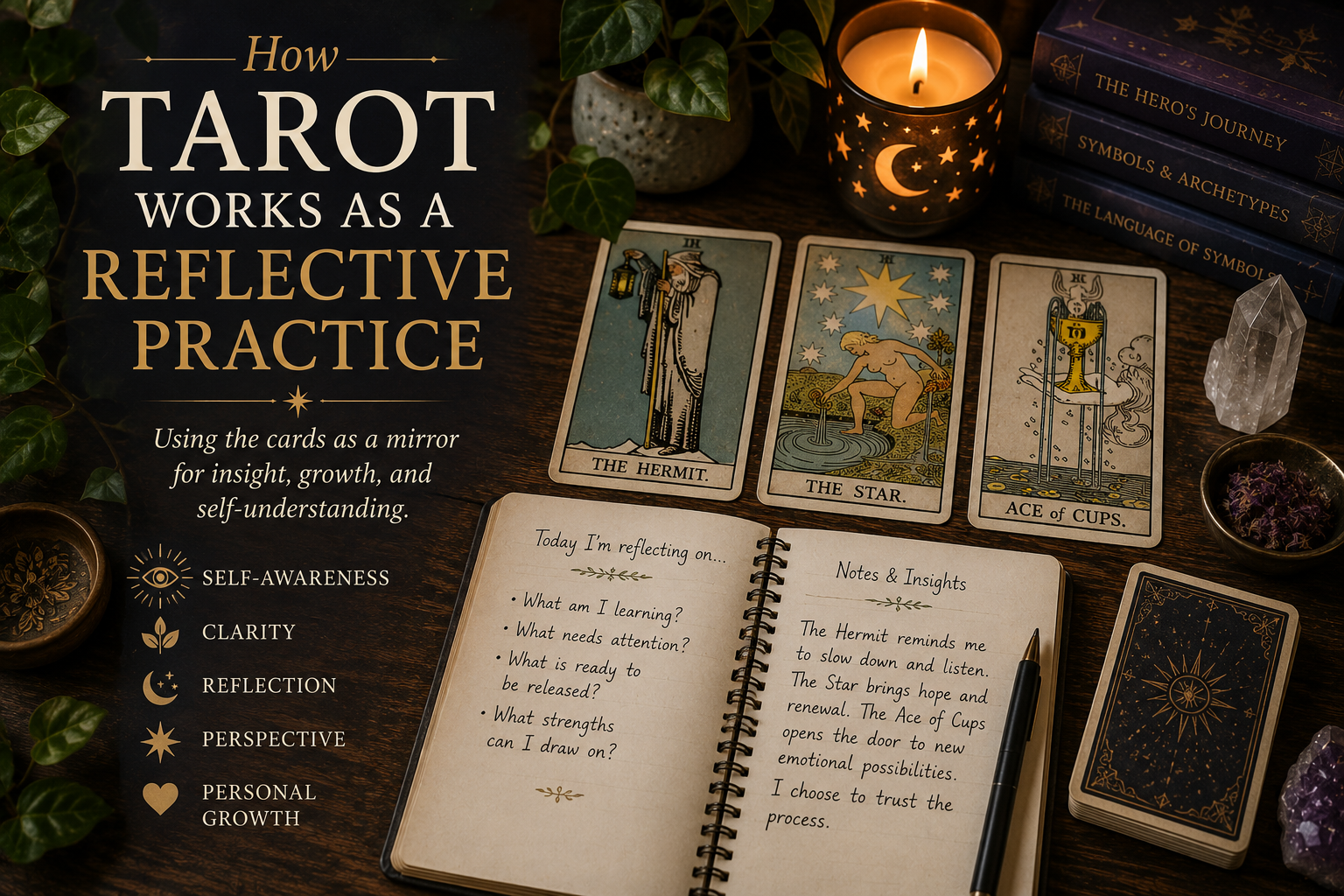
    Rather than treating tarot as a tool for prediction, many people use it as a reflective practice.

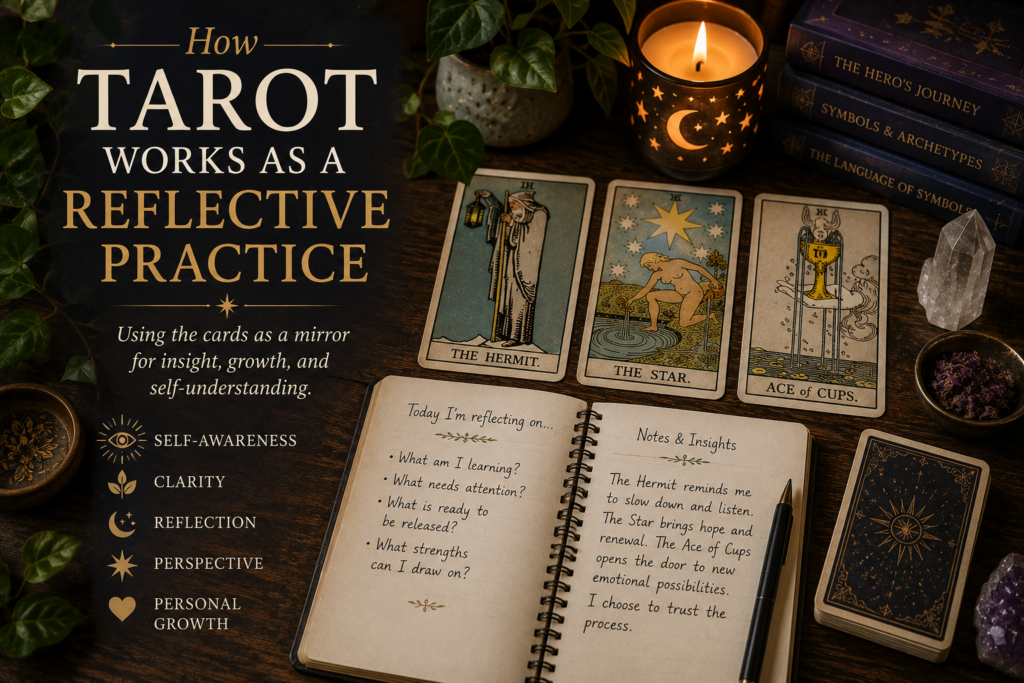
    In this approach, tarot serves as a way to explore thoughts, emotions, experiences, values, challenges, and possibilities. The cards function less like answers and more like mirrors. They help bring attention to patterns that might otherwise remain unnoticed.

    This perspective has attracted psychologists, writers, artists, spiritual seekers, coaches, counselors, and ordinary readers looking for meaningful self-reflection.

    Whether or not one believes tarot can predict future events, the cards can provide a powerful framework for contemplation and personal insight.

    This guide explores how tarot practice can function as a reflective tool and why so many people find value in working with the cards in this way.

    tarot practice

    In This Guide

    • What reflective tarot practice means
    • How tarot differs from prediction
    • Why symbols encourage reflection
    • Tarot and self-awareness
    • Tarot and journaling
    • Tarot and personal growth
    • Psychological perspectives on tarot
    • Common misconceptions
    • How to begin a reflective tarot practice
    • Frequently asked questions

    What Is a Reflective Tarot Practice?

    A reflective tarot practice uses the cards as prompts for contemplation rather than sources of certainty.

    Instead of asking:

    “What will happen?”

    The reader might ask:

    • What am I overlooking?
    • What perspective am I missing?
    • What challenge am I currently facing?
    • What strengths can I draw upon?
    • What patterns are emerging in my life?

    The cards become conversation partners.

    They offer images, symbols, stories, and themes that stimulate reflection.

    The goal is not necessarily prediction.

    The goal is greater awareness.

    Tarot as a Mirror

    One of the most useful metaphors for tarot is the mirror.

    A mirror does not create your reflection.

    It reveals what is already present.

    Similarly, tarot often reflects thoughts, emotions, assumptions, hopes, fears, and possibilities that may already exist within awareness or just beneath its surface.

    A card may prompt questions such as:

    Why does this image stand out?

    Why does this symbol feel important?

    And why am I reacting strongly to this card?

    The answers often reveal as much about the reader as the cards themselves.

    Why Symbols Encourage Reflection

    Tarot works through symbolism.

    Unlike direct advice, symbols invite interpretation.

    A symbol creates space.

    It allows multiple meanings to coexist.

    Consider a card such as The Hermit.

    Some readers may see solitude.

    Others may see wisdom.

    Others may see withdrawal, reflection, guidance, or spiritual seeking.

    The image does not force a single answer.

    Instead, it encourages exploration.

    Readers interested in the broader language of symbols may enjoy:

    What Is Symbolism? A Beginner’s Introduction

    Understanding symbolism often deepens reflective tarot work considerably.

    Why Reflection Matters

    Modern life often moves quickly.

    People solve problems, complete tasks, respond to messages, and move from one responsibility to the next.

    Reflection can become easy to neglect.

    Tarot provides a structured opportunity to pause.

    A reading creates space to ask:

    • What am I experiencing?
    • What am I learning?
    • What deserves attention?
    • What needs reconsideration?

    These questions support self-awareness regardless of one’s beliefs about divination.

    Explore Our Courses
    ChatGPT Image Jun 26, 2026, 04_57_25 PM
    PlayPause
    ChatGPT Image Jun 26, 2026, 04_57_25 PM
    image-slider-with-thumbnail1.jpeg
    image-slider-with-thumbnail2.jpeg
    ChatGPT Image Jun 26, 2026, 05_01_22 PM
    image-slider-with-thumbnail3.jpeg
    image-slider-with-thumbnail4.jpeg
    ChatGPT Image Jun 26, 2026, 04_51_54 PM
    image-slider-with-thumbnail5.jpeg
    image-slider-with-thumbnail6.jpeg
    ChatGPT Image Jun 27, 2026, 09_24_15 AM
    image-slider-with-thumbnail7.jpeg
    ChatGPT Image Jun 26, 2026, 04_54_23 PM
    ChatGPT Image Jun 26, 2026, 04_19_39 PM
    ChatGPT Image Jun 26, 2026, 04_28_19 PM
    ChatGPT Image Jun 26, 2026, 04_37_00 PM
    ChatGPT Image Jun 26, 2026, 05_04_59 PM
    ChatGPT Image Jun 26, 2026, 04_38_53 PM
    ChatGPT Image Jun 27, 2026, 09_13_22 AM
    ChatGPT Image Jun 26, 2026, 04_41_25 PM
    ChatGPT Image Jun 26, 2026, 04_44_22 PM
    ChatGPT Image Jun 30, 2026, 10_56_33 AM
    previous arrow
    next arrow

    Tarot and Self-Awareness

    One of the greatest strengths of reflective tarot practice is self-awareness.

    Many people discover recurring themes within their readings.

    Certain cards appear repeatedly.

    Certain situations arise again and again.

    And certain emotional responses become familiar.

    These patterns can reveal:

    • Habits
    • Strengths
    • Blind spots
    • Motivations
    • Concerns

    The cards help illuminate experiences that might otherwise remain unexamined.

    Tarot and Archetypes

    The Major Arcana contains many archetypal figures.

    Examples include:

    • The Fool
    • The Magician
    • The High Priestess
    • The Emperor
    • The Hermit
    • Death

    These figures represent recurring patterns of human experience.

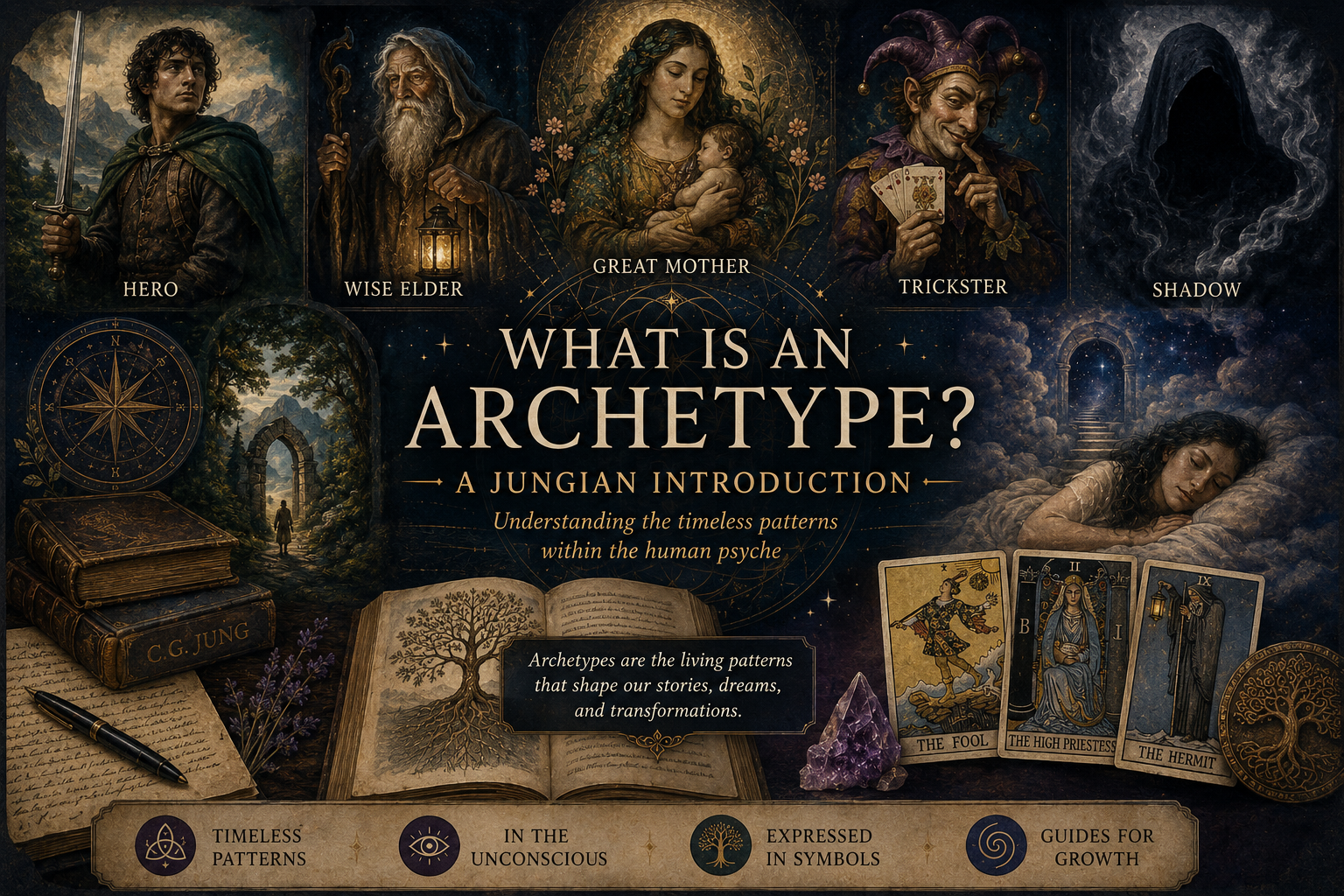
    Carl Jung referred to such patterns as archetypes.

    Readers interested in archetypal psychology may enjoy:

    What Is an Archetype? A Jungian Introduction

    Archetypal imagery gives tarot much of its reflective power.

    The cards resonate because they depict experiences that feel familiar and meaningful.

    Tarot and Storytelling

    Human beings naturally think through stories.

    Tarot cards often function like story fragments.

    A spread becomes a narrative.

    Characters appear.

    Challenges emerge.

    Transformation unfolds.

    The reader pieces together meaning through relationships between cards.

    This narrative process can reveal perspectives that logical analysis alone might miss.

    Stories help people make sense of experience.

    Tarot frequently supports that process.

    Tarot and Journaling

    Many readers combine tarot with journaling.

    This practice can be remarkably effective.

    After drawing a card, consider questions such as:

    • What stands out immediately?
    • What emotions arise?
    • What associations come to mind?
    • How might this card relate to my current situation?

    Writing slows the process.

    It encourages deeper reflection.

    Over time, journal entries often reveal patterns that would otherwise remain invisible.

    Tarot and Dream Work

    Tarot and dream interpretation share many similarities.

    Both involve:

    • Symbols
    • Images
    • Stories
    • Emotional responses
    • Multiple layers of meaning

    Neither system relies entirely on literal interpretation.

    Both invite exploration.

    Readers interested in dream symbolism may enjoy:

    How to Start Reading Dream Symbols

    Many people discover that dream work and tarot practice complement one another beautifully.

    Tarot and Mythology

    Tarot also shares deep connections with mythology.

    The Hero’s journey.

    The Wise Elder.

    Transformation through challenge.

    Death and rebirth.

    These mythological themes appear throughout the cards.

    Readers interested in mythic patterns may enjoy:

    Why Mythology Matters

    Mythological understanding often enriches reflective tarot practice by providing larger symbolic contexts.

    Tarot and Personal Growth

    Reflective tarot does not promise instant transformation.

    What it offers is attention.

    Attention often leads to awareness.

    Awareness often supports change.

    The cards cannot make decisions for us.

    They cannot eliminate uncertainty.

    They can, however, encourage thoughtful engagement with our experiences.

    This makes tarot a valuable companion for personal growth.

    Reflective Tarot and Spiritual Practice

    Many people incorporate tarot into broader spiritual practices.

    The cards may accompany:

    • Meditation
    • Prayer
    • Contemplation
    • Journaling
    • Retreats
    • Personal reflection

    In these contexts, tarot serves as a symbolic tool for exploring spiritual questions and experiences.

    Readers interested in symbolic spirituality may enjoy:

    What Is Christian Hermeticism?

    While traditions differ, many share an appreciation for symbols as pathways to reflection.

    A Simple Daily Tarot Practice

    One of the easiest ways to begin is with a single-card draw.

    Each morning or evening:

    1. Draw one card.
    2. Observe the imagery.
    3. Notice emotional responses.
    4. Write a few reflections.
    5. Revisit the card later.

    The goal is not perfect interpretation.

    The goal is engagement.

    Consistency often matters more than complexity.

    Questions for Reflective Tarot Reading

    Instead of predictive questions, consider asking:

    • What deserves my attention today?
    • What am I learning?
    • What challenge am I currently facing?
    • What perspective might help?
    • What strength can I rely upon?

    These questions often generate richer reflection than questions seeking certainty about future events.

    Common Misconceptions About Reflective Tarot

    Tarot Requires Psychic Ability

    No.

    Reflective tarot relies primarily on observation, symbolism, and contemplation.

    There Is One Correct Interpretation

    Most cards support multiple valid interpretations.

    Context matters.

    Personal experience matters.

    Tarot Gives Absolute Answers

    Reflective tarot encourages exploration rather than certainty.

    Reflection Is Less Valuable Than Prediction

    Many readers find that self-awareness ultimately proves more valuable than specific predictions.

    Why Tarot Practice Continues to Grow

    The popularity of reflective tarot has increased significantly in recent decades.

    Part of this growth may reflect broader cultural interest in:

    • Mindfulness
    • Journaling
    • Personal growth
    • Symbolism
    • Psychology

    People increasingly seek tools that encourage reflection.

    Tarot offers a flexible and accessible framework for doing so.

    Learning More About Tarot

    Readers interested in deepening their tarot practice may enjoy:

    Beginner’s Guide to Tarot

    and

    Recommended Books for Studying Tarot

    Both resources provide helpful foundations for developing a thoughtful and sustainable tarot practice.

    For scholarly perspectives on symbolism and psychological interpretation, readers may also find value in resources from the C.G. Jung Institute of San Francisco and the Joseph Campbell Foundation.

    Frequently Asked Questions

    What is a reflective tarot practice?

    A reflective tarot practice uses the cards as tools for contemplation, self-awareness, and personal insight rather than focusing primarily on prediction.

    Do I need to believe in fortune-telling to use tarot?

    No. Many people use tarot purely as a reflective or symbolic practice.

    Why are symbols important in tarot?

    Symbols encourage interpretation and help reveal multiple layers of meaning within an experience.

    Can tarot improve self-awareness?

    Many readers find that tarot helps them recognize patterns, assumptions, emotions, and perspectives that deserve attention.

    Is journaling necessary?

    No, but journaling often deepens reflection and helps track recurring themes over time.

    How often should I practice tarot?

    Consistency matters more than frequency. Even a single card each day can support meaningful reflection.

    Can tarot be part of a spiritual practice?

    Yes. Many people incorporate tarot into meditation, contemplation, prayer, or personal reflection.

    Final Thoughts

    Tarot functions in many different ways for different people.

    For some, it serves primarily as a divinatory tool.

    For others, it becomes a reflective practice rooted in symbolism, self-awareness, and contemplation.

    The cards do not simply provide answers.

    They invite questions.

    They encourage observation.

    And they reveal possibilities.

    Like a mirror, tarot reflects aspects of experience that may otherwise go unnoticed.

    Whether approached through psychology, spirituality, mythology, symbolism, or personal growth, a thoughtful tarot practice offers something increasingly rare in modern life:

    A reason to slow down, pay attention, and reflect.

    And sometimes, that reflection becomes the most valuable insight of all.

  • What Is an Archetype? A Jungian Introduction

    What Is an Archetype? A Jungian Introduction

    Certain characters seem to appear everywhere.

    The wise old mentor. The courageous hero. The trickster who disrupts the established order. The nurturing mother. The mysterious stranger. The shadowy adversary.

    These figures appear in myths, fairy tales, novels, films, dreams, religious traditions, and personal experiences. They emerge in stories separated by thousands of years and vast geographical distances. Yet they remain surprisingly familiar.

    Why?

    Swiss psychiatrist Carl Jung proposed an answer that would become one of the most influential ideas in modern psychology.

    He called these recurring patterns archetypes.

    The concept of the Jungian archetype continues to influence psychology, mythology, literature, religion, symbolism, dream interpretation, and spiritual traditions. Whether one fully accepts Jung’s theories or views them as symbolic models, archetypes offer a fascinating way of understanding recurring patterns within human experience.

    This guide introduces the concept of archetypes from a Jungian perspective and explores why they remain relevant today.

    This article contains affiliate links.

    archetype

    In This Guide

    • What an archetype is
    • Carl Jung’s theory of archetypes
    • The collective unconscious
    • Common archetypes
    • Archetypes in mythology and religion
    • Archetypes in dreams
    • Archetypes and symbolism
    • Misconceptions about archetypes
    • Why archetypes still matter
    • Frequently asked questions

    What Is a Jungian Archetype?

    A Jungian archetype is a recurring pattern, image, figure, or theme that appears across cultures, myths, dreams, stories, and human experiences.

    According to Jung, archetypes are not learned through culture alone.

    Instead, they arise from deeper structures within the human psyche.

    An archetype is not a specific person.

    It is a pattern.

    For example:

    The Hero is an archetype.

    Luke Skywalker, Frodo Baggins, King Arthur, and countless other characters are specific expressions of that pattern.

    Similarly:

    The Wise Elder is an archetype.

    Merlin, Gandalf, and many spiritual teachers represent variations of that pattern.

    The archetype remains constant.

    The expression changes.

    Carl Jung and the Origins of Archetype Theory

    Carl Jung developed the theory of archetypes during the early twentieth century.

    Originally a student and colleague of Sigmund Freud, Jung eventually developed his own approach to psychology.

    While Freud focused heavily on personal experiences and unconscious desires, Jung became increasingly interested in symbols, mythology, religion, dreams, and cultural patterns.

    As he studied myths and religious traditions from around the world, he noticed recurring images and themes.

    Cultures that had no apparent connection often produced remarkably similar stories.

    Jung believed these similarities pointed toward deeper structures within the human mind.

    This observation became one of the foundations of archetype theory.

    The Collective Unconscious

    To understand archetypes, it helps to understand another key Jungian concept.

    The collective unconscious.

    Jung proposed that the human psyche contains more than personal memories and experiences.

    Beneath the personal unconscious lies a deeper layer shared by humanity.

    He called this shared foundation the collective unconscious.

    According to Jung, archetypes emerge from this deeper level.

    Just as all humans share similar biological structures, Jung suggested that we may also share certain psychological patterns.

    Archetypes are expressions of these patterns.

    Whether interpreted literally or metaphorically, the concept remains one of Jung’s most influential contributions.

    Explore Our Courses

    ChatGPT Image Jun 26, 2026, 04_57_25 PM
    PlayPause
    ChatGPT Image Jun 26, 2026, 04_57_25 PM
    image-slider-with-thumbnail1.jpeg
    image-slider-with-thumbnail2.jpeg
    ChatGPT Image Jun 26, 2026, 05_01_22 PM
    image-slider-with-thumbnail3.jpeg
    image-slider-with-thumbnail4.jpeg
    ChatGPT Image Jun 26, 2026, 04_51_54 PM
    image-slider-with-thumbnail5.jpeg
    image-slider-with-thumbnail6.jpeg
    ChatGPT Image Jun 27, 2026, 09_24_15 AM
    image-slider-with-thumbnail7.jpeg
    ChatGPT Image Jun 26, 2026, 04_54_23 PM
    ChatGPT Image Jun 26, 2026, 04_19_39 PM
    ChatGPT Image Jun 26, 2026, 04_28_19 PM
    ChatGPT Image Jun 26, 2026, 04_37_00 PM
    ChatGPT Image Jun 26, 2026, 05_04_59 PM
    ChatGPT Image Jun 26, 2026, 04_38_53 PM
    ChatGPT Image Jun 27, 2026, 09_13_22 AM
    ChatGPT Image Jun 26, 2026, 04_41_25 PM
    ChatGPT Image Jun 26, 2026, 04_44_22 PM
    ChatGPT Image Jun 30, 2026, 10_56_33 AM
    previous arrow
    next arrow

    Archetypes Are Not Stereotypes

    A common misunderstanding occurs when people confuse archetypes with stereotypes.

    The two are very different.

    A stereotype reduces individuals to simplistic assumptions.

    An archetype describes recurring symbolic patterns.

    For example:

    The Mother archetype does not refer to every mother.

    Instead, it represents themes associated with nurturing, protection, fertility, care, and creation.

    Archetypes describe possibilities rather than fixed identities.

    They remain flexible and symbolic.

    The Hero Archetype

    The Hero is perhaps the most recognizable archetype.

    Hero stories appear throughout mythology, religion, literature, and popular culture.

    The Hero often:

    • Leaves the familiar world
    • Faces challenges
    • Encounters allies and enemies
    • Learns important lessons
    • Returns transformed

    This pattern appears in ancient myths and modern films alike.

    Many people connect with Hero stories because they mirror personal struggles and growth.

    The Hero’s journey becomes a symbolic map of transformation.

    The Wise Elder

    The Wise Elder appears as a guide, teacher, mentor, or spiritual advisor.

    This figure offers wisdom rather than direct action.

    Examples appear throughout mythology and literature:

    • Merlin
    • Gandalf
    • Tiresias
    • Various spiritual teachers

    The Wise Elder often represents insight, knowledge, and perspective gained through experience.

    The Trickster

    The Trickster disrupts order.

    This archetype breaks rules, challenges assumptions, and introduces change.

    Tricksters can be humorous.

    They can also be frustrating.

    Examples include:

    • Loki
    • Hermes
    • Coyote
    • Anansi

    The Trickster reminds us that growth often occurs when expectations are challenged.

    The Shadow

    The Shadow is one of Jung’s most important archetypes.

    It represents aspects of ourselves that we prefer not to acknowledge.

    The Shadow may contain:

    • Fear
    • Anger
    • Jealousy
    • Shame
    • Untapped potential

    Many stories externalize the Shadow through villains, monsters, or adversaries.

    Jung believed genuine personal growth requires confronting rather than avoiding the Shadow.

    The Great Mother

    The Great Mother appears throughout mythology and religion.

    This archetype often represents:

    • Nurturing
    • Protection
    • Fertility
    • Creation
    • Compassion

    Yet the Great Mother can also possess destructive aspects.

    Nature nourishes life.

    Nature can also bring storms and destruction.

    This duality often appears in mythological expressions of the archetype.

    The Child

    The Child archetype symbolizes beginnings, potential, renewal, and future possibilities.

    Also the Child often appears in myths involving miraculous births, divine children, or unexpected saviors.

    Psychologically, the archetype reminds us of growth, creativity, and emerging possibilities.

    Archetypes and Mythology

    Archetypes appear most clearly in mythology.

    Heroic quests.

    Wise guides.

    Sacred marriages.

    Descent into darkness.

    Death and rebirth.

    These themes appear repeatedly across cultures.

    Readers interested in these recurring patterns may enjoy:

    Why Mythology Matters

    Myths provide some of the richest expressions of archetypal imagery.

    Archetypes and Symbolism

    Archetypes often communicate through symbols.

    The Hero may appear through a sword.

    The Wise Elder through a lantern.

    The Shadow through darkness.

    The Child through a seed or a newborn.

    Because of this connection, the study of archetypes naturally overlaps with symbolism.

    Readers interested in symbolic interpretation may enjoy:

    What Is Symbolism? A Beginner’s Introduction

    Symbols provide visible forms for archetypal patterns that would otherwise remain abstract.

    Archetypes and Dreams

    Jung believed dreams frequently express archetypal material.

    Dream figures sometimes embody archetypal roles.

    A stranger may function as the Shadow.

    A teacher may appear as the Wise Elder.

    A journey may reflect the Hero’s path.

    Dreams rarely announce these meanings directly.

    Instead, they communicate through symbols and stories.

    Readers interested in dream interpretation may enjoy:

    How to Start Reading Dream Symbols

    Dream work often provides opportunities to observe archetypes in action.

    Archetypes and Tarot

    Many tarot readers encounter archetypes through the cards.

    The Major Arcana contains numerous archetypal figures.

    Examples include:

    • The Fool
    • The Magician
    • The High Priestess
    • The Hermit
    • The Emperor
    • Death

    These figures function as symbolic patterns rather than literal individuals.

    Readers interested in tarot symbolism may enjoy:

    Beginner’s Guide to Tarot

    Tarot provides a rich visual language for exploring archetypal themes.

    Archetypes and Christian Hermeticism

    Archetypal thinking also appears within mystical traditions.

    Christian Hermeticism often explores recurring symbolic patterns through scripture, symbolism, contemplation, and spiritual reflection.

    Readers interested in these themes may enjoy:

    What Is Christian Hermeticism?

    While Jung and Christian Hermetic thinkers approached these subjects differently, both traditions recognize the importance of symbolic patterns in human experience.

    Common Misconceptions About Archetypes

    Archetypes Are Literal Entities

    Jung generally described archetypes as psychological patterns rather than independent beings.

    Archetypes Predict Behavior

    Archetypes influence patterns of experience, but they do not determine individual choices.

    Everyone Fits Into One Archetype

    People express many archetypal patterns throughout life.

    No single archetype defines an entire person.

    Archetypes Are Only Found in Ancient Myths

    Modern films, novels, games, and personal experiences continue expressing archetypal themes.

    Why Archetypes Still Matter

    The enduring popularity of archetypes suggests that Jung identified something meaningful.

    People continue responding to archetypal stories because they reflect recurring human experiences.

    The Hero’s struggle.

    The Shadow’s challenge.

    The Wise Elder’s guidance.

    The Child’s potential.

    These patterns help people understand growth, conflict, transformation, and meaning.

    Even those who question Jung’s theories often find value in archetypal language as a tool for reflection.

    Learning More About Archetypes

    Readers interested in exploring Jung’s work further may find valuable resources through the C.G. Jung Institute of San Francisco and the C.G. Jung Foundation for Analytical Psychology.

    Both organizations provide educational resources related to Jungian psychology, archetypes, symbolism, dreams, and personal development.

    Frequently Asked Questions

    What is a Jungian archetype?

    A Jungian archetype is a recurring psychological pattern that appears in myths, dreams, stories, symbols, and human experiences.

    Did Carl Jung invent archetypes?

    Jung did not invent recurring symbolic patterns, but he developed one of the most influential modern theories explaining them.

    What is the collective unconscious?

    The collective unconscious is Jung’s concept of a shared psychological foundation from which archetypes emerge.

    Are archetypes real?

    Different people answer this question differently. Some view archetypes as psychological realities, while others see them as useful symbolic models.

    What is the most common archetype?

    The Hero is probably the most widely recognized archetype because Hero stories appear across many cultures.

    How do archetypes appear in dreams?

    Dream figures, journeys, symbols, and situations often express archetypal themes and patterns.

    Why are archetypes important?

    Archetypes help explain recurring patterns in stories, myths, religions, dreams, and personal experiences.

    Final Thoughts

    The concept of the Jungian archetype offers a fascinating lens through which to view human experience.

    Whether encountered in mythology, dreams, religion, literature, tarot, or personal reflection, archetypes reveal recurring patterns that seem woven into the fabric of human storytelling and imagination.

    The Hero continues to face challenges.

    The Wise Elder continues to offer guidance.

    The Shadow continues to demand attention.

    These patterns remain meaningful because they reflect enduring aspects of life itself.

    Carl Jung believed archetypes emerge from deep structures within the psyche. Whether one accepts that theory literally or approaches it symbolically, archetypes provide a powerful framework for understanding the stories we tell, the dreams we dream, and the symbols that continue to shape our lives.

    The more we study archetypes, the more we begin to recognize them everywhere. And once we see them, it becomes difficult not to notice how deeply they influence the ways human beings search for meaning.

  • Recommended Books for Studying Tarot

    Recommended Books for Studying Tarot

    For many people, tarot begins with a deck.

    Soon afterward comes a realization.

    The cards contain far more depth than first appears.

    A beginner may start by learning keywords and simple spreads, but serious tarot study eventually opens into symbolism, mythology, psychology, spirituality, history, philosophy, and personal transformation. The cards become a doorway into a much larger world.

    One of the best ways to deepen your understanding is through books. While online videos and social media offer useful insights, books provide the space needed to explore tarot in greater depth. The best tarot books do more than explain card meanings. They teach ways of thinking, observing, reflecting, and developing a personal relationship with the cards.

    The challenge for beginners is knowing where to start.

    Hundreds of tarot books exist, and their approaches vary dramatically. Some focus on traditional interpretations. Others emphasize intuition, psychology, Kabbalah, mysticism, or spiritual development.

    This guide introduces some of the most influential and useful tarot books available today. Whether you are new to tarot or seeking more advanced studies, these works can help build a strong foundation.

    This article contains affiliate links.

    tarot books

    In This Guide

    • Why books remain important for tarot study
    • The best beginner tarot books
    • Books that strengthen intuition
    • Books focused on personal growth
    • Advanced esoteric tarot books
    • Christian and mystical approaches to tarot
    • Kabbalistic and symbolic studies
    • How to build a tarot library
    • Frequently asked questions

    Why Read Tarot Books?

    Modern learners often begin with videos, blogs, and social media.

    These resources can be valuable.

    Yet books offer something different.

    Books allow an author to develop ideas carefully and thoroughly. They provide historical context, deeper symbolism, practical exercises, and detailed discussions that are difficult to fit into shorter formats.

    Many of today’s respected tarot teachers developed their understanding through decades of reading, study, and reflection.

    A thoughtful tarot library becomes an ongoing teacher.

    A Note About Different Approaches

    One of the first things readers discover is that tarot authors do not always agree.

    Some emphasize intuition.

    Some emphasize psychology.

    And some focus on spiritual development.

    Others explore occult traditions, Kabbalah, mythology, or religious symbolism.

    This diversity is one of tarot’s strengths.

    No single book contains everything.

    Reading multiple perspectives helps develop a richer understanding of the cards.

    Best Tarot Books for Beginners

    Seventy-Eight Degrees of Wisdom by Rachel Pollack

    Few books appear on recommendation lists as consistently as Seventy-Eight Degrees of Wisdom.

    Rachel Pollack remains one of the most influential voices in modern tarot. A respected tarot scholar, novelist, and teacher, Pollack helped shape contemporary tarot study for several generations.

    This book explores the symbolism and meaning of every card while connecting tarot to mythology, psychology, spirituality, and personal development.

    Many readers consider it the single most important modern tarot book.

    Although it is accessible to beginners, it rewards repeated reading throughout one’s tarot journey.

    The Big Book of Tarot by Joan Bunning

    Joan Bunning’s The Big Book of Tarot provides one of the most approachable introductions available.

    The writing is clear and practical.

    Bunning explains card meanings, spreads, and reading techniques without overwhelming newcomers with advanced theory.

    Readers who want a structured and straightforward learning experience often find this book especially helpful.

    It serves as an excellent bridge between beginner and intermediate study.

    Tarot: No Questions Asked by Theresa Reed

    Theresa Reed, often known as “The Tarot Lady,” brings a modern and accessible voice to tarot.

    Tarot: No Questions Asked emphasizes intuition and confidence.

    Rather than encouraging rigid interpretations, Reed teaches readers how to trust their own observations and develop authentic reading skills.

    Her approach feels practical, encouraging, and grounded in real-world reading experience.

    For many beginners, this book helps remove anxiety and perfectionism from the learning process.

    Tarot Books for Personal Growth

    Tarot for Your Self by Mary K. Greer

    Mary K. Greer has spent decades shaping modern tarot education.

    Tarot for Your Self remains one of the most influential tarot workbooks ever published.

    Rather than simply teaching card meanings, Greer invites readers into a process of self-discovery.

    The book includes:

    • Journaling exercises
    • Personal reflection
    • Meditation techniques
    • Creative exploration

    Many readers describe this book as transformative.

    It encourages a living relationship with the cards rather than simple memorization.

    21 Ways to Read a Tarot Card by Mary K. Greer

    21 Ways to Read a Tarot Card addresses one of the most important lessons in tarot:

    There is never just one way to read a card.

    Greer presents multiple methods for approaching the same image.

    Readers learn how symbolism, intuition, psychology, storytelling, and observation can all reveal different layers of meaning.

    This book helps break the habit of relying solely on keywords.

    For developing readers, it can be a revelation.

    tarot books

    Building a Foundation in Symbolism

    Tarot is ultimately a symbolic language.

    Readers interested in deeper symbolic study may also enjoy:

    What Is Symbolism? A Beginner’s Introduction

    A strong understanding of symbolism often improves tarot reading more than memorizing additional keywords.

    The cards communicate through images, stories, archetypes, and patterns of meaning.

    Explore Our Courses

    ChatGPT Image Jun 26, 2026, 04_57_25 PM
    PlayPause
    ChatGPT Image Jun 26, 2026, 04_57_25 PM
    image-slider-with-thumbnail1.jpeg
    image-slider-with-thumbnail2.jpeg
    ChatGPT Image Jun 26, 2026, 05_01_22 PM
    image-slider-with-thumbnail3.jpeg
    image-slider-with-thumbnail4.jpeg
    ChatGPT Image Jun 26, 2026, 04_51_54 PM
    image-slider-with-thumbnail5.jpeg
    image-slider-with-thumbnail6.jpeg
    ChatGPT Image Jun 27, 2026, 09_24_15 AM
    image-slider-with-thumbnail7.jpeg
    ChatGPT Image Jun 26, 2026, 04_54_23 PM
    ChatGPT Image Jun 26, 2026, 04_19_39 PM
    ChatGPT Image Jun 26, 2026, 04_28_19 PM
    ChatGPT Image Jun 26, 2026, 04_37_00 PM
    ChatGPT Image Jun 26, 2026, 05_04_59 PM
    ChatGPT Image Jun 26, 2026, 04_38_53 PM
    ChatGPT Image Jun 27, 2026, 09_13_22 AM
    ChatGPT Image Jun 26, 2026, 04_41_25 PM
    ChatGPT Image Jun 26, 2026, 04_44_22 PM
    ChatGPT Image Jun 30, 2026, 10_56_33 AM
    previous arrow
    next arrow

    Advanced Tarot Books

    Holistic Tarot by Benebell Wen

    At over 800 pages, Holistic Tarot is less a book and more a comprehensive course.

    Benebell Wen combines practical reading techniques with history, symbolism, psychology, and occult traditions.

    Her approach emphasizes personal development and disciplined study.

    Readers who enjoy deep research and extensive detail often consider this one of the most valuable modern tarot references available.

    It is especially useful for those interested in professional-level study.

    Tarot: The Library of Esoterica by Jessica Hundley

    This visually stunning volume explores tarot through history, art, culture, and symbolism.

    Rather than functioning as a traditional instructional guide, it presents tarot within broader esoteric traditions.

    The artwork alone makes it worth owning.

    Readers interested in the historical and artistic dimensions of tarot often find this book inspiring.

    Tarot and Mythology

    Tarot shares many themes with mythological traditions.

    Heroes embark on journeys.

    Wise figures offer guidance.

    Transformations occur through challenge and sacrifice.

    Readers interested in these deeper patterns may enjoy:

    Why Mythology Matters

    Understanding mythological themes often reveals new dimensions within the cards.

    Christian and Mystical Approaches to Tarot

    Meditations on the Tarot: A Journey into Christian Hermeticism

    Originally published anonymously and later attributed to Valentin Tomberg, Meditations on the Tarot occupies a unique place in tarot literature.

    This is not a book about card meanings.

    Instead, it uses the Major Arcana as points of departure for profound reflections on Christianity, mysticism, Hermetic philosophy, theology, symbolism, and spiritual development.

    The work has influenced scholars, mystics, clergy, and esoteric students for decades.

    Many readers consider it one of the most intellectually and spiritually ambitious books ever written about tarot.

    It is best approached slowly and contemplatively.

    Readers interested in the themes explored within this work may also enjoy:

    What Is Christian Hermeticism?

    Thoth Tarot Studies

    Understanding Aleister Crowley’s Thoth Tarot by Lon Milo DuQuette

    The Thoth Tarot can appear intimidating to newcomers.

    Its symbolism draws from:

    • Astrology
    • Kabbalah
    • Alchemy
    • Ceremonial magic
    • Mythology

    Lon Milo DuQuette has a remarkable ability to explain these complex ideas with clarity and humor.

    This book serves as one of the best introductions to the Thoth system.

    Readers interested in Crowley’s deck will find it indispensable.

    The Tarot Architect by Lon Milo DuQuette

    DuQuette’s The Tarot Architect explores tarot as a symbolic structure for spiritual development.

    The book encourages readers to view the cards as parts of an interconnected system rather than isolated meanings.

    His writing combines scholarship, humor, and practical insight.

    Readers seeking deeper esoteric understanding often find this book highly rewarding.

    Kabbalistic Tarot Studies

    Fool’s Pilgrimage by Stephan A. Hoeller

    Stephan Hoeller, a respected scholar of Gnosticism and Western esotericism, presents the tarot through the lens of Kabbalah.

    The Fool’s journey becomes a symbolic exploration of spiritual development.

    Rather than focusing on prediction, Hoeller emphasizes contemplation, symbolism, and personal transformation.

    Readers interested in mystical and philosophical approaches will find much to explore here.

    Tarot and Other Symbolic Systems

    Many tarot students eventually explore related traditions.

    These may include:

    • Dream symbolism
    • Alchemy
    • Runes
    • Lenormand
    • Mythology

    You may enjoy:

    How to Start Reading Dream Symbols

    What Is Alchemy? Historical and Spiritual Perspectives

    Beginner’s Guide to Runes

    These systems often enrich one’s understanding of tarot symbolism.

    Building a Tarot Library

    New readers sometimes feel pressure to buy dozens of books.

    This is unnecessary.

    A strong library can begin with only a few carefully chosen works.

    A balanced starter collection might include:

    • Seventy-Eight Degrees of Wisdom
    • Tarot for Your Self
    • Tarot: No Questions Asked
    • The Big Book of Tarot

    These books provide an excellent foundation before moving into more specialized studies.

    Over time, you can expand into mythology, psychology, Kabbalah, Christian Hermeticism, and other areas of interest.

    Learning Beyond Books

    Books remain essential, but they work best alongside practice.

    Read.

    Journal.

    Study spreads.

    Reflect on symbolism.

    Keep notes.

    Develop your own observations.

    Tarot ultimately becomes meaningful through direct engagement with the cards.

    Further Study Resources

    Readers interested in scholarly and historical perspectives may wish to explore resources provided by the Tarot Heritage Project and the British Museum Collection Online, both of which offer valuable historical context related to tarot imagery, card history, and visual symbolism.

    Frequently Asked Questions

    What is the best tarot book for beginners?

    Many readers consider Seventy-Eight Degrees of Wisdom by Rachel Pollack the most influential beginner-friendly tarot book.

    Which tarot book is best for intuition?

    Tarot: No Questions Asked by Theresa Reed offers an excellent introduction to intuitive reading.

    Which tarot book is best for self-discovery?

    Tarot for Your Self by Mary K. Greer remains one of the most respected personal growth-focused tarot books available.

    What is the most comprehensive tarot book?

    Holistic Tarot by Benebell Wen is often considered one of the most comprehensive modern tarot references.

    Is Meditations on the Tarot a beginner book?

    Not usually. Most readers benefit from gaining some familiarity with tarot before approaching it.

    Which book should I read for the Thoth Tarot?

    Understanding Aleister Crowley’s Thoth Tarot by Lon Milo DuQuette is widely considered one of the best introductions.

    How many tarot books do I need?

    Only a few. A small collection of high-quality books is often more valuable than a large collection that remains unread.

    Final Thoughts

    The best tarot books do more than teach card meanings.

    They teach ways of seeing.

    They deepen understanding of symbolism, psychology, mythology, spirituality, and personal growth. And they encourage readers to move beyond memorization and into genuine relationship with the cards.

    Whether you begin with Rachel Pollack, Mary K. Greer, Theresa Reed, Joan Bunning, Benebell Wen, Lon Milo DuQuette, Stephan Hoeller, or Valentin Tomberg, each author offers a unique perspective on tarot’s rich symbolic landscape.

    The cards themselves may never change.

    Yet the deeper you study them, the more they seem to reveal.

    That journey often begins with a single deck.

    It continues through the wisdom found in great books.

  • Beginner’s Guide to Lenormand

    Beginner’s Guide to Lenormand

    Lenormand is one of the most practical and straightforward divination systems in use today. While many people discover it after learning tarot, Lenormand follows its own unique approach. It uses simple images, direct meanings, and combinations of cards to answer questions about everyday life.

    For beginners, Lenormand can feel surprisingly different from other symbolic systems. The cards often seem simple at first glance. A rider. A clover. A dog. A key. A ship. Yet these ordinary images create a remarkably detailed language when read together.

    One reason many readers become devoted to Lenormand is its clarity. Rather than focusing primarily on psychological themes or spiritual lessons, Lenormand often describes events, situations, people, opportunities, obstacles, and outcomes with impressive specificity.

    This beginner Lenormand guide introduces the foundations of the system without overwhelming you with advanced techniques. The goal is to help you understand what Lenormand is, how it works, and how to begin learning its symbolic language.

    Whether you are entirely new to divination or coming from tarot, runes, or other symbolic traditions, this guide will help you take your first steps into the world of Lenormand.
    This article contains affiliate links.

    beginner lenormand

    In This Guide

    • What Lenormand is
    • The history of Lenormand
    • The structure of the deck
    • How Lenormand differs from other systems
    • Why card combinations matter
    • Choosing your first deck
    • How beginners can start learning
    • Common mistakes new readers make
    • Frequently asked questions

    What Is Lenormand?

    Lenormand is a card system that uses thirty-six symbolic images to answer questions and describe situations.

    Unlike tarot, which often emphasizes archetypes, psychology, and spiritual themes, Lenormand tends to focus on practical realities.

    The cards describe:

    • People
    • Events
    • Opportunities
    • Challenges
    • Relationships
    • Communication
    • Travel
    • Work
    • Finances
    • Everyday life

    Each card has a relatively stable core meaning.

    The real power of Lenormand emerges when cards combine into phrases and sentences.

    Many readers describe Lenormand as a symbolic language rather than a collection of individual card meanings.

    Who Was Mademoiselle Lenormand?

    The deck takes its name from Marie Anne Lenormand, a famous French fortune teller who lived during the late eighteenth and early nineteenth centuries.

    She gained considerable fame during her lifetime and reportedly read for influential political and social figures.

    Interestingly, the modern Lenormand deck was not actually created by her.

    The thirty-six-card system emerged after her death and became associated with her name because of her popularity.

    Despite this historical detail, the name Lenormand has remained attached to the system ever since.

    What Does a Lenormand Deck Contain?

    A standard Lenormand deck contains thirty-six cards.

    Some of the most well-known cards include:

    • Rider
    • Clover
    • Ship
    • House
    • Tree
    • Dog
    • Tower
    • Garden
    • Key
    • Sun
    • Moon
    • Cross

    Unlike tarot, there are no Major Arcana or Minor Arcana.

    Every card plays an equal role within the system.

    This simplicity makes Lenormand easier to learn structurally, although mastering card combinations takes practice.

    Why Are the Images So Simple?

    One of the first things beginners notice is the straightforward artwork.

    A Lenormand card typically features a single image.

    For example:

    The Dog shows a dog.

    The Ship shows a ship.

    The Key shows a key.

    The Garden shows a garden.

    These simple images are intentional.

    Lenormand relies on direct symbolism.

    The images act as symbolic building blocks that combine to create larger meanings.

    Because the symbols are relatively clear, the system often produces practical and concise readings.

    Explore Our Courses
    ChatGPT Image Jun 26, 2026, 04_57_25 PM
    PlayPause
    ChatGPT Image Jun 26, 2026, 04_57_25 PM
    image-slider-with-thumbnail1.jpeg
    image-slider-with-thumbnail2.jpeg
    ChatGPT Image Jun 26, 2026, 05_01_22 PM
    image-slider-with-thumbnail3.jpeg
    image-slider-with-thumbnail4.jpeg
    ChatGPT Image Jun 26, 2026, 04_51_54 PM
    image-slider-with-thumbnail5.jpeg
    image-slider-with-thumbnail6.jpeg
    ChatGPT Image Jun 27, 2026, 09_24_15 AM
    image-slider-with-thumbnail7.jpeg
    ChatGPT Image Jun 26, 2026, 04_54_23 PM
    ChatGPT Image Jun 26, 2026, 04_19_39 PM
    ChatGPT Image Jun 26, 2026, 04_28_19 PM
    ChatGPT Image Jun 26, 2026, 04_37_00 PM
    ChatGPT Image Jun 26, 2026, 05_04_59 PM
    ChatGPT Image Jun 26, 2026, 04_38_53 PM
    ChatGPT Image Jun 27, 2026, 09_13_22 AM
    ChatGPT Image Jun 26, 2026, 04_41_25 PM
    ChatGPT Image Jun 26, 2026, 04_44_22 PM
    ChatGPT Image Jun 30, 2026, 10_56_33 AM
    previous arrow
    next arrow

    Lenormand as a Language

    Many experienced readers describe Lenormand as learning a new language.

    Each card functions like a word.

    When cards appear together, they create phrases.

    For example:

    • Dog + Book
    • Rider + Letter
    • Sun + Key

    The meaning emerges through the interaction of the cards.

    This characteristic makes Lenormand very different from systems that focus heavily on individual card interpretation.

    Learning the language of combinations becomes one of the most important skills in Lenormand practice.

    Why People Love Lenormand

    Many readers appreciate Lenormand because of its practical nature.

    The cards often provide clear descriptions rather than abstract concepts.

    Questions about:

    • Work
    • Relationships
    • Communication
    • Travel
    • Family
    • Daily life

    often fit naturally within the system.

    Readers frequently describe Lenormand as direct, efficient, and surprisingly detailed.

    This does not mean the cards lack depth.

    Rather, the depth often emerges through precision rather than complexity.

    How Lenormand Differs from Tarot

    Because many beginners arrive from tarot, comparisons naturally arise.

    Tarot often explores:

    • Archetypes
    • Inner development
    • Spiritual lessons
    • Psychological themes

    Lenormand often focuses on:

    • Situations
    • Events
    • Circumstances
    • Practical outcomes

    Neither system is better.

    They simply emphasize different things.

    Readers interested in tarot may enjoy:

    Beginner’s Guide to Tarot

    A future article in this series will explore these differences in much greater detail.

    Symbolism in Lenormand

    Although Lenormand is direct, it remains a symbolic system.

    The cards communicate through images.

    Understanding symbolism helps readers interpret the cards more effectively.

    For example:

    The Anchor may suggest stability.

    The Ship may suggest movement.

    The Key may suggest importance or access.

    The Garden may suggest public life or community.

    Readers interested in the broader study of symbols may enjoy:

    What Is Symbolism? A Beginner’s Introduction

    A solid understanding of symbolism strengthens every aspect of Lenormand practice.

    Why Context Matters

    A common beginner mistake involves treating card meanings as fixed definitions.

    In reality, context matters.

    Consider the Snake.

    Depending on surrounding cards, it might suggest:

    • Complication
    • Deception
    • A difficult person
    • A winding path
    • Strategy

    The neighboring cards help determine how the symbol functions.

    This emphasis on context makes Lenormand both challenging and rewarding.

    The Importance of Card Combinations

    Many newcomers try to memorize all thirty-six cards individually.

    While helpful, this only takes you part of the way.

    The real skill lies in combining cards.

    For example:

    House + Tree

    Book + Key

    Sun + Rider

    Each combination creates a different message.

    Learning to read pairs is one of the most important steps in becoming comfortable with Lenormand.

    Future articles will explore this process extensively.

    Choosing Your First Lenormand Deck

    The best beginner deck is usually one with clear imagery.

    Avoid highly artistic or heavily modified decks at first.

    Simple images help reinforce the symbolic language.

    Many readers recommend traditional-style decks because they make learning easier.

    Once you understand the system, exploring alternative artwork becomes much easier.

    Do You Need Psychic Abilities?

    No.

    This question appears frequently among beginners.

    Lenormand can be approached in many ways.

    Some readers incorporate intuition heavily.

    Others focus primarily on symbolism and structure.

    Most combine both approaches.

    The important point is that you do not need special abilities to begin learning.

    Observation, practice, and familiarity with the cards matter far more than claims of psychic gifts.

    How Beginners Can Start Learning

    The most effective approach is gradual.

    Start by becoming familiar with a few cards at a time.

    Notice:

    • The image
    • The core meaning
    • Common associations
    • Possible interpretations

    Then begin practicing simple combinations.

    The goal is not memorization alone.

    The goal is understanding how the symbolic language functions.

    A Simple Daily Practice

    One effective exercise involves drawing two cards each day.

    Ask yourself:

    How might these cards relate to one another?

    What phrase could they create?

    What situation might they describe?

    This simple habit helps develop combination skills naturally.

    Over time, reading card pairs becomes more intuitive.

    Common Mistakes Beginners Make

    Memorizing Without Practicing

    Knowledge of individual meanings matters.

    Practical reading matters more.

    Ignoring Context

    Cards rarely exist in isolation.

    The surrounding cards influence interpretation.

    Comparing Everything to Tarot

    Lenormand works differently.

    Allow it to be its own system.

    Looking for One Perfect Meaning

    Most cards possess a range of possible interpretations.

    Context determines which meaning fits best.

    Moving Too Quickly

    Learning combinations takes time.

    Patience produces better results than rushing.

    Lenormand and Other Symbolic Systems

    Many people who enjoy Lenormand also study:

    • Tarot
    • Runes
    • Dream symbolism
    • Mythology
    • Alchemy

    Each system explores meaning through symbols.

    Readers interested in related symbolic traditions may enjoy:

    Beginner’s Guide to Runes

    and

    How to Start Reading Dream Symbols

    Although these systems differ significantly, they all encourage careful observation and symbolic thinking.

    Why Lenormand Continues to Grow in Popularity

    Over the past two decades, interest in Lenormand has grown dramatically.

    Many readers appreciate its:

    • Directness
    • Practical focus
    • Structured approach
    • Precision

    In an era filled with information, people often value systems that communicate clearly.

    Lenormand offers exactly that.

    Its symbols remain simple.

    Its language remains elegant.

    And its readings often feel surprisingly specific.

    Learning More About Lenormand

    Readers interested in studying Lenormand further may find valuable resources through Udemy and Lenormand Reader.

    Frequently Asked Questions

    What is Lenormand?

    Lenormand is a thirty-six-card divination system that uses symbolic images and card combinations to describe situations, people, and events.

    Is Lenormand the same as tarot?

    No. Although both use cards, Lenormand and tarot function differently and emphasize different types of interpretation.

    Is Lenormand easier than tarot?

    The structure is simpler, but reading combinations effectively requires practice.

    Do I need intuition to read Lenormand?

    No. Many readers rely heavily on symbolism, structure, and observation.

    How many cards are in a Lenormand deck?

    A traditional Lenormand deck contains thirty-six cards.

    What is the best way to learn Lenormand?

    Begin with the individual cards, then focus on reading pairs and combinations.

    Can I read Lenormand for myself?

    Yes. Many people use Lenormand for personal reflection and practical guidance.

    Final Thoughts

    Lenormand offers a unique and elegant approach to symbolic reading.

    Its thirty-six simple images combine into a rich language capable of describing people, situations, opportunities, and challenges with remarkable clarity.

    The most important lesson for beginners is this:

    Do not think of Lenormand as thirty-six separate meanings.

    Think of it as a language.

    The cards speak through combinations, context, and relationships.

    As you spend time with the deck, the symbols begin connecting naturally. Patterns emerge. The language becomes familiar. What initially appears simple gradually reveals surprising depth.

    That journey begins with a single card, a little curiosity, and a willingness to learn one symbol at a time.

  • How to Start Reading Dream Symbols

    How to Start Reading Dream Symbols

    Dreams have fascinated humanity for thousands of years.

    Ancient cultures viewed dreams as messages from the gods, glimpses into spiritual realities, or sources of wisdom. Philosophers debated their meaning. Mystics reflected upon them. Psychologists studied them. Artists and writers drew inspiration from them.

    Even today, many people wake from a dream and wonder:

    What did that mean?

    Why was I back in my childhood home?

    Why did I dream about water, animals, strangers, or places I have never seen?

    The desire to understand dreams is deeply human. Yet many beginners quickly become frustrated when they search for simple answers. Dream dictionaries often promise fixed meanings, but real dreams rarely work that way.

    The truth is that dream interpretation involves much more than looking up symbols in a list.

    Dreams speak through images, emotions, stories, memories, and symbolic associations. Learning how to read dream symbols requires patience, curiosity, and a willingness to explore layers of meaning.

    This guide introduces a thoughtful approach to dream symbolism and provides a foundation for deeper study.

    dream symbols

    In This Guide

    • What dream symbols are
    • Why dreams use symbols
    • Common misconceptions about dream interpretation
    • Personal versus universal symbolism
    • How to begin reading dream symbols
    • The importance of context
    • Dream symbols and psychology
    • Dream symbols and mythology
    • Practical steps for beginners
    • Frequently asked questions

    What Are Dream Symbols?

    A dream symbol is an image, object, person, place, action, or event that represents something beyond its literal appearance.

    In dreams, symbols often communicate ideas indirectly.

    A house may represent aspects of the self.

    A journey may symbolize personal growth.

    A storm may reflect emotional turbulence.

    A locked door may suggest a challenge, opportunity, or mystery.

    Dreams rarely communicate through direct explanations. Instead, they present symbolic stories that invite reflection.

    Understanding dream symbols begins with recognizing that dreams often speak through metaphor rather than straightforward statements.

    Why Do Dreams Use Symbols?

    Dreams appear to communicate differently than ordinary waking thought.

    During the day, people often think through language.

    Dreams frequently think through images.

    An image can communicate many ideas simultaneously.

    A single symbol may evoke:

    • Memory
    • Emotion
    • Desire
    • Fear
    • Hope
    • Conflict
    • Possibility

    Because symbols can hold multiple layers of meaning, they become powerful tools for dream communication.

    Rather than presenting a logical argument, dreams often create symbolic experiences.

    The Problem with Dream Dictionaries

    One of the first places many beginners turn is a dream dictionary.

    These resources can sometimes be helpful.

    They can also be misleading.

    A typical dream dictionary might claim:

    • Snakes mean betrayal.
    • Water means emotions.
    • Birds mean freedom.

    While such interpretations occasionally prove useful, they often oversimplify the situation.

    Dream symbols do not function like mathematical equations.

    The same symbol may carry very different meanings depending on the dreamer, the context, and the emotional atmosphere of the dream.

    A snake may represent fear for one person and healing for another.

    The symbol itself is only part of the story.

    Explore Our Courses
    ChatGPT Image Jun 26, 2026, 04_57_25 PM
    PlayPause
    ChatGPT Image Jun 26, 2026, 04_57_25 PM
    image-slider-with-thumbnail1.jpeg
    image-slider-with-thumbnail2.jpeg
    ChatGPT Image Jun 26, 2026, 05_01_22 PM
    image-slider-with-thumbnail3.jpeg
    image-slider-with-thumbnail4.jpeg
    ChatGPT Image Jun 26, 2026, 04_51_54 PM
    image-slider-with-thumbnail5.jpeg
    image-slider-with-thumbnail6.jpeg
    ChatGPT Image Jun 27, 2026, 09_24_15 AM
    image-slider-with-thumbnail7.jpeg
    ChatGPT Image Jun 26, 2026, 04_54_23 PM
    ChatGPT Image Jun 26, 2026, 04_19_39 PM
    ChatGPT Image Jun 26, 2026, 04_28_19 PM
    ChatGPT Image Jun 26, 2026, 04_37_00 PM
    ChatGPT Image Jun 26, 2026, 05_04_59 PM
    ChatGPT Image Jun 26, 2026, 04_38_53 PM
    ChatGPT Image Jun 27, 2026, 09_13_22 AM
    ChatGPT Image Jun 26, 2026, 04_41_25 PM
    ChatGPT Image Jun 26, 2026, 04_44_22 PM
    ChatGPT Image Jun 30, 2026, 10_56_33 AM
    previous arrow
    next arrow

    Personal Symbols and Shared Symbols

    When studying dream symbols, it helps to distinguish between personal and shared symbolism.

    Personal Symbols

    Personal symbols arise from individual experience.

    For example:

    If someone grew up near the ocean, water may evoke feelings of comfort and safety.

    For another person, water may evoke danger or loss.

    The same symbol carries different meanings because personal history shapes interpretation.

    Shared Symbols

    Some symbols appear across many cultures.

    Examples include:

    • Trees
    • Mountains
    • Rivers
    • The sun
    • The moon
    • Animals

    These recurring symbols often connect with broader human experiences.

    Even here, however, context remains essential.

    No symbol possesses a single universal meaning.

    Why Context Matters

    Context is one of the most important principles in dream interpretation.

    Consider a dog.

    A friendly dog may symbolize companionship, loyalty, protection, or affection.

    An aggressive dog may symbolize fear, conflict, threat, or mistrust.

    The symbol remains the same.

    The context changes everything.

    This principle applies to nearly every dream symbol.

    Rather than asking:

    “What does this symbol mean?”

    A better question is:

    “What does this symbol mean in this dream?”

    Future articles in this series will explore this principle in much greater depth.

    The Importance of Emotion

    Dream symbols rarely exist apart from emotion.

    Often, the feeling of a dream provides more insight than the images themselves.

    Ask yourself:

    • Was I afraid?
    • Was I relieved?
    • Was I curious?
    • Was I joyful?
    • Was I ashamed?

    The emotional atmosphere frequently reveals how a symbol functions within the dream.

    Two people may dream about the same image while experiencing entirely different emotional responses.

    Those emotional differences often point toward different interpretations.

    Dream Symbols and Psychology

    Modern psychology has contributed significantly to the study of dreams.

    Sigmund Freud emphasized hidden desires and unconscious motivations.

    Carl Jung focused on symbolism, archetypes, and the deeper layers of the psyche.

    Jung believed dreams often compensate for imbalances in conscious life.

    They may reveal overlooked aspects of ourselves.

    They may challenge assumptions.

    And they may present symbolic images that encourage growth and self-understanding.

    Many contemporary approaches to dream work continue building upon Jung’s insights.

    Dream Symbols and Archetypes

    Some dream symbols seem to appear repeatedly across cultures and historical periods.

    Examples include:

    • Wise elders
    • Heroes
    • Shadows
    • Mothers
    • Children
    • Guides
    • Sacred animals

    Jung referred to these recurring patterns as archetypes.

    Archetypal symbols often appear in dreams because they reflect enduring aspects of human experience.

    Understanding archetypes can deepen dream interpretation, though beginners should focus first on observing the dream itself rather than forcing symbols into predefined categories.

    Dream Symbols and Mythology

    Dreams and myths share many similarities.

    Both communicate through stories.

    Both rely on symbols.

    And both explore transformation, conflict, wisdom, and identity.

    Because of these connections, mythology can provide valuable insight into dream symbolism.

    Readers interested in mythic patterns may enjoy:

    Why Myth Still Matters

    Many dream images resemble themes found in myths, legends, and sacred stories throughout history.

    Dream Symbols and Spiritual Traditions

    Various spiritual traditions have approached dreams as meaningful experiences.

    Mystics, contemplatives, and spiritual practitioners often viewed dreams as opportunities for reflection.

    Rather than treating dreams as predictions, many traditions approached them as invitations to deeper understanding.

    This perspective appears within:

    • Mysticism
    • Symbolic theology
    • Hermetic traditions
    • Contemplative practices

    Readers interested in symbolic spiritual traditions may also enjoy:

    What Is Christian Hermeticism?

    These traditions emphasize symbolic interpretation and the search for meaning beneath surface appearances.

    Symbolism Beyond Dreams

    Learning to interpret dreams often leads people toward broader studies of symbolism.

    Dreams share symbolic language with:

    • Mythology
    • Religion
    • Literature
    • Art
    • Alchemy
    • Tarot
    • Runes

    For a broader introduction, readers may wish to explore:

    What Is Symbolism? A Beginner’s Introduction

    Understanding symbolism in general often improves one’s ability to work with dream symbols specifically.

    A Simple Method for Reading Dream Symbols

    Beginners often benefit from a straightforward process.

    Step One: Record the Dream

    Write down as much as possible.

    Even small details may become important later.

    Step Two: Identify Key Symbols

    Notice recurring images.

    What stands out?

    What seems unusual?

    And what feels emotionally significant?

    Step Three: Explore Personal Associations

    Ask:

    What does this symbol mean to me?

    What memories or emotions does it evoke?

    Step Four: Consider Context

    How does the symbol function within the dream?

    What role does it play?

    Step Five: Reflect Rather Than Conclude

    Dream interpretation is rarely about finding a perfect answer.

    The goal is exploration.

    Remain open to multiple possibilities.

    Common Mistakes Beginners Make

    Searching for One Correct Meaning

    Dreams often contain layers of meaning.

    Multiple interpretations may coexist.

    Ignoring Emotion

    The emotional tone of a dream is frequently as important as the images themselves.

    Relying Entirely on Dream Dictionaries

    Dream dictionaries can provide ideas, but they should not replace personal reflection.

    Overanalyzing Every Detail

    Not every dream image carries profound significance.

    Focus first on the most vivid or emotionally charged elements.

    Expecting Immediate Clarity

    Some dreams reveal their meaning gradually.

    Patience is part of the process.

    Why Dream Symbols Matter

    Dream symbols matter because they provide access to dimensions of experience that often remain hidden during waking life.

    They help people explore:

    • Emotions
    • Conflicts
    • Desires
    • Fears
    • Possibilities
    • Personal growth

    Whether approached psychologically, spiritually, creatively, or symbolically, dream work offers opportunities for self-discovery.

    The goal is not perfect interpretation.

    The goal is deeper awareness.

    Learning More About Dreams

    Readers interested in the scholarly study of dreams may find valuable resources through the International Association for the Study of Dreams (IASD) and the C.G. Jung Institute of San Francisco.

    Both organizations provide educational materials exploring dreams, symbolism, psychology, and the role of dream imagery in human life.

    Frequently Asked Questions

    What are dream symbols?

    Dream symbols are images, objects, people, places, or events that represent ideas beyond their literal appearance.

    Do dream symbols have universal meanings?

    Some symbols appear across cultures, but context and personal experience remain essential for interpretation.

    Are dream dictionaries accurate?

    They can provide useful starting points, but dream symbols rarely have fixed meanings.

    Why do emotions matter in dream interpretation?

    Emotions often reveal how a symbol functions within the dream and provide important clues to its significance.

    Can dreams predict the future?

    Many approaches to dream work focus on reflection and self-understanding rather than prediction.

    How can I improve my dream recall?

    Keeping a dream journal and recording dreams immediately upon waking often improves recall over time.

    Do I need psychological training to interpret dreams?

    No. Anyone can begin exploring dream symbols through observation, curiosity, and reflection.

    Final Thoughts

    Dreams speak in a language that differs from ordinary conversation.

    They rely on images, emotions, stories, and symbols to communicate meaning. Learning to work with dream symbols requires patience, openness, and a willingness to explore rather than rush toward conclusions.

    The most important lesson for beginners is simple:

    Dream symbols are not code words waiting to be translated.

    They are invitations to reflection.

    The more attention you give to your dreams, the more familiar their symbolic language becomes. Over time, patterns emerge. Connections deepen. The images begin to reveal layers of meaning that may have remained hidden at first glance.

    Every dream offers an opportunity to listen more carefully to the stories unfolding beneath the surface of conscious awareness.

  • Why Myth Still Matters

    Why Myth Still Matters

    In a world shaped by technology, science, and constant access to information, mythology can seem like a relic of the distant past.

    Many people think of myths as old stories that primitive cultures used to explain natural events before modern knowledge existed. In this view, mythology belongs in museums, classrooms, and ancient texts rather than in contemporary life.

    Yet myths continue to surround us.

    They appear in novels, films, television, video games, religious traditions, political narratives, and personal stories. Modern audiences still respond to heroes, wise mentors, journeys into darkness, sacred quests, and stories of sacrifice and renewal. The settings may change, but the patterns remain.

    This persistence raises an important question.

    If myths are simply outdated stories, why do they continue to capture the human imagination?

    The answer reveals something important about human nature.

    Myths survive because they address timeless concerns. They explore identity, meaning, suffering, hope, transformation, wisdom, and the search for purpose. They help people navigate experiences that cannot always be reduced to facts and information.

    Understanding why mythology matters offers insight into both the ancient world and ourselves.

    why mythology matters

    In This Guide

    • What mythology is
    • Common misconceptions about myth
    • Why myths endure
    • Mythology and human meaning
    • Myth and symbolism
    • Myth and psychology
    • Mythology in modern culture
    • Myth and spiritual reflection
    • Why mythology still matters today
    • Frequently asked questions

    What Is Mythology?

    Mythology refers to the collection of stories, symbols, beliefs, and traditions that cultures use to express fundamental truths about existence.

    Myths often address questions such as:

    • Where did the world come from?
    • Why do people suffer?
    • What makes a good life?
    • What happens after death?
    • How should human beings live?

    Unlike historical records, myths are not primarily concerned with documenting events.

    Their purpose is often symbolic rather than factual.

    A myth may communicate truth through story, image, metaphor, and archetypal pattern.

    Because of this, mythology continues to speak to readers long after the original cultures have changed or disappeared.

    The Misunderstood Meaning of “Myth”

    In everyday conversation, people often use the word myth to mean something false.

    Someone might say:

    “That’s just a myth.”

    In this context, myth means mistake, fiction, or misunderstanding.

    Scholars use the term differently.

    Within mythology, a myth is a meaningful story that communicates cultural, spiritual, psychological, or symbolic truths.

    Whether a myth describes literal events is often secondary.

    Its significance lies in what it reveals about human experience.

    This distinction is important because myths continue to influence people regardless of whether they are interpreted literally.

    Why Human Beings Tell Stories

    Human beings naturally think through stories.

    Stories help us organize experience.

    They create patterns.

    They connect events into meaningful narratives.

    Without stories, life can feel fragmented and chaotic.

    Myths represent some of humanity’s oldest and most enduring stories.

    They provide frameworks for understanding experiences that are often difficult to explain.

    Love.

    Loss.

    Courage.

    Fear.

    Death.

    Transformation.

    Hope.

    These experiences appear throughout mythology because they remain central to human life.

    Why Mythology Matters Across Cultures

    One of the most fascinating aspects of mythology is how similar themes appear across different cultures.

    A hero leaves home.

    A wise guide offers counsel.

    A dangerous journey unfolds.

    A descent into darkness occurs.

    A treasure or wisdom is gained.

    A return follows.

    Although details vary, these patterns appear repeatedly.

    Ancient Greece, Norse mythology, Indigenous traditions, Hindu epics, biblical narratives, and countless other traditions contain similar themes.

    This recurrence suggests that myths express something fundamental about human experience.

    The stories differ.

    The patterns remain.

    Explore Our Courses
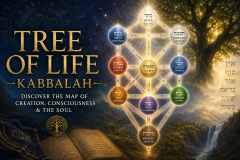
    ChatGPT Image Jun 26, 2026, 04_57_25 PM
    PlayPause
    ChatGPT Image Jun 26, 2026, 04_57_25 PM
    image-slider-with-thumbnail1.jpeg
    image-slider-with-thumbnail2.jpeg
    ChatGPT Image Jun 26, 2026, 05_01_22 PM
    image-slider-with-thumbnail3.jpeg
    image-slider-with-thumbnail4.jpeg
    ChatGPT Image Jun 26, 2026, 04_51_54 PM
    image-slider-with-thumbnail5.jpeg
    image-slider-with-thumbnail6.jpeg
    ChatGPT Image Jun 27, 2026, 09_24_15 AM
    image-slider-with-thumbnail7.jpeg
    ChatGPT Image Jun 26, 2026, 04_54_23 PM
    ChatGPT Image Jun 26, 2026, 04_19_39 PM
    ChatGPT Image Jun 26, 2026, 04_28_19 PM
    ChatGPT Image Jun 26, 2026, 04_37_00 PM
    ChatGPT Image Jun 26, 2026, 05_04_59 PM
    ChatGPT Image Jun 26, 2026, 04_38_53 PM
    ChatGPT Image Jun 27, 2026, 09_13_22 AM
    ChatGPT Image Jun 26, 2026, 04_41_25 PM
    ChatGPT Image Jun 26, 2026, 04_44_22 PM
    ChatGPT Image Jun 30, 2026, 10_56_33 AM
    previous arrow
    next arrow

    Mythology and Symbolism

    Myths communicate through symbols.

    A dragon may symbolize chaos, fear, greed, or untamed power.

    A mountain may represent spiritual ascent.

    A river may suggest transformation or passage.

    A forest may symbolize mystery and the unknown.

    These symbols allow myths to communicate multiple layers of meaning simultaneously.

    Readers interested in the broader language of symbols may enjoy our introduction:

    What Is Symbolism? A Beginner’s Introduction

    Symbolism gives mythology much of its enduring power.

    The images continue speaking long after the original stories are told.

    Mythology and Archetypes

    Many myths revolve around recurring character types.

    These figures appear again and again throughout world traditions.

    Examples include:

    • The Hero
    • The Wise Elder
    • The Trickster
    • The Shadow
    • The Divine Child
    • The Great Mother

    Carl Jung referred to these recurring patterns as archetypes.

    He believed archetypes emerge from deep structures within the human psyche.

    Myths provide some of the clearest expressions of these patterns.

    When people recognize themselves within mythic stories, they often connect with archetypal experiences that transcend culture and historical period.

    Future articles in this series will explore archetypal figures in much greater detail.

    Mythology and Psychology

    The relationship between mythology and psychology became especially important during the twentieth century.

    Carl Jung argued that myths reveal psychological truths about human development.

    According to Jung, mythological symbols often emerge in dreams, fantasies, religious experiences, and creative works.

    Myths therefore serve as maps of inner experience.

    The hero’s journey may represent personal growth.

    A descent into the underworld may symbolize confronting hidden aspects of the self.

    A battle with a monster may reflect internal struggles.

    Through this lens, mythology becomes more than a collection of stories.

    It becomes a language for understanding human experience.

    Mythology and Spiritual Reflection

    Many people approach mythology as a spiritual resource.

    This does not necessarily require belief in every mythological narrative.

    Rather, myths offer opportunities for contemplation.

    A myth can encourage questions such as:

    • What challenge am I facing?
    • What transformation is occurring in my life?
    • What wisdom am I overlooking?
    • What fears must I confront?

    These questions help explain why myths remain relevant long after the cultures that created them have changed.

    The stories continue offering insight into contemporary experiences.

    Mythology and Christian Hermetic Thought

    Mythological themes often appear within mystical and symbolic traditions.

    Christian Hermeticism, for example, places significant emphasis on symbolic interpretation, wisdom, and contemplation.

    Rather than dismissing symbolic narratives, Christian Hermetic thinkers frequently explored how stories, images, and patterns could reveal deeper truths.

    Readers interested in this tradition may wish to explore:

    What Is Christian Hermeticism?

    Both mythology and Christian Hermetic thought recognize the power of symbols to communicate meaning beyond literal description.

    Mythology and Alchemy

    The relationship between mythology and alchemy is equally rich.

    Alchemical texts frequently employ mythological imagery.

    Kings and queens.

    Dragons.

    Serpents.

    Sacred marriages.

    Deaths and rebirths.

    These symbols communicate ideas about transformation and wisdom.

    Readers interested in this symbolic tradition may enjoy:

    What Is Alchemy? Historical and Spiritual Perspectives

    Alchemy demonstrates how mythological images can become tools for reflection and personal growth.

    Mythology in Modern Culture

    Despite claims that modern society has moved beyond mythology, mythic patterns remain everywhere.

    Consider popular films and novels.

    Heroes leave ordinary worlds and enter extraordinary ones.

    Mentors provide guidance.

    Trials test character.

    Sacrifices lead to transformation.

    These structures appear repeatedly because they continue resonating with audiences.

    Modern storytelling often reimagines ancient patterns rather than abandoning them.

    The clothes change.

    The archetypes remain.

    Why Mythology Matters in a Digital Age

    The modern world excels at providing information.

    Yet information alone does not always provide meaning.

    People still ask:

    • Why am I here?
    • What gives life purpose?
    • How do I face suffering?
    • What does transformation look like?

    Myths address these questions through narrative rather than argument.

    They offer symbolic frameworks for understanding experiences that cannot always be solved through logic alone.

    This is one reason mythology remains valuable.

    It helps people explore meaning.

    Mythology and Personal Reflection

    One of mythology’s greatest strengths lies in its ability to encourage self-reflection.

    A reader may encounter a myth and recognize aspects of their own journey.

    The story becomes a mirror.

    Through that mirror, new perspectives emerge.

    Challenges gain context.

    Experiences gain meaning.

    Questions become clearer.

    This reflective dimension helps explain why mythology remains relevant across generations.

    The stories continue changing because the readers continue changing.

    Learning from Myth Without Literalism

    People sometimes assume that appreciating mythology requires believing every story as historical fact.

    This assumption creates unnecessary tension.

    Many scholars, spiritual practitioners, psychologists, and readers value myths because of their symbolic significance.

    Myths can remain meaningful even when approached as symbolic narratives.

    Their value lies not merely in what happened but in what the stories reveal about humanity.

    Why Mythology Matters Today

    The question why mythology matters becomes easier to answer once we recognize what myths actually do.

    They help people:

    • Understand themselves
    • Explore meaning
    • Reflect on transformation
    • Connect with cultural traditions
    • Engage with symbols
    • Navigate life’s challenges

    Myths remain relevant because human beings continue facing many of the same questions that concerned ancient cultures.

    The world changes.

    The questions endure.

    Learning More About Mythology

    Readers interested in the scholarly study of mythology can explore the work of the Joseph Campbell Foundation and the Mythological Studies Program at Pacifica Graduate Institute.

    Both organizations provide valuable resources for understanding mythology, symbolism, archetypes, and the enduring role of myth in human culture.

    Frequently Asked Questions

    Why mythology matters in modern life?

    Mythology helps people explore meaning, identity, transformation, and the deeper patterns that shape human experience.

    Are myths simply false stories?

    Not necessarily. Myths often communicate symbolic, cultural, psychological, or spiritual truths rather than historical facts.

    Why do mythological themes appear across cultures?

    Many scholars believe myths reflect recurring human experiences and concerns that transcend cultural boundaries.

    What is the connection between mythology and psychology?

    Psychologists such as Carl Jung argued that myths express archetypal patterns that emerge within the human psyche.

    Does mythology still influence modern culture?

    Yes. Mythic themes continue appearing in literature, film, religion, art, and popular storytelling.

    How does mythology relate to symbolism?

    Myths communicate through symbols that convey deeper meanings beyond literal interpretation.

    Can mythology support personal growth?

    Many people use myths as tools for reflection, self-understanding, and exploring life’s challenges and transformations.

    Final Thoughts

    Myths endure because they address realities that remain central to human life.

    They speak to questions of purpose, identity, suffering, wisdom, courage, and transformation. They provide symbolic maps for navigating experiences that often resist simple explanations.

    The question why mythology matters ultimately leads back to the human search for meaning.

    Ancient storytellers used myths to explore that search.

    Modern readers continue doing the same.

    Whether encountered through religion, literature, psychology, symbolism, or spiritual reflection, mythology remains one of humanity’s most powerful ways of understanding itself.

    The stories survive because the questions survive.

    And as long as people continue asking those questions, mythology will continue to matter.

  • What Is Symbolism? A Beginner’s Introduction

    What Is Symbolism? A Beginner’s Introduction

    Every day, people encounter symbols without giving them much thought.

    A wedding ring suggests commitment. A flag represents a nation. A dove may evoke peace. A crossroads can imply choice or uncertainty. Even simple objects can carry meanings that extend far beyond their physical form.

    This ability to communicate ideas through images, objects, stories, and patterns lies at the heart of symbolism.

    The question what is symbolism may seem straightforward at first, yet symbolism touches nearly every aspect of human experience. Religion, mythology, literature, art, dreams, psychology, folklore, and spiritual traditions all rely on symbols to communicate meaning.

    Throughout history, people have used symbols to express ideas that are difficult to explain through ordinary language alone. Symbols help us explore mystery, transformation, identity, purpose, and the deeper patterns that shape our lives.

    Whether you are interested in mythology, spirituality, tarot, dreams, alchemy, archetypes, or personal growth, learning how symbolism works provides a foundation for understanding many of the world’s most enduring traditions.

    This guide introduces symbolism from a beginner’s perspective and explores why symbols continue to matter in the modern world.

    what is symbolism

    In This Guide

    • What symbolism is
    • Why humans use symbols
    • The difference between signs and symbols
    • Symbolism in religion, mythology, and culture
    • Personal and universal symbols
    • Symbolism and psychology
    • Symbolism in spiritual traditions
    • Common misconceptions about symbols
    • Why symbolism still matters
    • Frequently asked questions

    What Is Symbolism?

    At its simplest, symbolism is the use of images, objects, stories, actions, or patterns to represent ideas beyond their literal meaning.

    A symbol points toward something larger than itself.

    A rose is a flower.

    At the same time, it may symbolize love, beauty, mystery, devotion, secrecy, or spiritual unfolding.

    A river is a body of water.

    Yet many cultures associate rivers with life, movement, change, cleansing, or the passage of time.

    Symbols function on multiple levels at once. They exist in the physical world while simultaneously communicating deeper meanings.

    A complete answer to the question what is symbolism must therefore recognize that symbols operate both externally and internally. They appear in the world around us and within the world of human imagination.

    Why Do Humans Use Symbols?

    Human beings naturally think through images and associations.

    Long before written language became widespread, people communicated ideas through stories, rituals, art, and symbolic objects.

    Symbols allow us to express complex concepts quickly.

    Consider the image of a crown.

    Without a lengthy explanation, many people associate a crown with authority, leadership, responsibility, power, or sovereignty.

    Symbols condense meaning.

    They create connections between visible images and invisible ideas.

    Because of this, symbolism appears in every culture throughout history.

    Signs and Symbols: What Is the Difference?

    People often use the words sign and symbol interchangeably, but they are not exactly the same.

    A sign usually has a specific and direct meaning.

    A stop sign tells drivers to stop.

    A restroom sign indicates a location.

    The meaning remains relatively fixed.

    Symbols are different.

    A symbol invites interpretation.

    Its meaning may expand depending on context.

    For example, a tree might symbolize:

    • Growth
    • Wisdom
    • Family lineage
    • Stability
    • Life itself

    The symbol remains open to deeper reflection.

    This openness gives symbols much of their power.

    Explore Our Courses
    ChatGPT Image Jun 26, 2026, 04_57_25 PM
    PlayPause
    ChatGPT Image Jun 26, 2026, 04_57_25 PM
    image-slider-with-thumbnail1.jpeg
    image-slider-with-thumbnail2.jpeg
    ChatGPT Image Jun 26, 2026, 05_01_22 PM
    image-slider-with-thumbnail3.jpeg
    image-slider-with-thumbnail4.jpeg
    ChatGPT Image Jun 26, 2026, 04_51_54 PM
    image-slider-with-thumbnail5.jpeg
    image-slider-with-thumbnail6.jpeg
    ChatGPT Image Jun 27, 2026, 09_24_15 AM
    image-slider-with-thumbnail7.jpeg
    ChatGPT Image Jun 26, 2026, 04_54_23 PM
    ChatGPT Image Jun 26, 2026, 04_19_39 PM
    ChatGPT Image Jun 26, 2026, 04_28_19 PM
    ChatGPT Image Jun 26, 2026, 04_37_00 PM
    ChatGPT Image Jun 26, 2026, 05_04_59 PM
    ChatGPT Image Jun 26, 2026, 04_38_53 PM
    ChatGPT Image Jun 27, 2026, 09_13_22 AM
    ChatGPT Image Jun 26, 2026, 04_41_25 PM
    ChatGPT Image Jun 26, 2026, 04_44_22 PM
    ChatGPT Image Jun 30, 2026, 10_56_33 AM
    previous arrow
    next arrow

    Symbolism in Ancient Cultures

    Symbolism appears throughout the ancient world.

    Egyptian temples featured symbolic imagery connected to creation, kingship, and divine order.

    Greek mythology used symbolic stories to explore human nature and the relationship between mortals and the gods.

    Many Indigenous traditions around the world use animals, natural features, and sacred objects as symbolic expressions of spiritual truths.

    Symbols helped people understand the cosmos and their place within it.

    Rather than viewing the world as random, many ancient cultures perceived layers of meaning woven throughout creation.

    Symbolism in Religion

    Religious traditions rely heavily on symbols.

    Christianity uses the cross, bread, wine, water, light, and the shepherd as powerful symbolic images.
    Judaism incorporates symbolic objects such as the menorah and the Torah scroll.
    Buddhism employs symbols including the lotus flower and the wheel.

    Islamic art often uses geometric patterns that reflect divine order and unity.

    Symbols help communicate spiritual truths that extend beyond literal description.

    They invite contemplation and reflection.

    For many believers, symbols serve as bridges between visible realities and invisible mysteries.

    Symbolism in Mythology

    Myths are filled with symbolic patterns.

    Heroes leave home and face trials.

    Dragons guard treasures.

    Wise guides appear at critical moments.

    Journeys lead to transformation.

    These recurring images often communicate deeper truths about human experience.

    Mythological symbolism remains influential because the themes continue to resonate across cultures and generations.

    The stories may change, but the underlying patterns often remain recognizable.

    Universal and Cultural Symbols

    Some symbols appear across many cultures.

    The sun often represents life, illumination, vitality, or divine presence.

    Water frequently symbolizes purification, emotion, renewal, or transformation.

    Mountains often suggest spiritual ascent, stability, or encounters with the sacred.

    At the same time, symbols can carry meanings specific to particular cultures.

    A symbol that communicates one idea in one tradition may carry a different meaning elsewhere.

    Understanding symbolism therefore requires attention to both universal patterns and cultural context.

    Personal Symbols

    Not all symbols are universal.

    Some become meaningful through personal experience.

    A particular song may remind someone of a loved one.

    A specific location may symbolize home, freedom, or loss.

    A family heirloom may carry emotional significance unavailable to outsiders.

    Personal symbols often emerge through memory, relationships, and life experiences.

    Because of this, symbolism operates at both collective and individual levels.

    Symbolism and Psychology

    The study of symbolism received renewed attention through psychology, particularly through the work of Carl Jung.

    Jung believed that symbols reveal important aspects of the human psyche.

    He argued that dreams, myths, religions, and stories often express recurring symbolic patterns.

    These patterns help people understand themselves and navigate life’s challenges.

    According to Jung, symbols can communicate insights that remain difficult to access through rational analysis alone.

    His work continues to influence modern discussions of symbolism, spirituality, creativity, and personal development.

    Symbolism and Archetypes

    Closely related to symbolism is the concept of archetypes.

    Archetypes are recurring patterns or figures that appear across cultures and stories.

    Examples include:

    • The Hero
    • The Wise Elder
    • The Trickster
    • The Shadow
    • The Caregiver

    These archetypal figures often appear through symbolic images and narratives.

    In a future article, we will explore archetypes in greater depth and examine their role within psychology, mythology, and spirituality.

    Symbolism in Spiritual Traditions

    Many spiritual traditions rely on symbolic language.

    Rather than explaining everything directly, they use images, metaphors, rituals, and stories.

    Symbols create space for contemplation.

    They encourage reflection rather than simple answers.

    This symbolic approach appears throughout:

    • Mysticism
    • Alchemy
    • Hermeticism
    • Religious traditions
    • Meditation practices

    For example, readers interested in symbolic spiritual traditions may enjoy our introduction to:

    What Is Christian Hermeticism?

    Christian Hermetic thought places strong emphasis on symbolism as a means of exploring wisdom, creation, and spiritual understanding.

    Symbolism in Alchemy

    Alchemy provides one of the richest symbolic languages in Western history.

    Alchemical texts often feature:

    • Suns and moons
    • Kings and queens
    • Dragons
    • Birds
    • Vessels
    • Crowns
    • Gardens

    These images communicate ideas about transformation, wisdom, and the human search for wholeness.

    Rather than describing concepts directly, alchemists frequently expressed them through symbolic imagery.

    Readers interested in this tradition may wish to explore:

    What Is Alchemy? Historical and Spiritual Perspectives

    Alchemy demonstrates how symbols can communicate multiple layers of meaning simultaneously.

    Symbolism in Tarot and Runes

    Tarot and runes are also symbolic systems.

    Each card or rune functions as more than a simple image.

    The symbols invite reflection on experiences, relationships, choices, challenges, and opportunities.

    Readers interested in these traditions may find these beginner guides helpful:

    Beginner’s Guide to Tarot

    and

    Beginner’s Guide to Runes

    In both cases, symbolism provides the foundation for interpretation and reflection.

    Common Misconceptions About Symbolism

    Symbols Have Only One Meaning

    Most symbols possess multiple layers of meaning.

    Context matters.

    History matters.

    Personal experience matters.

    Every Symbol Is Universal

    Some symbols appear broadly across cultures, but many depend on specific historical and cultural settings.

    Symbols Are Merely Decorative

    Throughout history, symbols have carried profound religious, philosophical, psychological, and spiritual significance.

    Symbolism Is Irrational

    Symbols complement rational thought rather than replacing it.

    They help express dimensions of experience that logic alone may struggle to communicate.

    Why Symbolism Still Matters

    Modern society often emphasizes information and analysis.

    These tools are valuable.

    Yet human beings continue to respond to stories, images, rituals, and symbols.

    Symbols help us navigate experiences that resist simple explanations.

    Love.

    Loss.

    Purpose.

    Identity.

    Transformation.

    Faith.

    Hope.

    Symbols provide a language for exploring these realities.

    They connect personal experience with larger patterns of meaning.

    This enduring relevance explains why symbolism continues to appear in literature, psychology, religion, art, mythology, and spiritual practice.

    How Should Beginners Study Symbolism?

    Begin with observation.

    Pay attention to recurring images.

    Notice patterns across stories, myths, dreams, and traditions.

    Read widely.

    Study cultural contexts.

    Remain curious.

    Most importantly, avoid rushing toward definitive conclusions.

    Symbols often reveal their meanings gradually.

    A symbol that seems simple today may carry greater depth tomorrow.

    The study of symbolism rewards patience and reflection.

    Learning More About Symbolism

    Readers interested in the scholarly study of symbolism can explore the work of the The Joseph Campbell Foundation, which provides resources related to mythology, symbolism, and the recurring patterns found within stories and cultures around the world.

    Its educational materials offer valuable insight into the symbolic dimensions of myth and human experience.

    Frequently Asked Questions

    What is symbolism in simple terms?

    Symbolism is the use of images, objects, stories, or actions to represent ideas beyond their literal meaning.

    Why are symbols important?

    Symbols help communicate complex ideas, emotions, and spiritual concepts that may be difficult to express directly.

    Are symbols universal?

    Some symbols appear across many cultures, but others depend on specific cultural, historical, or personal contexts.

    Is symbolism connected to psychology?

    Yes. Psychologists such as Carl Jung explored how symbols appear in dreams, myths, and human development.

    How does symbolism relate to spirituality?

    Many spiritual traditions use symbols to communicate deeper truths and encourage contemplation.

    Do symbols have fixed meanings?

    Not always. Context often influences how symbols are interpreted.

    Can anyone learn symbolism?

    Absolutely. Studying symbolism begins with curiosity, observation, and a willingness to explore deeper layers of meaning.

    Final Thoughts

    The question what is symbolism opens the door to one of humanity’s oldest and most fascinating ways of understanding the world.

    Symbols appear wherever people seek meaning.

    They appear in myths and religions, dreams and stories, rituals and works of art. They help connect visible realities with invisible ideas.

    By learning the language of symbolism, we begin to notice patterns that might otherwise remain hidden. We become more attentive to the ways cultures communicate wisdom, how traditions preserve meaning, and how individuals make sense of their experiences.

    The study of symbolism is ultimately the study of meaning itself.

    And once you begin noticing symbols, you may discover that they have been speaking all along.

error

Enjoyed this article? Please spread the word :)

RSS
Follow by Email
Pinterest
fb-share-icon
Reddit
BLUESKY