Category: Christian Hermeticism

  • An Introduction to Christian Hermetic Thought

    An Introduction to Christian Hermetic Thought

    Christian Hermeticism occupies a fascinating place at the crossroads of Christianity, philosophy, symbolism, mysticism, and spiritual reflection.

    For some readers, the phrase may sound unfamiliar. For others, it may evoke images of alchemy, hidden wisdom, Renaissance scholars, or esoteric traditions. The reality is both more complex and more interesting than many assume.

    Christian Hermetic thought represents an effort to explore spiritual truths through symbolism, contemplation, philosophy, and the study of sacred patterns. Rather than rejecting Christianity, many Christian Hermetic thinkers sought to deepen their understanding of Christian teachings by engaging with ancient wisdom traditions, symbolic interpretation, and contemplative practices.

    Throughout history, this approach has influenced theologians, philosophers, mystics, artists, alchemists, and spiritual seekers. Its influence can be found in Renaissance scholarship, Western esotericism, symbolic theology, and even modern discussions of archetypes and symbolism.

    This article introduces the foundations of Christian Hermetic thought and explores why it continues to attract interest today.

    Christian Hermetic thought

    In This Guide

    • What Christian Hermetic thought is
    • The origins of Hermeticism
    • Christianity and Hermetic philosophy
    • Renaissance Christian Hermeticism
    • Key themes in Christian Hermetic thought
    • Symbolism and sacred interpretation
    • Alchemy and spiritual transformation
    • Common misconceptions
    • Why Christian Hermetic thought remains relevant
    • Frequently asked questions

    What Is Christian Hermetic Thought?

    Christian Hermetic thought refers to a stream of spiritual and philosophical reflection that combines Christian theology with ideas associated with the Hermetic tradition.

    Rather than viewing faith and wisdom as separate pursuits, Christian Hermetic thinkers often sought harmony between revelation, reason, symbolism, and contemplation.

    Many viewed the created world as filled with signs that point toward deeper spiritual realities.

    They believed that careful reflection on scripture, nature, symbols, and spiritual experience could reveal insights into divine wisdom.

    This approach does not represent a single denomination or unified movement.

    Instead, it encompasses a variety of thinkers, traditions, and perspectives connected by shared interests in symbolism, contemplation, and spiritual understanding.


    What Is Hermeticism?

    To understand Christian Hermetic thought, it helps to understand Hermeticism itself.

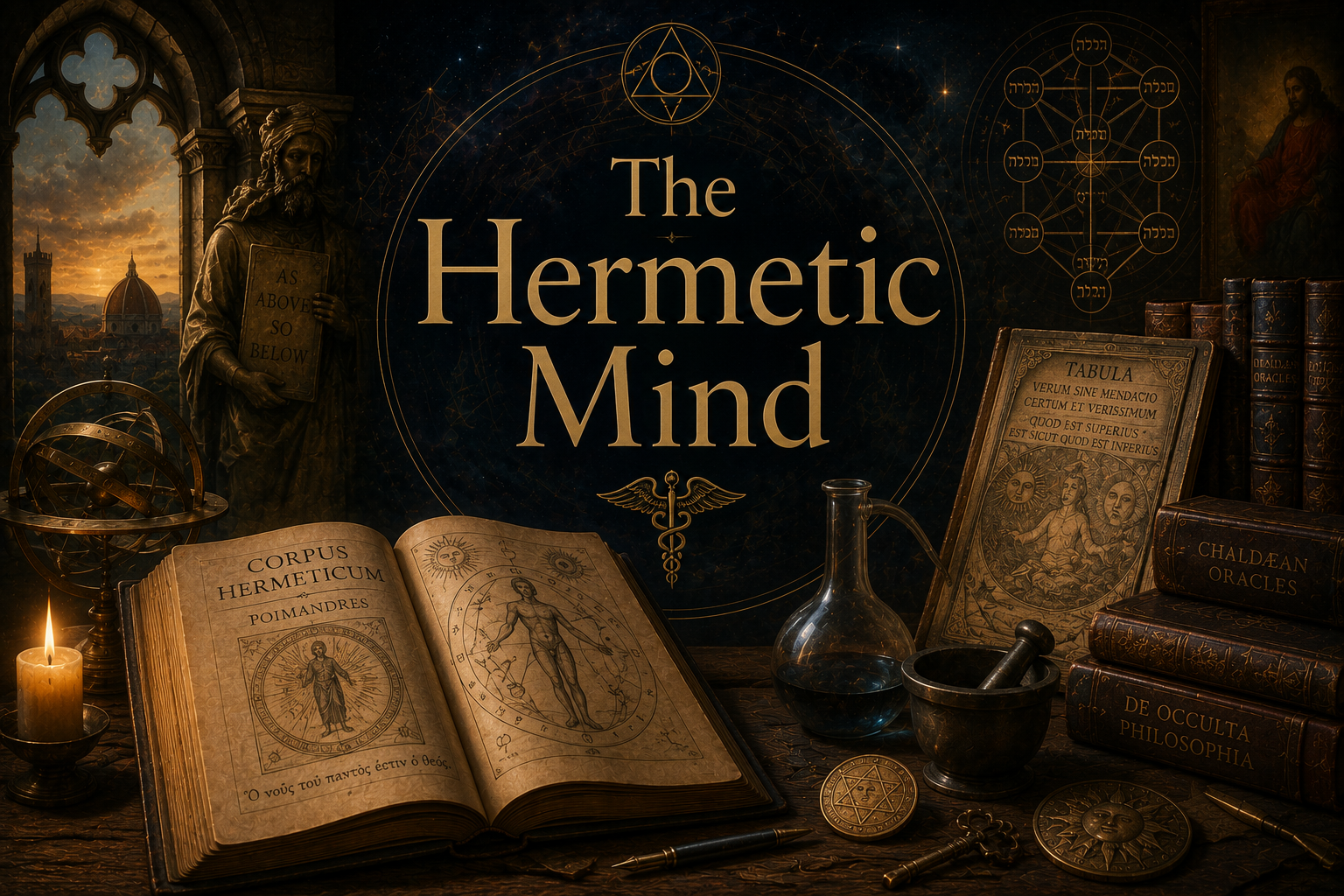
    Hermeticism traces its origins to a collection of writings associated with Hermes Trismegistus, a legendary figure who combines elements of the Greek god Hermes and the Egyptian god Thoth.

    The writings attributed to Hermes became known collectively as the Hermetica.

    These texts explore topics such as:

    • Divine wisdom
    • Creation
    • Humanity’s relationship to God
    • Spiritual transformation
    • Knowledge of the self
    • Knowledge of the cosmos

    Although historians now understand these writings to have emerged during the early centuries of the Common Era, they exercised tremendous influence throughout later periods.

    The Renaissance Rediscovery

    Christian Hermetic thought flourished during the Renaissance.

    In 1463, the scholar Marsilio Ficino translated portions of the Corpus Hermeticum into Latin.

    Many Renaissance thinkers believed these texts contained ancient wisdom that predated classical philosophy.

    This belief encouraged scholars to explore possible connections between Hermetic teachings and Christianity.

    Although modern scholarship has revised many historical assumptions about the origins of the Hermetic texts, their influence on Renaissance thought remains undeniable.

    Christianity and Hermetic Wisdom

    Christian Hermetic thinkers generally viewed wisdom as something that could be sought through multiple avenues.

    Scripture remained central.

    Yet many believed God also revealed truths through:

    • Nature
    • Symbolism
    • Reason
    • Philosophy
    • Contemplation

    This perspective encouraged the study of symbolic patterns within creation.

    The world itself became a kind of sacred text worthy of reflection.

    Many Christian Hermetic writers saw no contradiction between faith and the pursuit of wisdom.

    Instead, they viewed both as complementary.

    The Importance of Symbolism

    Few themes are more important to Christian Hermetic thought than symbolism.

    Symbols communicate truths that often resist simple explanation.

    A symbol points beyond itself.

    It invites contemplation rather than immediate conclusions.

    Christian Hermetic thinkers frequently interpreted:

    • Biblical imagery
    • Natural phenomena
    • Sacred geometry
    • Numbers
    • Rituals
    • Myths

    through symbolic lenses.

    Readers interested in the broader study of symbols may enjoy:

    What Is Symbolism? A Beginner’s Introduction

    Symbolic interpretation remains one of the defining characteristics of Christian Hermetic thought.

    The World as a Reflection of Divine Order

    A recurring theme within Christian Hermetic writings is the belief that creation reflects divine wisdom.

    This perspective sometimes appears through the phrase “as above, so below,” often associated with Hermetic literature.

    Although interpretations vary, many Christian Hermetic thinkers viewed the visible world as reflecting deeper spiritual realities.

    Nature becomes meaningful.

    Patterns become significant.

    The created order reveals traces of divine intelligence.

    This outlook encourages careful observation and contemplation.

    Christian Hermetic Thought and Alchemy

    One of the most famous areas of overlap involves alchemy.

    Popular culture often reduces alchemy to attempts to turn lead into gold.

    Historical alchemy was far more complex.

    Many alchemists viewed physical processes as symbolic representations of spiritual transformation.

    The purification of metals became a metaphor for the purification of the soul.

    Readers interested in this topic may enjoy:

    What Is Alchemy? Historical and Spiritual Perspectives

    For many Christian Hermetic thinkers, alchemy provided a symbolic language for discussing spiritual growth and renewal.

    The Search for Wisdom

    Wisdom occupies a central place within Christian Hermetic thought.

    The pursuit of wisdom differs from the pursuit of information.

    Information accumulates facts.

    Wisdom seeks understanding.

    Many Christian Hermetic writers emphasized:

    • Self-knowledge
    • Humility
    • Reflection
    • Discernment
    • Spiritual maturity

    These qualities were viewed as essential for genuine spiritual development.

    Contemplation and Inner Transformation

    Christian Hermetic thought often encourages contemplation.

    Contemplation involves attentive reflection rather than constant activity.

    It asks readers to slow down.

    To observe.

    To reflect.

    And to seek deeper understanding.

    This contemplative dimension distinguishes Christian Hermetic thought from purely intellectual approaches.

    Knowledge alone is not enough.

    Transformation matters.

    Christian Hermetic Thought and Archetypes

    Modern readers often notice parallels between Christian Hermetic symbolism and archetypal psychology.

    Carl Jung himself showed considerable interest in alchemy, symbolism, and religious imagery.

    Readers interested in archetypal patterns may enjoy:

    What Is an Archetype? A Jungian Introduction

    Although Jung and Christian Hermetic thinkers approached these subjects differently, both traditions recognize recurring symbolic patterns that appear across human experience.

    Myth, Symbol, and Sacred Narrative

    Christian Hermetic thought frequently engages with mythic and symbolic narratives.

    This does not necessarily mean treating myths as literal history.

    Rather, myths can communicate spiritual truths through symbolic storytelling.

    Readers interested in mythological themes may enjoy:

    Why Mythology Matters

    Many Christian Hermetic thinkers explored how sacred stories reveal deeper patterns of meaning.

    Tarot and Christian Hermetic Thought

    Some modern readers first encounter Christian Hermetic ideas through tarot literature.

    The most famous example is Meditations on the Tarot: A Journey into Christian Hermeticism.

    This influential work uses the Major Arcana as starting points for profound reflections on Christianity, symbolism, philosophy, and spiritual development.

    Readers interested in tarot studies may enjoy:

    Recommended Books for Studying Tarot

    It is important to note that Christian Hermetic thought extends far beyond tarot itself.

    The tarot simply provides one symbolic framework among many.

    Common Misconceptions About Christian Hermetic Thought

    Christian Hermeticism Is a Religion

    Christian Hermetic thought is better understood as a philosophical and spiritual approach rather than a separate religion.

    It Rejects Christianity

    Historically, Christian Hermetic thinkers generally viewed themselves as engaging deeply with Christian ideas rather than rejecting them.

    It Is Primarily About Secret Knowledge

    While wisdom and insight are important themes, Christian Hermetic thought emphasizes spiritual transformation rather than hidden information alone.

    It Is Only About Alchemy

    Alchemy represents one aspect of the tradition, but symbolism, contemplation, theology, philosophy, and spiritual reflection are equally important.

    Why Christian Hermetic Thought Still Matters

    Modern readers continue exploring Christian Hermetic thought for several reasons.

    It offers a framework for integrating:

    • Faith
    • Symbolism
    • Philosophy
    • Contemplation
    • Personal growth

    Many people seek spiritual approaches that encourage both reflection and intellectual engagement.

    Christian Hermetic thought provides one possible path.

    Its emphasis on symbolism, wisdom, and transformation remains relevant in a world often dominated by speed and distraction.

    Learning More About Christian Hermetic Thought

    Readers interested in historical sources can explore the The Internet Sacred Text Archive’s Hermetic Collection and the The Gnostic Society Library’s Hermetic Texts.

    Both collections provide access to important Hermetic writings and historical resources for further study.

    Frequently Asked Questions

    What is Christian Hermetic thought?

    Christian Hermetic thought combines Christian spirituality with Hermetic philosophy, symbolism, contemplation, and the pursuit of wisdom.

    Who was Hermes Trismegistus?

    Hermes Trismegistus is a legendary figure associated with the writings known as the Hermetica.

    Is Christian Hermeticism a denomination?

    No. It is a philosophical and spiritual tradition rather than a church or denomination.

    What role does symbolism play?

    Symbolism plays a central role because it allows spiritual truths to be explored through images, patterns, stories, and metaphors.

    How is alchemy connected to Christian Hermeticism?

    Many Christian Hermetic thinkers interpreted alchemical processes as symbols of spiritual transformation.

    Is Christian Hermetic thought compatible with Christianity?

    Different Christians answer this question differently. Historically, many Christian Hermetic thinkers viewed their work as an extension of Christian reflection.

    Where should beginners start?

    A good starting point is learning about symbolism, Hermetic history, Christian mysticism, and the major themes found within the Hermetic tradition.

    Final Thoughts

    Christian Hermetic thought represents a rich and multifaceted tradition that brings together spirituality, symbolism, contemplation, philosophy, and the search for wisdom.

    Rather than offering simple answers, it encourages deeper questions.

    It invites readers to explore the relationship between visible and invisible realities, between symbols and meaning, between knowledge and transformation.

    Its influence can be seen in alchemy, mysticism, symbolic theology, archetypal thought, and modern spiritual reflection.

    Whether approached historically, philosophically, or spiritually, Christian Hermetic thought offers a fascinating perspective on the human search for wisdom.

    At its heart lies a simple yet profound conviction:

    The world contains meaning, and thoughtful reflection can help us perceive it more clearly.

  • What Is Christian Hermeticism? An Introduction to a Symbolic and Mystical Tradition

    What Is Christian Hermeticism? An Introduction to a Symbolic and Mystical Tradition

    The phrase Christian Hermeticism often raises questions.

    Some people encounter it while studying alchemy, mysticism, symbolism, or Renaissance philosophy. Others come across the term while exploring the Western mystery traditions and wonder whether it belongs within Christianity, outside of Christianity, or somewhere in between.

    The answer is not always simple.

    Christian Hermeticism sits at the crossroads of faith, philosophy, symbolism, and contemplation. It draws from Christian theology while engaging with a body of writings and ideas associated with Hermetic thought. Throughout history, various thinkers sought to understand how divine wisdom, sacred symbolism, nature, and spiritual transformation might fit together within a Christian worldview.

    Because of this unique blend, Christian Hermeticism continues to attract readers interested in mysticism, symbolism, alchemy, contemplative spirituality, and the deeper layers of religious meaning.

    This guide explores the historical foundations of Christian Hermeticism and introduces its major themes without assuming prior knowledge.

    What Is Christian Hermeticism

    In This Guide

    • What Christian Hermeticism is
    • The origins of Hermetic thought
    • Hermes Trismegistus and the Hermetic writings
    • The relationship between Christianity and Hermeticism
    • Christian Hermeticism during the Renaissance
    • Symbolism and contemplation
    • Common misconceptions
    • Why Christian Hermeticism still matters
    • Frequently asked questions

    What Is Christian Hermeticism?

    At its most basic level, Christian Hermeticism is a tradition of thought that combines Christian spirituality with ideas found in the Hermetic writings.

    Rather than seeing the world as meaningless or disconnected, Christian Hermetic thinkers often viewed creation as filled with signs, symbols, patterns, and reflections of divine wisdom.

    Nature could reveal spiritual truths.

    Symbols could illuminate deeper realities.

    The visible world could point toward the invisible.

    This perspective encouraged contemplation, symbolic interpretation, and the search for wisdom.

    A complete answer to the question of what Christian Hermeticism is must therefore include both historical and spiritual dimensions.

    Historically, it emerged through the interaction of Christian theology and ancient Hermetic texts.

    Spiritually, it encouraged reflection on the relationship between God, humanity, creation, and wisdom.

    Who Was Hermes Trismegistus?

    The name Hermes Trismegistus stands at the center of Hermetic tradition.

    Hermes Trismegistus is a legendary figure associated with a collection of writings known as the Hermetica.

    Ancient readers often viewed him as an extraordinarily wise teacher who possessed profound knowledge about the cosmos, humanity, and the divine.

    Modern scholarship generally understands Hermes Trismegistus as a symbolic or literary figure rather than a historical individual.

    The writings attributed to him likely emerged over several centuries in the Hellenistic world, especially in Egypt during the early centuries of the Common Era.

    These texts explored themes such as:

    • Divine wisdom
    • The nature of reality
    • Human consciousness
    • Spiritual ascent
    • The relationship between humanity and God

    Although the Hermetic writings are not Christian texts, many later Christian thinkers found aspects of them intriguing and compatible with certain philosophical and spiritual questions.

    What Are the Hermetic Writings?

    The Hermetic writings consist of several texts traditionally attributed to Hermes Trismegistus.

    Among the most famous are:

    • The Corpus Hermeticum
    • The Asclepius
    • The Emerald Tablet

    These writings explore philosophical and spiritual themes through dialogues, teachings, prayers, and symbolic language.

    Readers encounter discussions about:

    • Creation
    • Divine order
    • Wisdom
    • Human nature
    • Spiritual knowledge

    Many of these texts emphasize the pursuit of wisdom and the transformation of understanding through contemplation.

    Their influence spread widely throughout late antiquity, the Middle Ages, and the Renaissance.

    How Did Christianity and Hermeticism Meet?

    The relationship between Christianity and Hermeticism developed gradually.

    Early Christian thinkers lived in a world filled with competing philosophies, religious traditions, and schools of thought.

    Some Christian scholars encountered Hermetic writings alongside Platonic philosophy and other intellectual traditions.

    Later generations became interested in whether certain Hermetic ideas reflected truths compatible with Christian belief.

    Particular attention focused on themes such as:

    • Divine wisdom
    • Creation
    • Spiritual renewal
    • The pursuit of truth

    Not every Christian agreed with these interpretations.

    Many remained skeptical of Hermetic texts.

    Others viewed them as valuable sources of philosophical insight.

    The conversation continued for centuries.

    Christian Hermeticism During the Renaissance

    Christian Hermeticism became especially influential during the Renaissance.

    In fifteenth-century Italy, scholars recovered and translated ancient texts that had been unavailable in Western Europe for generations.

    Among these were the Hermetic writings.

    Many Renaissance thinkers believed these texts contained ancient wisdom that could enrich Christian understanding.

    One of the most influential figures was Marsilio Ficino, who translated the Corpus Hermeticum into Latin.

    Another important figure was Giovanni Pico della Mirandola, whose work sought to synthesize various philosophical and religious traditions.

    These scholars did not reject Christianity.

    Rather, they attempted to explore how ancient wisdom traditions might illuminate Christian truths.

    Their efforts helped shape Renaissance spirituality, philosophy, and symbolism.

    The Importance of Wisdom

    One theme appears repeatedly throughout Christian Hermetic thought.

    Wisdom.

    Wisdom is more than information.

    It is more than intellectual knowledge.

    Wisdom involves seeing reality clearly and understanding one’s place within the larger order of creation.

    Many Christian Hermetic thinkers viewed wisdom as a gift that draws the soul closer to God.

    This emphasis connects Hermetic thought to biblical traditions that celebrate wisdom literature.

    Books such as Proverbs and Ecclesiastes reflect a similar concern with understanding divine order and living in harmony with truth.

    The World as Symbol

    One of the most distinctive aspects of Christian Hermeticism is its symbolic perspective.

    Rather than viewing symbols as decorative additions, Christian Hermetic thinkers often saw them as meaningful expressions of deeper realities.

    Nature became a kind of symbolic language.

    The stars, seasons, elements, animals, plants, and patterns of creation could all serve as reminders of spiritual truths.

    This symbolic outlook influenced:

    • Art
    • Literature
    • Architecture
    • Mysticism
    • Alchemy

    The goal was not to escape the physical world but to perceive the deeper meanings reflected within it.

    Christian Hermeticism and Alchemy

    Many people first encounter Christian Hermeticism through alchemy.

    Although the two traditions are not identical, they often overlap.

    Alchemists frequently used symbolic language to describe transformation.

    Gold, fire, vessels, kings, queens, and celestial bodies all carried symbolic significance.

    Many Christian Hermetic thinkers interpreted these images as reflections of spiritual growth and renewal.

    Readers interested in the historical and symbolic dimensions of alchemy may also enjoy our article:

    What Is Alchemy? Historical and Spiritual Perspectives

    Throughout history, alchemy and Christian Hermeticism often shared a common interest in transformation, wisdom, and the relationship between the visible and invisible worlds.

    Contemplation and Spiritual Reflection

    Christian Hermeticism places significant emphasis on contemplation.

    Contemplation involves more than analysis.

    It requires attentive reflection.

    It invites the individual to pause, observe, and consider deeper realities.

    For many practitioners, symbols functioned as aids to contemplation.

    A symbol could focus attention.

    A story could reveal wisdom.

    A natural process could suggest spiritual truths.

    This contemplative dimension distinguishes Christian Hermeticism from purely academic or intellectual approaches.

    Knowledge was valuable, but wisdom remained the ultimate goal.

    Common Misconceptions About Christian Hermeticism

    Christian Hermeticism Is a Separate Religion

    It is not.

    Christian Hermeticism developed within Christian contexts and engages with Christian theology, even as it draws on Hermetic sources.

    Christian Hermeticism Is the Same as Occultism

    Not exactly.

    While some later esoteric traditions incorporated Hermetic ideas, Christian Hermeticism has its own historical development and should not be reduced to modern occult movements.

    Christian Hermeticism Rejects Christianity

    Historically, many Christian Hermetic thinkers saw themselves as committed Christians.

    They sought deeper understanding, not replacement of Christian belief.

    Christian Hermeticism Is Only About Secret Knowledge

    Although Hermetic writings often discuss wisdom and insight, the tradition involves much more than hidden teachings.

    It includes contemplation, symbolism, philosophy, theology, and spiritual reflection.

    Why Christian Hermeticism Still Matters

    The modern world often separates knowledge into isolated categories.

    Science examines nature.

    Religion addresses faith.

    Art explores meaning.

    Psychology studies the mind.

    Christian Hermeticism offers a different perspective.

    It encourages readers to consider connections.

    It asks how wisdom, symbolism, spirituality, and creation might relate to one another.

    Many contemporary readers find this integrative approach appealing.

    The tradition reminds us that symbols can still communicate meaning and that contemplation remains valuable in a world dominated by speed and distraction.

    Christian Hermeticism and Symbolic Traditions

    Students of symbolism often discover connections between Christian Hermetic thought and other symbolic systems.

    Tarot, for example, developed much later and in a different context, yet many modern readers approach it through symbolic and contemplative lenses.

    Readers interested in symbolic interpretation may wish to explore our:

    Beginner’s Guide to Tarot

    Both traditions invite careful attention to symbols, images, and patterns of meaning.

    Learning More About Christian Hermeticism

    Readers interested in scholarly resources can explore the work of The Warburg Institute, one of the leading centers for the study of Renaissance thought, Hermeticism, symbolism, and the history of ideas.

    The institute’s research has contributed significantly to modern understanding of Hermetic traditions and their influence on Western culture.

    Frequently Asked Questions

    What is Christian Hermeticism in simple terms?

    Christian Hermeticism is a tradition that combines Christian spirituality with ideas found in the Hermetic writings, emphasizing wisdom, symbolism, contemplation, and the search for deeper understanding.

    Who wrote the Hermetic texts?

    The texts are traditionally attributed to Hermes Trismegistus, though modern scholars believe they were written by multiple authors over several centuries.

    Is Christian Hermeticism a denomination?

    No. It is a philosophical and spiritual tradition rather than a separate church or denomination.

    Is Christian Hermeticism compatible with Christianity?

    Different Christians answer this question differently. Historically, many Christian Hermetic thinkers considered themselves faithful Christians while drawing insight from Hermetic writings.

    Is Christian Hermeticism connected to alchemy?

    Yes. The two traditions often intersect through their shared interest in symbolism, transformation, and spiritual reflection.

    Why is symbolism so important in Christian Hermeticism?

    Symbols are viewed as meaningful expressions of deeper realities. They help communicate truths that may be difficult to express through ordinary language.

    Do I need to study alchemy to understand Christian Hermeticism?

    No. Alchemy is one related tradition, but Christian Hermeticism also involves theology, philosophy, contemplation, and symbolism.

    Final Thoughts

    The question of what Christian Hermeticism is opens the door to a fascinating and often misunderstood tradition.

    Rooted in the encounter between Christian spirituality and Hermetic thought, it invites readers to explore wisdom, symbolism, contemplation, and the meaningful patterns woven throughout creation.

    Christian Hermeticism is not merely a historical curiosity. Its questions remain relevant today.

    How do we find wisdom?

    How do symbols communicate truth?

    And how do we understand our place within the larger order of creation?

    For centuries, Christian Hermetic thinkers wrestled with these questions through prayer, study, reflection, and symbolic interpretation. Their writings continue to offer a rich source of insight for anyone interested in the deeper dimensions of spirituality and meaning.

    In future articles, we will explore the symbols, ideas, and practices that shaped this remarkable tradition in greater depth.

    Read more in the article, An Introduction to Christian Hermetic Thought.

error

Enjoyed this article? Please spread the word :)

RSS
Follow by Email
Pinterest
fb-share-icon
Reddit
BLUESKY