Introduction
The High Priestess is one of the most enigmatic and enduring figures in tarot. Seated between pillars, veiled yet present, silent yet commanding, she invites the reader into a mode of knowing that is different from analysis, argument, or outward display. If The Magician turns power outward through will and skill, The High Priestess turns awareness inward toward mystery, receptivity, memory, and hidden order. To study her well is to recognize that not all wisdom announces itself. Some truths wait behind symbols, dreams, scripture, myth, and the quiet movements of the soul.
The High Priestess tarot meaning remains central to serious tarot study because the card stands at the threshold between visible form and invisible depth. She is the second numbered card of the Major Arcana, yet she often feels older than the sequence itself. Readers encounter her as guardian, witness, initiatrix, contemplative, and keeper of the inner book. Her image has attracted occultists, mystics, historians, Jungian thinkers, Christian Hermetic readers, and symbolists because she embodies a paradox: she conceals in order to reveal. Her silence is not emptiness. It is gestation.
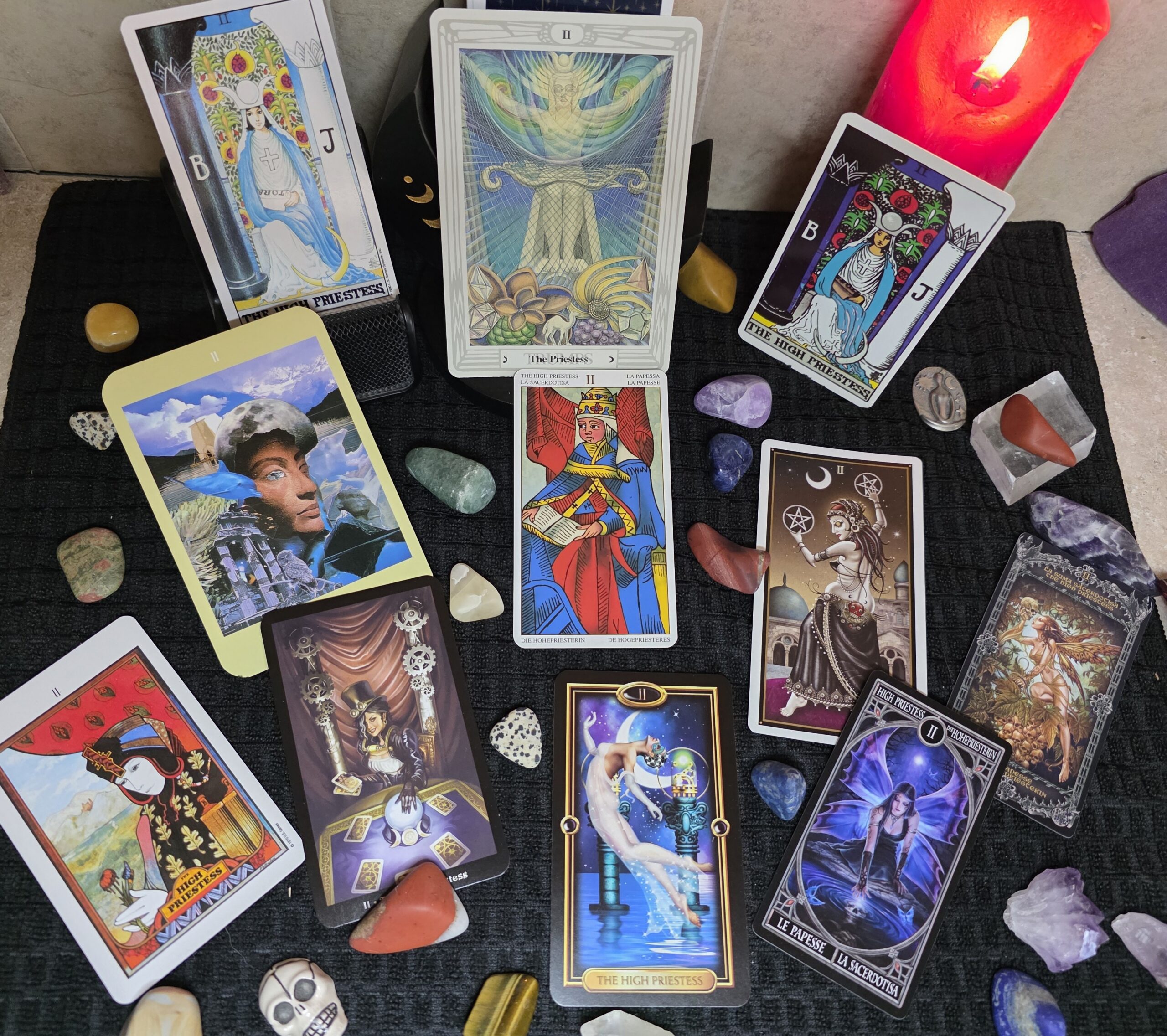
Within the structure of the deck, The High Priestess follows The Magician and precedes The Empress. This placement matters. After the first burst of conscious intention comes a pause, an inward turning, a descent into the hidden matrix from which meaningful action must arise. Rachel Pollack emphasizes that the early Major Arcana present not only external stages of development but also inner principles that must be integrated if the Fool’s journey is to mature (Pollack). Mary K. Greer likewise treats the card as a call to reflection, intuition, and symbolic literacy rather than passive vagueness (Greer). Benebell Wen expands this by situating the card within a broad esoteric framework that includes Kabbalah, sacred symbolism, and contemplative practice (Wen).
For readers who want a deeper symbolic education, Rose and Rune also recommends The Hermetic Mirror, a course that explores esoteric symbolism, contemplative interpretation, and the inner language of sacred images. It pairs especially well with serious study of The High Priestess because this card rewards patience, layered reading, and a willingness to sit with mystery rather than rush toward certainty.
This article contains affiliate links.
This guide approaches The High Priestess through multiple lenses: historical, symbolic, mythological, archetypal, psychological, esoteric, Christian Hermetic, alchemical, and practical. Rather than reducing the card to fortune-telling phrases, we will explore how her imagery developed, how Rider-Waite-Smith and Thoth traditions differ, how the card relates to the Tree of Life, astrology, and contemplative spirituality, and why modern readers continue to find in her an image of profound inward authority. Along the way, we will connect to related Rose and Rune resources, including Articles, Courses, and foundational tarot study such as Beginner’s Guide to Tarot, How Tarot Works as a Reflective Practice, and The Magician Tarot Meaning.
In This Guide
- Card Overview
- Historical Origins of the Card
- Rider-Waite-Smith Symbolism
- Thoth Tarot Symbolism
- The Card’s Archetypal Meaning
- Mythological Connections
- Alchemical Symbolism
- Christian Hermetic Reflections
- The Tree of Life and Hebrew Letter
- Astrological Correspondences
- Chakra Correspondence
- Upright Meaning
- Reversed Meaning
- Practical Reflection Questions
- Meditation Exercise
- Related Cards
- What Modern Readers Can Learn from The High Priestess
- Frequently Asked Questions
- Further Reading
- Final Thoughts
Card Overview
Traditional card number: II (2)
Suit: Major Arcana
Element: Water, though some systems emphasize lunar receptivity over a single classical element
Planet: The Moon
Zodiac sign: No single zodiac sign in the Golden Dawn system, though some modern readers connect the card with Cancer because of lunar symbolism
Hebrew letter: Gimel (ג)
Path on the Tree of Life: The path between Kether and Tiphereth in the Golden Dawn arrangement
Chakra correspondence: Third Eye, with secondary resonance at the Crown
Golden Dawn correspondence: Gimel, the Moon
Thoth correspondence: Priestess, Gimel, the Moon
Keywords: intuition, mystery, receptivity, contemplation, hidden knowledge, sacred memory, silence, gestation, discernment, symbolic wisdom
Core themes: inner knowing, the unseen order behind appearances, the veil between worlds, spiritual listening, and the disciplined cultivation of insight
The number two introduces polarity, relation, reflection, and interiority. Where one asserts, two receives and mirrors. In the sequence of the Major Arcana, The High Priestess represents not passivity but depth. She teaches that consciousness matures not only by acting upon the world but also by learning how to listen, remember, and discern.
Historical Origins of the Card
To understand The High Priestess tarot meaning, it helps to begin with the card’s historical complexity. Unlike some tarot figures whose visual identity remained relatively stable, this card changed dramatically over time. In early decks, the figure often appeared not as a mystical priestess in the modern sense but as the Papess, a controversial and symbolically charged image that reflected medieval and Renaissance religious imagination.
In early Italian tarot, including fifteenth-century traditions, the card was commonly titled La Papessa. Historians have long debated the meaning of this figure. Some connect her to the medieval legend of Pope Joan, the apocryphal story of a woman who supposedly rose to the papacy in disguise. Others interpret the image more broadly as a satirical or allegorical figure shaped by the political and religious tensions of the time. Robert M. Place argues that early tarot imagery should be understood within the symbolic and cultural environment of Renaissance Europe rather than retrofitted too quickly into later occult systems (Place).
In the Tarot de Marseille tradition, the Papess remains seated, veiled in ecclesiastical authority, often holding a book. That book becomes one of the most enduring features of the card’s later evolution. Even before occult reinterpretation, the image already suggested literacy, hidden doctrine, and a guarded relationship to sacred knowledge. Yet the early card did not necessarily imply intuitive mysticism in the modern sense. Its meaning was more ambiguous, poised between authority, secrecy, transgression, and symbolic inversion.
The nineteenth-century occult revival transformed the card decisively. Writers such as Éliphas Lévi, members of the Hermetic Order of the Golden Dawn, and later Arthur Edward Waite reinterpreted the Papess through Kabbalah, esotericism, and symbolic theology. The figure ceased to be a controversial pseudo-papal image and became instead a guardian of hidden wisdom. By the time of the Rider-Waite-Smith deck in 1909, the card had become The High Priestess, a title that shifted emphasis from ecclesiastical anomaly to sacred interior authority.
This change matters. Waite and Pamela Colman Smith did not simply rename the card. They reimagined it. The new image drew on biblical symbolism, temple imagery, Kabbalah, lunar mysticism, and esoteric notions of the veil. The card’s center of gravity moved from historical satire or religious ambiguity toward contemplative mystery. In the Thoth deck, Crowley and Lady Frieda Harris continued this esoteric development, deepening the card’s lunar, qabalistic, and initiatory dimensions.
Tarot historians such as Michael Dummett, Ronald Decker, and Robert M. Place remind readers that these occult layers are later accretions, not original fifteenth-century meanings. Yet later meanings are not therefore invalid. Tarot evolved precisely because successive generations found in its images a symbolic language capable of carrying new insight. The High Priestess is one of the clearest examples of this evolution. She begins as the Papess, becomes an esoteric guardian, and now stands for many readers as an archetype of contemplative wisdom, symbolic literacy, and spiritual depth.
Rider-Waite-Smith Symbolism
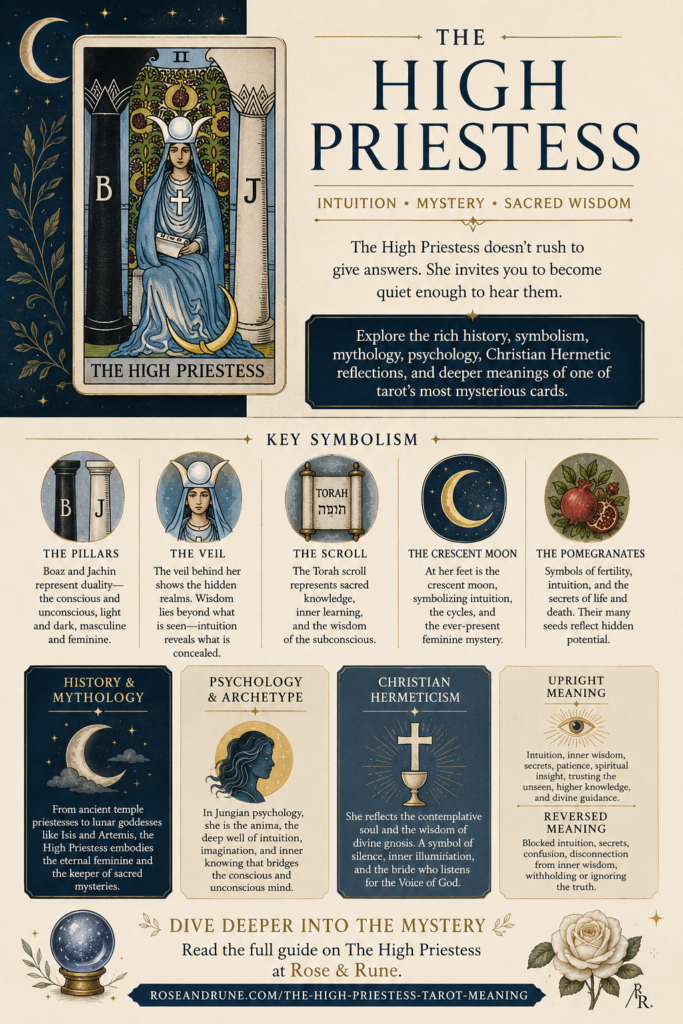
The Rider-Waite-Smith High Priestess is among the most symbolically dense images in modern tarot. Pamela Colman Smith’s illustration, guided by Waite’s esoteric framework, presents a seated woman between two pillars marked B and J, usually read as Boaz and Jachin from the Temple of Solomon. Between them hangs a veil decorated with pomegranates. At her feet lies a crescent moon. She wears blue robes, a cross on her chest, and a crown associated with lunar cycles. In her lap rests a partially concealed scroll marked TORA.
The colors establish the card’s emotional and symbolic atmosphere. Blue dominates, suggesting depth, stillness, water, contemplation, and interiority. White accents imply purity, clarity, and sacred reserve. Unlike the vivid red and active gesture of The Magician, The High Priestess remains composed and inward. Her authority does not depend on movement. It depends on presence.
The pillars are among the card’s most discussed elements. In biblical tradition, Boaz and Jachin stood at the entrance to Solomon’s Temple (1 Kings 7:21). In esoteric interpretation, they come to signify polarity: mercy and severity, active and receptive, outer and inner, manifest and hidden. The High Priestess sits between them, not choosing one over the other but inhabiting the threshold where opposites are held in tension. Pollack notes that this middle position suggests a consciousness capable of containing contradiction without collapsing into simplification (Pollack).
The veil behind her is equally important. Decorated with pomegranates, it recalls the veil of the Temple and the hidden sanctuary beyond ordinary access. Pomegranates carry associations with fertility, sacred abundance, Persephone, and the mysteries of descent and return. The veil indicates that reality contains more than appears on the surface. Yet it also implies that access to deeper truth requires preparation. The High Priestess does not tear the veil open. She guards it.
The scroll marked TORA is partially hidden, and that partial concealment matters. Waite likely intended a layered allusion: Torah as sacred law, but also a broader suggestion that wisdom is both revealed and concealed. Knowledge is not absent. It is veiled, requiring study, reverence, and readiness. Greer often emphasizes that tarot is not merely about intuition in the vague modern sense but about learning how to read symbols, patterns, and contexts with disciplined attention (Greer). The scroll embodies that principle.
The crescent moon at her feet links the card to cycles, tides, dreams, memory, and reflected light. The moon does not generate its own radiance. It receives and reflects. This makes it a fitting emblem for the card’s mode of knowing. The High Priestess does not dominate reality by force. She receives what is subtle, hidden, and indirect. Wen highlights the card’s connection to esoteric literacy, noting that true intuitive knowledge is often cultivated through symbolic study rather than impulsive guesswork (Wen).
Numerologically, the card’s number two reinforces reflection, duality, and relation. Hidden symbolism also appears in the card’s posture. She is seated, stable, and frontal, suggesting judgment without haste. Her gaze meets the viewer, but she does not perform for the viewer. This is crucial. The High Priestess is not a spectacle. She is a presence before whom the reader must become quiet enough to perceive.
Thoth Tarot Symbolism
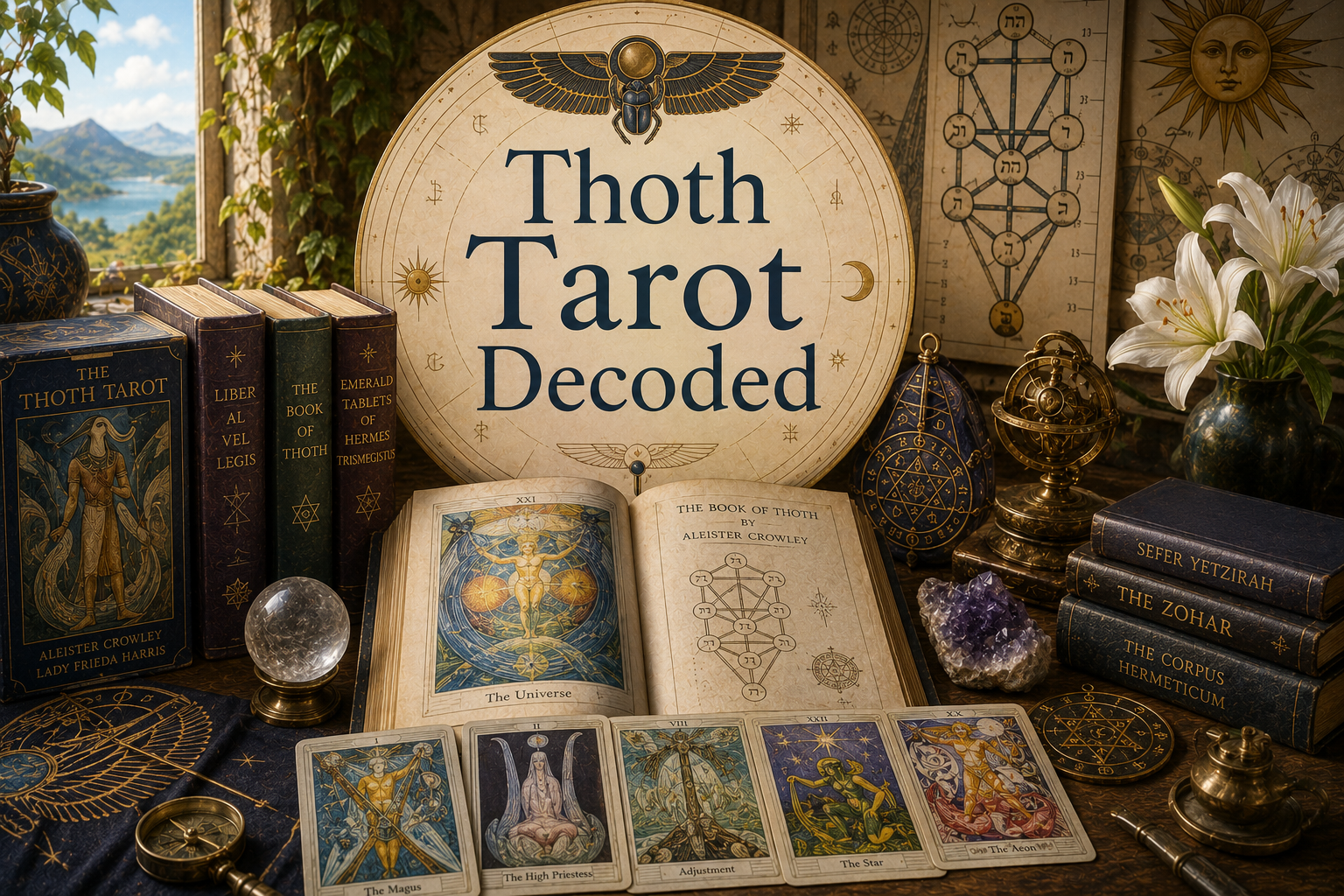
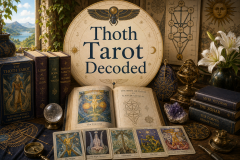
In the Thoth Tarot, Crowley titles the card The Priestess, not The High Priestess. The shift is subtle but meaningful. Crowley and Lady Frieda Harris intensify the card’s lunar, qabalistic, and initiatory dimensions while reducing some of the explicitly temple-like structure of the Rider-Waite-Smith image. The Thoth Priestess appears as a flowing, veiled, luminous figure associated with hidden currents, gestation, and the transmission of mystery.
Crowley’s system preserves the Golden Dawn attribution of the Moon and the Hebrew letter Gimel. In The Book of Thoth, he describes the Priestess as the feminine counterpart to the Magus, but not merely in a simplistic gendered sense. She is the matrix through which force becomes form, the hidden medium of transmission, and the guardian of the secret before articulation. Lon Milo DuQuette, in his commentary on the Thoth deck, emphasizes that the Priestess represents the current of inner knowing that precedes rational formulation. She is not anti-intellectual. She is pre-discursive and trans-discursive at once (DuQuette).
Compared with the Rider-Waite-Smith version, the Thoth Priestess feels less architectural and more fluid. The card emphasizes movement within stillness, hidden gestation, and the lunar current as a path of initiation. Astrological attribution remains lunar, but the card’s qabalistic associations become more explicit. The Priestess is not simply a keeper of secrets. She is the living process by which hidden wisdom becomes available to consciousness.
This changes the feel of The High Priestess tarot meaning when approached through Thoth. The Rider-Waite-Smith card often appears as a guardian at the threshold. The Thoth Priestess appears more like the threshold itself: a current, a passage, a veil of becoming. Crowley’s broader esoteric framework also intensifies the card’s initiatory role. She is linked not only to contemplation but to the transmission of mystery through symbol, image, and sacred silence.
For readers comparing systems, the difference is instructive. The Rider-Waite-Smith High Priestess often teaches discernment through symbolic stillness. The Thoth Priestess deepens that lesson by showing mystery as a living process. Both agree that wisdom cannot be reduced to surface appearances. Both insist that the unseen is not unreal. It is formative.
The Card’s Archetypal Meaning
From a Jungian and archetypal perspective, The High Priestess represents the deep feminine principle of inward knowing, symbolic receptivity, and psychic mediation. She is related to what Jung called the anima in certain contexts, though she cannot be reduced to that single category. More broadly, she belongs to the family of archetypes that include the wise woman, the sibyl, the veiled goddess, the contemplative virgin, and the guardian of hidden wisdom.
Her mature expression includes discernment, patience, interior authority, and the capacity to listen beneath noise. She knows that not every truth should be forced into premature speech. She honors incubation. And she trusts symbolic process. In psychological terms, she often appears when the conscious mind must learn to receive material from dreams, intuition, memory, or the unconscious without immediately flattening it into explanation.
Her shadow expression can take several forms. One is passivity masquerading as wisdom: withholding action not from discernment but from fear. Another is obscurity for its own sake, the use of mystery as a defense against vulnerability or clarity. A third is dissociation from embodied life, as though inwardness alone were enough. Pollack repeatedly warns against reducing feminine archetypes in tarot to sentimental clichés or vague intuition. The High Priestess is not merely dreamy. She is exacting in her own way (Pollack).
Jung’s work on symbols and the collective unconscious helps explain why this card resonates so strongly. Human beings do not live by rational analysis alone. Dreams, myths, images, and religious symbols shape psychic life in ways that often precede conscious understanding. The High Priestess stands for the faculty that can remain with such material long enough for meaning to ripen. In this sense, she is deeply relevant to individuation. She teaches the ego to become less domineering and more receptive to the deeper patterns of the psyche.
Stephan Hoeller and other Jungian interpreters of symbolic traditions often emphasize gnosis as inner knowing born of encounter rather than mere information. The High Priestess belongs to that mode of knowing. She does not abolish reason. She places reason in a larger field where symbol, contemplation, and inward listening also matter.
Mythological Connections
The High Priestess gathers together a wide range of mythological parallels. In Greek mythology, she resonates with Persephone, Artemis, Hecate, and Athena in different ways. Persephone reflects the mystery of descent, hidden cycles, and knowledge gained through the underworld. Hecate brings the liminal aspect of the card: crossroads, moonlight, thresholds, and occult knowing. Artemis contributes virgin sovereignty and untamed inward authority. Athena adds wisdom, though The High Priestess is less strategic than contemplative.
In Egyptian symbolism, Isis is perhaps the strongest parallel. Isis is veiled wisdom, sacred motherhood, magical literacy, and initiatory knowledge. The famous phrase “I am all that has been, is, and shall be, and no mortal has lifted my veil” became deeply influential in Western esoteric imagination, even if its reception history is complex. The High Priestess often feels Isiac because she unites concealment with revelation.
Norse mythology offers subtler parallels through figures associated with fate, memory, and hidden knowledge, including the Norns. Though not a direct equivalent, the Norns share with The High Priestess an association with the unseen patterning of life. They do not merely predict. They participate in the weaving of destiny.
Biblical symbolism enters through temple imagery, the veil, wisdom literature, and Marian resonances. The card is not reducible to Christian symbolism, yet Christian readers often perceive in her echoes of Sophia, contemplative receptivity, and the hidden heart that “ponders” rather than proclaims. The pomegranates, veil, and sacred book all support this layered scriptural atmosphere.
Across mythic traditions, the recurring pattern is clear: there exists a feminine figure who mediates hidden wisdom, guards thresholds, and teaches that truth is not always immediate. The High Priestess belongs to that lineage.
Alchemical Symbolism
Although The High Priestess is not as overtly alchemical as Temperance or Death, the card has profound alchemical relevance. She belongs especially to the hidden stages of the work: dissolution, gestation, containment, and the inward preparation without which transformation cannot proceed. Adam McLean’s studies of alchemical imagery repeatedly show that transformation requires vessels, veils, and periods of obscurity. The work often begins in darkness, in secrecy, in the hidden matrix where opposites are not yet reconciled but are being prepared for union (McLean).
The High Priestess can be linked to the alchemical vessel, the vas, because she contains rather than disperses. She is also related to the lunar principle in alchemy: reflection, moisture, receptivity, and the subtle body of transformation. If The Magician corresponds more readily to the active spark, The High Priestess corresponds to the chamber in which that spark can be received, cooled, reflected upon, and transmuted.
In inner development, this means that not every stage of growth is visible. Some of the most important transformations occur in silence, in waiting, in dream life, in prayer, in study, and in the patient endurance of uncertainty. The card teaches that incubation is not failure. It is part of the work.
Christian Hermetic Reflections
Within Christian Hermetic reading, The High Priestess invites contemplation rather than dogma. Valentin Tomberg’s Meditations on the Tarot does not treat the card as a license for esoteric spectacle but as an invitation into sacred interiority, purity of attention, and reverent listening. In such a framework, the card may be approached through Marian symbolism, Sophia, the hidden heart, and the contemplative life.
One fruitful Christian symbolic parallel is the distinction between outer law and inward inscription. The partially veiled scroll suggests that sacred truth is not merely possessed; it must be interiorized. Another is the temple veil, which marks the boundary between ordinary perception and holy depth. The High Priestess does not abolish that boundary. She teaches reverence before it.
Hermetically, the card expresses the principle that reality is layered and that symbolic contemplation can become a path of purification. Yet Christian Hermetic reflection also guards against spiritual vanity. The High Priestess is not a collector of secrets. She is a witness to the truth that wisdom requires humility, patience, and inward silence. Her lesson is not elitism. It is receptivity.
The Tree of Life and Hebrew Letter
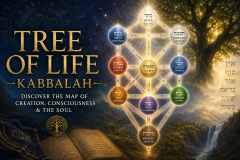
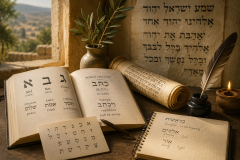
In the Golden Dawn system, The High Priestess corresponds to the Hebrew letter Gimel (ג), often translated as “camel.” The camel is a striking symbol because it suggests passage across difficult terrain, carrying what is necessary through the desert. This deepens the card’s meaning considerably. The High Priestess is not static mystery for its own sake. She is the path by which consciousness crosses the wilderness between transcendence and beauty.
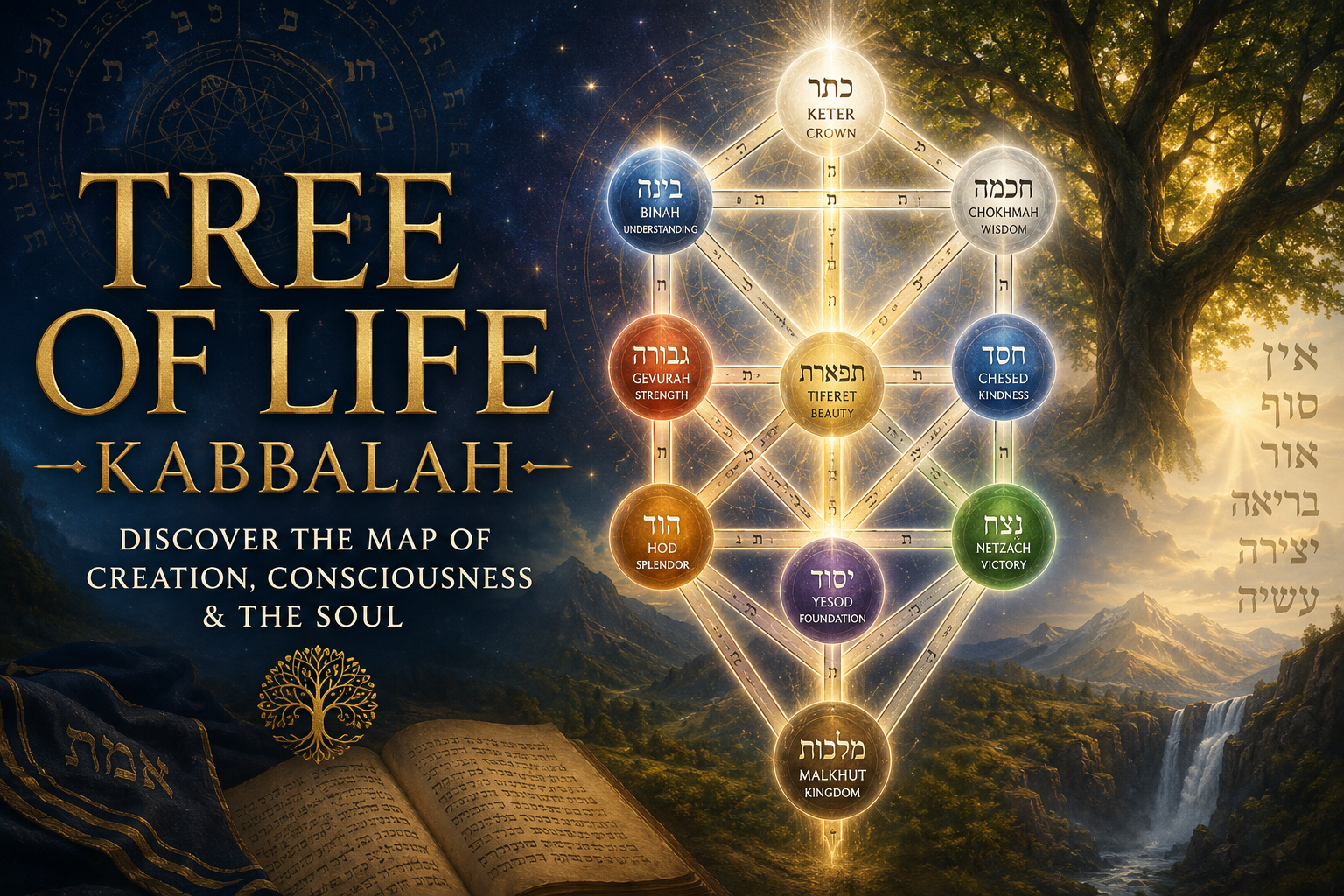
On the Tree of Life, Gimel connects Kether and Tiphereth. In other words, the path links the Crown, pure divine unity, with Beauty, the harmonized center associated with the solar heart. This means the lunar path of The High Priestess mediates between transcendence and integrated consciousness. She is the subtle current through which higher light becomes inwardly receivable.
Golden Dawn attributions therefore make the card far more than a symbol of vague intuition. She is a precise path of transmission. Her relationship to neighboring paths also matters. She stands between the ungraspable source and the harmonized self, suggesting that contemplation, symbol, and inward purification are necessary if divine reality is to become meaningful within human life.
Astrological Correspondences
The traditional occult correspondence for The High Priestess is the Moon. This is one of the most fitting astrological attributions in tarot. The Moon governs cycles, tides, memory, dream life, fertility, reflection, psychic sensitivity, and the hidden rhythms that shape emotional and symbolic experience. Lunar consciousness is not irrational. It is indirect, imaginal, and responsive.
Some modern readers also connect the card with Cancer because of the Moon’s rulership there, though this is secondary to the primary lunar attribution. The element most often associated with the card is water, especially in the sense of psychic depth, receptivity, and inward movement. These correspondences influence interpretation by emphasizing that the card’s wisdom is cyclical rather than linear, reflective rather than declarative, and subtle rather than forceful.
Chakra Correspondence
The High Priestess is most naturally associated with the Third Eye chakra. This correspondence highlights perception beyond surface appearances, symbolic insight, dream awareness, and contemplative discernment. Psychologically, the Third Eye relates to pattern recognition, inner vision, and the ability to perceive meaning that is not immediately obvious. Spiritually, it points toward receptive awareness rather than domination.
Some readers also sense a secondary resonance with the Crown because the card mediates higher wisdom. Yet the Third Eye remains the strongest fit because The High Priestess is not pure transcendence. She is the faculty by which hidden meaning becomes inwardly visible.
Upright Meaning
Upright, The High Priestess suggests a period in which inward listening matters more than immediate action. The card often appears when something essential is still unfolding beneath the surface. It may indicate that the seeker already senses the truth but has not yet trusted it. It may also suggest that more observation, study, prayer, or symbolic reflection is needed before a decision becomes clear.
In personal growth, the card points toward self-trust, contemplative discipline, and the recovery of inner authority. In relationships, it can indicate emotional depth, unspoken understanding, hidden dynamics, or the need for patience and honesty about what is not yet fully conscious. Or in career matters, it may suggest research, preparation, confidential work, education, or the importance of reading the deeper context before acting. In creativity, it favors incubation, dream work, symbolic development, and gestation before public expression. Spiritually, it is one of tarot’s clearest invitations to contemplation.
Reversed Meaning
Reversed, The High Priestess does not simply become “bad intuition.” More often, the reversal suggests blocked receptivity, ignored inner knowing, confusion between fantasy and discernment, or secrecy that has become unhealthy. The card may indicate that the seeker is cut off from inward guidance, or that silence has turned into avoidance.
At times the reversal points to information withheld, emotional opacity, spiritual bypassing, or a tendency to romanticize mystery rather than do the work of interpretation. It can also indicate the opposite problem: overexposure, saying too much too soon, or forcing clarity before insight has ripened. Growth lies in restoring disciplined receptivity. The question is not merely “What am I feeling?” but “What is truly being shown, and how do I test it wisely?”
Practical Reflection Questions
- What truth am I sensing but not yet naming?
- Where in my life do I need more silence?
- What am I being asked to observe rather than control?
- How do I distinguish intuition from fear?
- What symbols, dreams, or recurring images have been asking for my attention?
- Where has waiting become wise, and where has it become avoidance?
- What hidden assumption shapes my current situation?
- What does inward authority feel like in my body?
- What sacred text, image, or practice is asking to be revisited?
- How do I respond when I do not yet have certainty?
- What part of me fears mystery?
- What part of me hides behind mystery?
- Where do I need stronger boundaries around my inner life?
- What am I still incubating?
- What would it mean to trust a quieter kind of knowing?
Meditation Exercise
Sit comfortably and let your breathing slow. Imagine yourself approaching a quiet temple at night. Two pillars stand before you. Between them hangs a veil embroidered with pomegranates. A calm figure sits before the veil, holding a hidden scroll. She does not speak. She simply waits.
Ask inwardly: “What am I ready to see?” Do not force an answer. Notice what arises: an image, a memory, a word, a feeling, or perhaps only silence. If silence comes, remain with it. Imagine the moonlight at her feet reflecting upward. Let that reflected light illuminate one question in your life. When you are ready, thank the figure, return slowly, and write down whatever emerged without judging it too quickly.
Related Cards
The High Priestess is deeply connected to neighboring Major Arcana cards. She follows The Magician, whose outward skill contrasts with her inward receptivity. She precedes The Empress, who gives embodied form to what The High Priestess holds in hidden gestation. And she also relates to The Hermit, another contemplative figure, though his wisdom is more individuated and active. The Moon shares her symbolic terrain of dream, uncertainty, and hidden process, while Justice and Temperance offer complementary forms of balance and discernment.
Among court cards, the Queens often carry aspects of her receptive authority, especially the Queen of Cups. Among the minors, the Two of Cups, Four of Swords, and Moon-related cards can echo parts of her symbolic field. In Thoth correspondences, her lunar path also deepens connections with cards concerned with reflection, hidden process, and the subtle transmission of force.
What Modern Readers Can Learn from The High Priestess
Modern life often rewards speed, visibility, and constant explanation. The High Priestess offers a corrective. She reminds readers that depth cannot always be rushed, that not every truth arrives in daylight, and that discernment requires intervals of silence. She teaches symbolic literacy in an age of distraction. And she also teaches that inwardness is not withdrawal from reality but a way of meeting reality more truthfully.
For students, artists, spiritual seekers, and reflective readers, her enduring wisdom lies in this: hidden things shape visible life. Dreams matter. Symbols matter. Memory matters. Prayer matters. Study matters. Waiting matters. The card remains relevant because human beings still need ways of honoring mystery without abandoning thought, and of cultivating intuition without surrendering discernment.
Explore More Study Paths
If you want to continue studying tarot, symbolism, and contemplative traditions, visit Articles or explore deeper learning through Courses.





Frequently Asked Questions
What does The High Priestess tarot card mean?
The card generally signifies intuition, hidden knowledge, contemplation, symbolic insight, and the need to listen beneath surface appearances.
Is The High Priestess a positive card?
Usually yes, though her positivity is subtle. She often points toward wisdom, patience, and inner guidance rather than immediate external results.
What is The High Priestess tarot meaning in love?
In relationships, the card can indicate emotional depth, unspoken understanding, hidden feelings, or the need for honesty about what remains beneath the surface.
What does The High Priestess reversed mean?
Reversed, the card may suggest blocked intuition, secrecy, confusion, avoidance, or difficulty distinguishing genuine inner guidance from projection or fear.
Why is The High Priestess associated with the Moon?
The Moon symbolizes cycles, reflection, dreams, memory, and subtle perception, all of which align closely with the card’s inward and symbolic mode of knowing.
What is the Hebrew letter of The High Priestess?
In the Golden Dawn system, the card corresponds to Gimel, the camel, a symbol of passage across difficult terrain and the transmission of what is essential.
How is The High Priestess different from The Magician?
The Magician acts, directs, and manifests. The High Priestess receives, discerns, and guards the hidden matrix from which meaningful action must arise.
Is The High Priestess about psychic powers?
Not primarily. The card is better understood as disciplined receptivity, symbolic literacy, contemplative depth, and trust in inward knowing.
What chakra corresponds to The High Priestess?
Most readers associate the card with the Third Eye chakra because of its connection to inner vision, discernment, and symbolic perception.
Why does The High Priestess still matter today?
She remains relevant because modern readers still need practices of silence, discernment, and symbolic depth in a culture shaped by speed and distraction.
Further Reading
- Rachel Pollack, Seventy-Eight Degrees of Wisdom
- Mary K. Greer, 21 Ways to Read a Tarot Card
- Benebell Wen, Holistic Tarot
- Lon Milo DuQuette, Understanding Aleister Crowley’s Thoth Tarot
- Robert M. Place, The Tarot: History, Symbolism, and Divination
- Adam McLean, Study Course on Alchemical Symbolism
- Valentin Tomberg, Meditations on the Tarot
- Arthur Edward Waite, The Original Rider Waite: The Pictorial Key To The Tarot: An Illustrated Guide
- Aleister Crowley, The Book of Thoth
For additional study, readers may also consult the Sacred Texts tarot archive, the C.G. Jung Institute of San Francisco, and the Tarot Association of the British Isles.
Final Thoughts
The High Priestess endures because she embodies a form of wisdom that modern culture often neglects but never outgrows. She reminds us that the hidden is not the unreal, that silence can be fertile, and that the deepest forms of understanding often arrive indirectly through symbol, prayer, dream, memory, and contemplation. Her lesson is not to abandon thought but to deepen it through reverence for what exceeds immediate explanation.
In that sense, The High Priestess tarot meaning is not a single definition but a discipline of attention. She asks us to become quiet enough to perceive, patient enough to wait, and honest enough to recognize that some truths are received before they are spoken. She does not flatter the ego with quick certainty. And she offers something better: the possibility of inward clarity, symbolic depth, and spiritual maturity.
If you want to continue the journey, explore more on Articles or find guided learning through Courses.
Works Cited
- Crowley, Aleister. The Book of Thoth.
- DuQuette, Lon Milo. Understanding Aleister Crowley’s Thoth Tarot.
- Greer, Mary K. Tarot for Your Self; 21 Ways to Read a Tarot Card.
- Jung, C. G. The Archetypes and the Collective Unconscious.
- McLean, Adam. Works on alchemical symbolism and Hermetic imagery.
- Place, Robert M. The Tarot: History, Symbolism, and Divination.
- Pollack, Rachel. Seventy-Eight Degrees of Wisdom.
- Tomberg, Valentin. Meditations on the Tarot.
- Waite, Arthur Edward. The Pictorial Key to the Tarot.
- Wen, Benebell. Holistic Tarot.