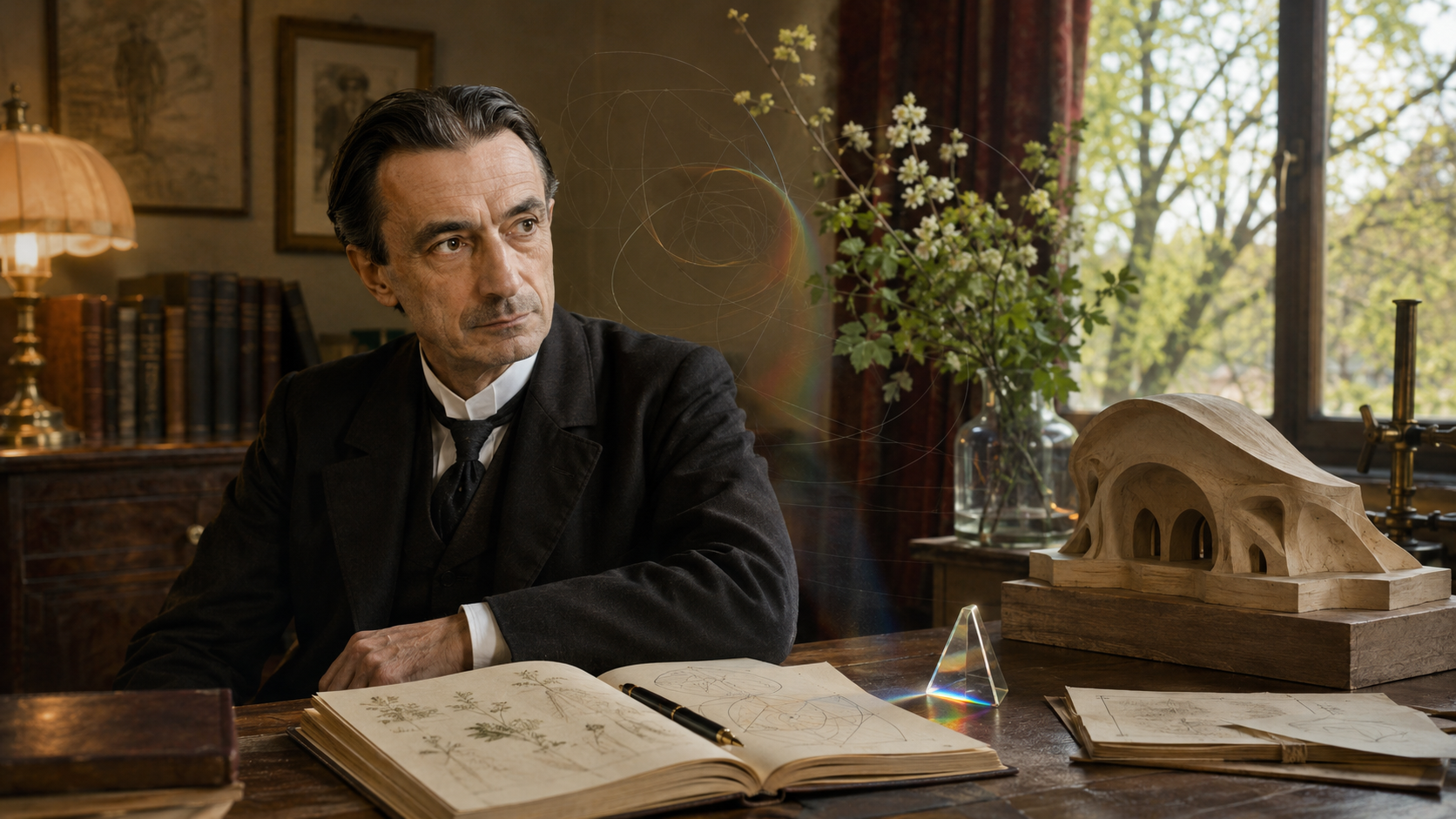

Rudolf Steiner often described Anthroposophy as a form of “spiritual science.” For modern readers, that phrase can sound like a contradiction. Science usually refers to knowledge gained through observation, experimentation, measurement, and results that others can independently verify. Spirituality appears to belong to a different realm, one shaped by faith, intuition, revelation, or personal experience.
Steiner believed this division between science and spirituality was too narrow. He argued that human beings could investigate spiritual reality through disciplined forms of consciousness. Just as scientists train themselves to observe the physical world carefully, Steiner believed spiritual seekers could train their thoughts, emotions, and perceptions to observe realities beyond the physical senses.
He did not want people merely to believe that a spiritual world exists. He wanted them to learn how to experience it consciously.
From Natural Science to Spiritual Investigation
Steiner respected the achievements of modern science. He did not argue that spiritual explanations should replace the careful study of nature. Instead, he believed science had limited itself by assuming that only physical matter could become an object of reliable knowledge.
The problem, as Steiner saw it, did not lie in the scientific method itself. It lay in restricting that method to what the physical senses could detect.
Steiner’s early intellectual work drew heavily upon Johann Wolfgang von Goethe, whose studies of plants, color, and natural forms emphasized direct and sustained observation. Goethe approached nature as something living and developing rather than as a collection of separate mechanisms. Steiner edited Goethe’s scientific writings and believed Goethe’s approach offered a model for a more participatory form of knowledge.
Spiritual science attempted to carry that kind of attentive observation into the life of consciousness. Instead of observing a plant, mineral, or physical process, the spiritual investigator would begin by observing thought, memory, imagination, emotion, and the activity of the self.
Steiner believed these inner experiences could become more precise through training.
Spiritual Knowledge Versus Religious Faith
Religious faith usually begins with trust. A believer may trust Scripture, a religious tradition, a spiritual teacher, or a community that preserves certain teachings. Faith can also involve confidence in realities that cannot be directly seen.
Steiner did not necessarily reject faith, but he did not consider it the final goal of spiritual development. He distinguished between receiving a teaching from someone else and knowing a spiritual reality through one’s own experience.
A Christian, for example, may believe in the spiritual identity of Christ because of the testimony of Scripture and the Church. Steiner wanted the spiritual investigator to move toward a direct perception of the reality behind that testimony. He believed Christ was not merely a figure of religious devotion but a cosmic spiritual being whose activity could become an object of higher knowledge.
This approach led Steiner far beyond conventional Christian theology. His teachings incorporated reincarnation, karma, the evolution of consciousness, spiritual hierarchies, and repeated stages of earthly and cosmic development. Although he presented Christ as central to human history, his interpretation differs substantially from historic Christian doctrine.
Steiner therefore did not understand spiritual science as another name for traditional Christianity. He saw it as a path through which the truths concealed within religion, mythology, and initiation traditions could become consciously known.

Training the Instruments of Perception
Physical science depends upon instruments. Telescopes extend vision into distant space. Microscopes reveal structures that the unaided eye cannot perceive. Steiner believed human consciousness could also become an instrument, but it first had to undergo preparation.
In Knowledge of the Higher Worlds and Its Attainment, Steiner describes a path of inner development based on concentration, meditation, patience, reverence, and moral responsibility. He argues that higher perception should not arise from uncontrolled fantasy or emotional excitement.
The student begins by learning to direct attention deliberately. Ordinary consciousness moves rapidly from one impression to another. Thoughts appear, emotions respond, and outside events continually interrupt the mind. Steiner’s exercises attempt to strengthen the individual’s ability to hold an image or thought steadily without losing awareness or falling into a dreamlike state.
He also places great importance on emotional balance. A person seeking spiritual knowledge must learn not to become controlled by fear, desire, anger, or personal ambition. Otherwise, private wishes may disguise themselves as spiritual revelations.
For Steiner, moral development was not separate from knowledge. It formed part of the method. The character of the observer affected what the observer could perceive.
Imagination, Inspiration, and Intuition
Steiner described three major stages of higher knowledge: Imagination, Inspiration, and Intuition. He used these words in specialized ways.
Imagination did not mean inventing fantasies. It referred to the ability to perceive meaningful spiritual images without confusing them with ordinary physical objects. These images acted as expressions of realities that could not appear directly to the physical senses.
Inspiration moved beyond the images toward the spiritual relationships or communications expressed through them. The investigator attempted to understand what the images revealed rather than interpreting them through personal preference.
Intuition represented an even deeper form of participation. In Steiner’s terminology, intuition meant direct contact with the inner nature of a spiritual being or reality. It did not mean a vague feeling or an unexplained hunch.
These stages were meant to provide spiritual investigation with an ordered method. They also reveal why Steiner’s thought attracts readers interested in symbolism. Myths, religious images, archetypal patterns, and natural forms may carry meanings that cannot be reduced to their literal appearance.
Yet Steiner repeatedly warned that the investigator must learn to distinguish genuine perception from imagination in its ordinary, fantasy-producing sense. Whether his method succeeds remains one of the central questions surrounding Anthroposophy.
Is Spiritual Science Really Science?
Modern science requires more than careful personal observation. Its claims must normally be testable, measurable, and open to independent verification. Another qualified researcher should be able to examine the evidence and determine whether the same conclusion follows.
Steiner argued that spiritual perceptions could also be verified, but only by people who had developed the necessary faculties. He sometimes compared this situation to learning mathematics. A person who has not studied geometry cannot evaluate an advanced geometric proof, but that does not make geometry a matter of private opinion.
Critics see a serious weakness in this comparison. Mathematical reasoning can be demonstrated publicly through shared logical steps. Spiritual visions cannot be displayed or measured in the same way. When two spiritual investigators disagree, no universally accepted procedure can determine which perception is correct.
For that reason, Anthroposophy should not be confused with empirical science as that term is generally understood today. Steiner’s spiritual science is better approached as an esoteric philosophy, a method of inner development, and a body of spiritual claims.
This distinction does not make Steiner’s questions meaningless. It simply prevents us from accepting the word “science” without examining how he used it.
A Path Between Materialism and Unquestioning Belief
Steiner attempted to find a path between two positions he considered incomplete. On one side stood materialism, which reduced reality to physical matter and treated consciousness as a product of biological processes. On the other stood religious belief that asked people to accept spiritual teachings without experiencing their truth directly.
Spiritual science was his proposed third path.
He wanted to preserve the clarity, discipline, and intellectual responsibility associated with science while opening inquiry to spiritual dimensions of existence. He believed the human mind could participate in reality rather than merely observe it from a distance.
This vision helps explain why Steiner’s work continues to interest people drawn to depth psychology, Christian esotericism, Hermetic philosophy, mythology, and the study of consciousness. He treated symbols as more than decorative images. He believed they could become thresholds through which the mind encountered deeper structures of reality.
Steiner’s approach also invites caution. The desire for spiritual knowledge can make people vulnerable to projection and self-deception. A compelling inner experience does not automatically prove that its interpretation is true. Any serious engagement with Steiner must preserve critical thought alongside spiritual openness.
What Steiner’s Question Still Asks of Us
The importance of Steiner’s “spiritual science” may lie as much in the question it raises as in the answers he offered.
Can spiritual life involve disciplined inquiry, or must it remain a matter of private belief? Can imagination reveal something true without becoming fantasy? Does consciousness merely observe the world, or does it possess capacities that modern materialism has not fully explained?
Steiner believed human beings did not have to choose between reason and spiritual experience. He envisioned a form of knowledge in which careful thought, moral development, and contemplative perception worked together.
Readers do not have to accept all of his conclusions to recognize the value of that challenge. Steiner asks us to become more conscious of how we know, what we mean by evidence, and whether the visible world exhausts the boundaries of reality.
His spiritual science remains controversial because it stands at an uncertain border. It is more systematic than ordinary mysticism, yet it does not meet the public standards of empirical science. It draws upon Christianity while departing from traditional Christian doctrine. It values imagination while warning against fantasy.
That borderland is precisely what makes Steiner both difficult and compelling.