Introduction
Among the Major Arcana, few images communicate abundance, beauty, fertility, and embodied wisdom as immediately as The Empress. Seated amid grain, forest, flowing water, and the signs of cultivated life, she appears not as an abstract ideal but as a living presence of generative power. Yet The Empress tarot meaning extends far beyond simplified ideas of motherhood, romance, or material comfort. Historically and symbolically, the card speaks to creation in its widest sense: the power to nourish, shape, receive, gestate, and bring forth life in forms both visible and invisible.
This article contains affiliate links.
In many modern tarot books, The Empress is reduced to a short list of pleasant keywords such as fertility, luxury, sensuality, and creativity. Those associations are not wrong, but they are incomplete. The card belongs to a much deeper symbolic lineage that includes medieval and Renaissance queenship, Marian imagery, goddess traditions, alchemical generation, Jungian archetypes, Christian contemplative symbolism, and the philosophical language of Western esotericism. To study The Empress seriously is to encounter a symbol of life-giving order, relational intelligence, and sacred embodiment.
Rachel Pollack describes the Major Arcana as a sequence of living mysteries rather than a set of fixed definitions, and The Empress exemplifies that principle beautifully. She can represent nature and culture, instinct and refinement, sensuality and spiritual receptivity, earthly pleasure and symbolic wisdom all at once (Pollack). Mary K. Greer encourages readers to approach each card as a field of relationships rather than a single answer, while Benebell Wen situates The Empress within a broad network of historical, occult, and psychological correspondences (Greer; Wen). Robert M. Place, meanwhile, reminds us that tarot images evolved over centuries and must be understood in relation to their artistic and historical contexts, not only through later occult overlays (Place).
This guide approaches The Empress tarot meaning through multiple lenses: historical, symbolic, mythological, archetypal, psychological, esoteric, Christian Hermetic, alchemical, and practical. We will consider how the card developed from early tarot traditions into the Rider-Waite-Smith and Thoth decks, how its imagery communicates layered ideas about generation and order, and why it remains so compelling for modern readers seeking depth rather than prediction. We will also explore how The Empress can illuminate creativity, relationships, vocation, spiritual practice, and the work of becoming more fully human.
Why The Empress Still Matters
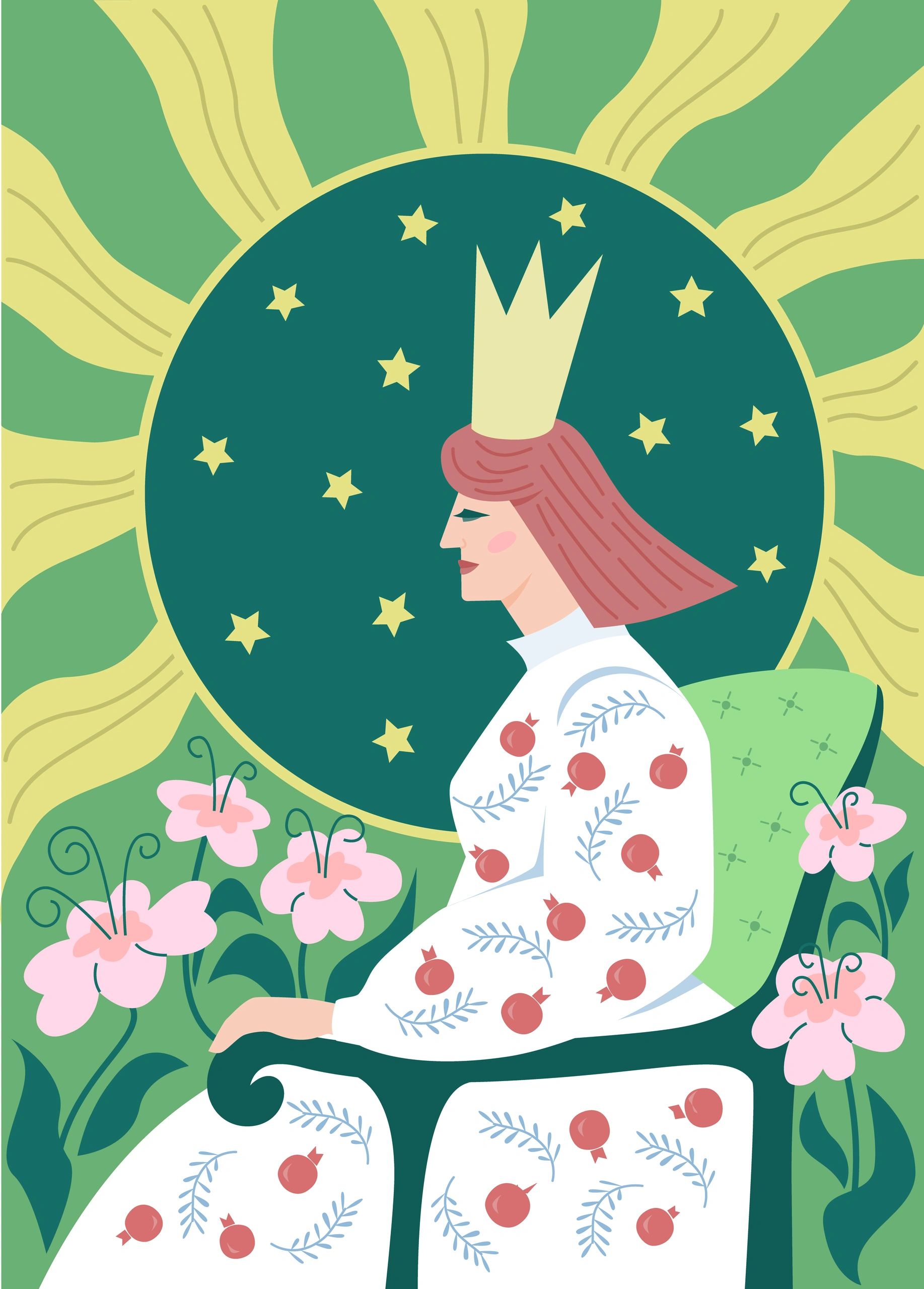
Rather than treating The Empress as a card that merely promises external blessings, this article reads her as a symbolic teacher. She asks what it means to cultivate life responsibly, to receive without passivity, to create without domination, and to honor the intelligence of the body, the imagination, and the natural world. In that sense, The Empress is not simply a figure of comfort. She is a figure of sacred participation in the mystery of growth.
In This Guide
- Card Overview
- Historical Origins of the Card
- Rider-Waite-Smith Symbolism
- Thoth Tarot Symbolism
- The Card’s Archetypal Meaning
- Mythological Connections
- Alchemical Symbolism
- Christian Hermetic Reflections
- The Tree of Life and Hebrew Letter
- Astrological Correspondences
- Chakra Correspondence
- Upright Meaning
- Reversed Meaning
- Practical Reflection Questions
- Meditation Exercise
- Related Cards
- What Modern Readers Can Learn from The Empress
- Frequently Asked Questions
- Further Reading
- Final Thoughts
Card Overview
The Empress is the third card of the Major Arcana. She follows The High Priestess and introduces a different mode of wisdom. Where The High Priestess often symbolizes hidden knowledge, inwardness, and mystery, The Empress brings fecundity into form. She is the principle of manifestation through nurture, beauty, relationship, and embodied life.
- Traditional card number: III
- Suit: Not applicable; Major Arcana
- Element: Earth, with strong Venusian and generative associations
- Planet: Venus
- Zodiac sign: Often associated with Venus and, by extension, Taurus and Libra; in Golden Dawn correspondences, the card is planetary rather than zodiacal
- Hebrew letter: Daleth (ד)
- Path on the Tree of Life: Path 14, between Chokmah and Binah
- Chakra correspondence: Often linked to the Sacral Chakra, with secondary resonance to the Heart Chakra
- Golden Dawn correspondence: Venus, Daleth, Path 14
- Thoth correspondence: The Empress, Venus, Daleth, the gate or door of manifestation
- Keywords: fertility, abundance, receptivity, beauty, creativity, nurture, embodiment, growth, cultivation, relational intelligence
- Core themes: life-giving power, sacred embodiment, cultivated abundance, generative love, artistic creation, the intelligence of nature, and the transformation of potential into living form
At its deepest level, The Empress tarot meaning concerns the mystery of generation. She does not force life into being through will alone. Instead, she receives, nourishes, protects, and brings to maturity. That pattern applies not only to literal motherhood but also to art, ideas, relationships, communities, and spiritual growth.
Historical Origins of the Card
To understand The Empress tarot meaning, it is important to begin with tarot history rather than with modern assumptions. Early tarot emerged in fifteenth-century Italy as a card game, not as a fully formed occult system. Historians such as Michael Dummett and Robert M. Place have shown that the earliest trumps belonged to a visual culture shaped by courtly hierarchy, Christian symbolism, civic allegory, and Renaissance political imagination rather than by a single secret doctrine (Place; see also historical scholarship referenced by Place).
Imperial Roots and Early Sovereignty
In the earliest decks, The Empress appears as an imperial female ruler. She is not yet the lush, nature-throned figure familiar from the Rider-Waite-Smith deck. Instead, she reflects the social and symbolic language of sovereignty. Crown, scepter, shield, and throne identify her as an image of lawful authority, fecund order, and dynastic continuity. The card’s meaning in this early context likely had more to do with rank, worldly power, and the ordering of society than with later occult ideas about Venus, fertility, or the divine feminine.
From Marseille to Modern Occult Tarot
The Tarot de Marseille preserved this imperial framework. There, L’Impératrice remains a seated ruler, often holding a shield marked with an eagle. The eagle is especially significant because it links the card to empire, vision, elevation, and authority. Over time, readers began to see in this image not only political rulership but also the broader principle of ordering intelligence expressed through feminine form. That shift did not erase the older meaning. Rather, it expanded it.
Robert M. Place notes that tarot symbolism evolved through reinterpretation. Images that began in one context acquired new significance as later generations read them through Christian mysticism, occult philosophy, alchemy, astrology, and psychology. The Empress is a clear example of this process. A Renaissance emblem of queenship gradually became a symbol of nature, beauty, fertility, and generative consciousness (Place).
The Rider-Waite-Smith deck introduced one of the most influential changes in the card’s visual history. Arthur Edward Waite and Pamela Colman Smith retained the idea of sovereignty but relocated it from the court to the living world. Their Empress sits in a field of grain, surrounded by forest and flowing water, crowned with stars and adorned with symbols of Venus. This transformed the card from a political emblem into a visual theology of abundance. Authority remained, but it was now expressed through life-giving presence rather than imperial regalia alone.
The Thoth deck deepened the card further. Aleister Crowley and Lady Frieda Harris emphasized Venus, sacred generation, and the cosmic principle of love as the force that binds and produces form. Crowley’s Empress is more overtly esoteric than Waite’s, drawing on Qabalah, alchemy, and mythic symbolism. Here the card becomes not merely a queen of the natural world but a metaphysical principle of creative manifestation.
Seen historically, The Empress evolved from ruler to symbol, from symbol to archetype, and from archetype to contemplative image. That development helps explain why the card can speak simultaneously about earthly life, artistic creation, sensual beauty, motherhood, spiritual receptivity, and the ordering power of love. Each layer belongs to the card’s long history.
For readers who want to deepen their study of symbolism, archetypes, and Western esoteric traditions, The Hermetic Mirror offers a thoughtful course environment for reflective learning. It is especially relevant for students interested in how tarot, myth, symbolism, and contemplative traditions can enrich one another without collapsing into sensationalism.
Rider-Waite-Smith Symbolism
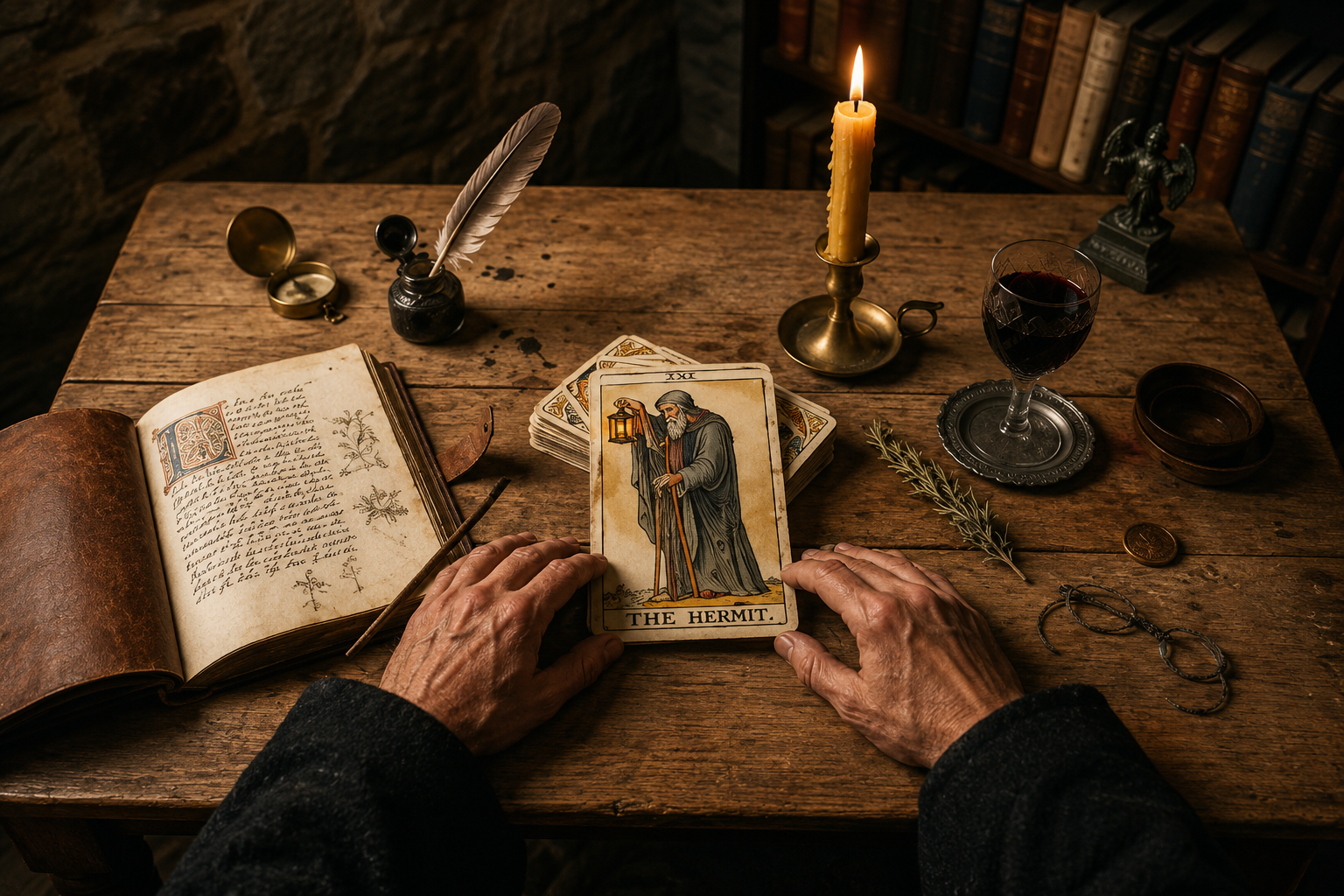
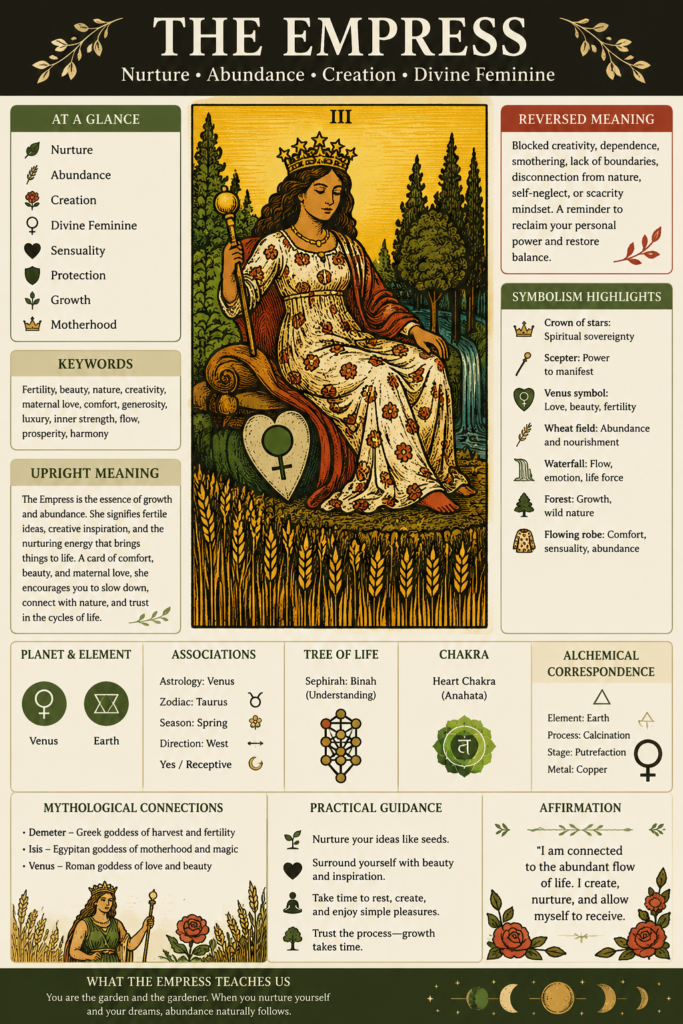
The Rider-Waite-Smith Empress is among the most beloved images in modern tarot because Pamela Colman Smith translated Waite’s esoteric intentions into a scene that feels immediately alive. Every detail contributes to The Empress tarot meaning: the crown of stars, the pomegranate-patterned gown, the wheat, the forest, the river, the Venus shield, and the soft but assured posture of the seated figure.
Cosmic and Fertility Symbols
The crown of twelve stars suggests cosmic order. It may evoke the zodiac, the months of the year, or the completeness of cyclical time. The Empress is not merely fertile in a personal sense. She participates in a larger rhythm of generation. Her creativity is aligned with pattern, season, and celestial order. Pollack often emphasizes that tarot images gain depth when we see them as part of a symbolic ecology rather than as isolated signs, and the starry crown does precisely that by placing The Empress within the wider cosmos (Pollack).
Embodied Authority and the Power of Three
The pomegranates on her gown are especially rich in meaning. In Western symbolism, pomegranates can suggest fertility, sensual fullness, sacred femininity, and the mysteries of life, death, and return. They also connect The Empress to Persephone and Demeter, themes we will revisit in the mythological section. Mary K. Greer encourages readers to attend to recurring symbolic motifs across decks and traditions, and the pomegranate is one of those motifs that opens multiple interpretive doors at once (Greer).
The field of wheat emphasizes cultivated abundance rather than wild excess. This is important. The Empress does not merely symbolize nature in its untamed form. She represents nature brought into relationship with care, rhythm, and stewardship. Grain is not just growth. It is growth tended toward nourishment. That distinction helps explain why the card often appears in readings about creative projects, home life, education, or work that requires patience and maturation.
The forest and flowing water in the background add another layer. Forest suggests the living mystery of the natural world, while water points to emotion, intuition, and the unseen currents that sustain visible life. The Empress therefore unites cultivated and uncultivated dimensions of being. She is both garden and wilderness, both form and flow.
The Venus shield at her side makes the card’s planetary association explicit. Venus here is not only romance. In classical and esoteric traditions, Venus governs attraction, harmony, beauty, proportion, pleasure, and relational intelligence. Benebell Wen notes that Venusian symbolism in tarot often concerns the power that draws things into meaningful relationship, whether in art, love, or social life (Wen). The Empress embodies that attractive and harmonizing force.
Her posture matters as much as her attributes. She is seated, receptive, and calm, yet not passive. Waite and Smith do not portray her as idle. She is established. Her authority is embodied rather than asserted. In contrast to more forceful archetypes, The Empress teaches that some of the most transformative forms of power are invitational, nourishing, and quietly formative.
Numerologically, the card’s number three suggests generation through relationship. One can symbolize unity or origin. Two introduces polarity or complementarity. Three often signifies the emergence of new form from the meeting of two principles. In that sense, The Empress as III is perfectly placed. She is the card of fruitful expression, the living third that arises from hidden mystery and active consciousness.
Waite’s own comments in The Pictorial Key to the Tarot are brief but suggestive. He describes the card in terms of fruitfulness, action, and the garden of the world. Later interpreters such as Pollack, Greer, and Wen expanded these hints into richer symbolic readings. Together, they help modern readers see that The Empress is not simply a card of comfort. She is a card of sacred embodiment and life-giving order.
Thoth Tarot Symbolism
In the Thoth Tarot, Crowley and Lady Frieda Harris present The Empress as a far more overtly esoteric figure. The card remains Venusian, but its symbolism is intensified through Qabalah, alchemy, sacred geometry, and mythic imagery. If the Rider-Waite-Smith Empress is a queen of cultivated abundance, the Thoth Empress is a cosmic matrix of generation.
Daleth and the Gate of Manifestation
Crowley associates the card with Venus and the Hebrew letter Daleth, meaning door. This is crucial. The Empress becomes a threshold through which life enters manifestation. Lon Milo DuQuette, in Understanding Aleister Crowley’s Thoth Tarot, explains that Daleth signifies passage, receptivity, and the opening through which force becomes form. The Empress is therefore not only fertile. She is the gate of incarnation, the principle by which possibility becomes embodied reality.
Venusian Love as Cosmic Process
Harris’s art emphasizes motion, radiance, and symbolic layering. The pelican, lotus, dove, and flowing forms all contribute to the card’s atmosphere of fecundity and sacrificial nourishment. The pelican is especially important in Christian and alchemical symbolism because it represents self-giving sustenance. Medieval legend held that the pelican fed its young with its own blood. Crowley uses this image in a broader esoteric sense, but it also creates a bridge to Christian symbolic interpretation.
The dove reinforces Venusian gentleness, love, and descending grace. The lotus suggests unfolding life, purity arising from depth, and the mystery of beauty emerging from hidden waters. Together these images make The Empress less domestic than in the Rider-Waite-Smith deck and more metaphysical. She is the principle of generative love active throughout the cosmos.
Crowley’s understanding of Venus is also broader than sentimental love. In The Book of Thoth, Venus concerns attraction, cohesion, delight, and the force by which multiplicity becomes harmonious form. The Empress thus represents the intelligence of union. She is the power that allows beauty, relation, and life to arise from differentiation.
Qabalistically, the card’s place on the Tree of Life deepens this interpretation. As Daleth, The Empress links Chokmah and Binah, wisdom and understanding. She is the door between dynamic impulse and structured form. DuQuette emphasizes that this path symbolism reveals The Empress as a mediating principle rather than a static personality. She is process, passage, and manifestation.
Compared with the Rider-Waite-Smith version, the Thoth Empress can feel less pastoral and more initiatory. She does not simply comfort. She reveals the hidden splendor of generation itself. For readers interested in esoteric tarot, this version deepens The Empress tarot meaning by showing that beauty is not superficial decoration. Beauty is one of the ways truth becomes perceptible.
The Card’s Archetypal Meaning
From a Jungian perspective, The Empress belongs to the realm of the Great Mother archetype, but that phrase must be handled carefully. Jung and later archetypal thinkers such as Edward Edinger and Stephan Hoeller understood archetypes not as stereotypes but as deep structures of psychic life. The Great Mother includes nourishment, protection, fertility, and belonging, but also engulfment, overprotection, and possessiveness when distorted.
Mature Expression of the Archetype
In its mature expression, The Empress symbolizes generative presence. She nourishes growth without controlling it. She creates conditions in which life can unfold. Also, she values embodiment, beauty, and relational depth. And she teaches receptivity without passivity and care without domination. This is why the card often resonates with artists, teachers, healers, gardeners, parents, and anyone whose work involves cultivation rather than conquest.
Shadow and Psychological Integration
Its shadow expression is equally important. The shadow Empress may smother rather than support. She may confuse love with possession, abundance with indulgence, comfort with stagnation, or beauty with vanity. Pollack’s work is especially helpful here because she consistently treats tarot archetypes as dynamic and morally complex rather than one-dimensional (Pollack). The Empress is not simply “nice.” She is powerful, and power always has a shadow.
Psychologically, The Empress can mark a stage in which a person learns to inhabit life more fully. That may mean trusting the body, honoring emotion, creating something meaningful, or learning how to receive care. For serious beginners, this is one of the most important dimensions of The Empress tarot meaning. The card is not only about what one produces. It is also about the capacity to dwell in life with enough openness that growth becomes possible.
Hoeller and other Jungian interpreters of symbolic systems often note that individuation requires a reconciliation with the neglected dimensions of the self. The Empress can therefore appear when a person must recover softness, sensual presence, imagination, or relational intelligence after a period of excessive abstraction or control. In that sense, she is not anti-intellectual. She is corrective. She reminds consciousness that life cannot be reduced to concepts alone.
Universal human experiences reflected in the card include gestation, creativity, belonging, nourishment, grief over barrenness, delight in beauty, and the longing to participate in something life-giving. These experiences are not limited by gender. The Empress is an archetype available to everyone because everyone must learn, in some form, how to cultivate life.
Mythological Connections
The Empress resonates with many mythological figures because myths repeatedly return to themes of fertility, sovereignty, beauty, descent, return, and sacred generation. No single goddess or queen exhausts the card’s meaning, but several illuminate it.
Goddesses of Fertility and Sovereignty
In Greek mythology, Demeter offers one of the clearest parallels. As goddess of grain, agriculture, and maternal grief, she embodies nourishment and the cycles of loss and renewal. Her relationship with Persephone deepens the symbolism of the pomegranate and reminds us that fertility is never merely cheerful abundance. It is bound to season, separation, and return. Aphrodite also belongs here, especially in relation to Venusian beauty, attraction, and generative desire, though The Empress is usually broader and more maternal than Aphrodite alone.
Biblical and Recurring Mythic Patterns
In Egyptian mythology, Isis provides another powerful lens. Isis is queenly, magical, maternal, and restorative. She gathers what has been broken, protects life, and mediates between death and renewal. Her symbolic richness aligns well with The Empress as a figure of sacred continuity and generative intelligence.
Norse mythology offers figures such as Freyja and Frigg. Freyja brings associations of beauty, desire, fertility, and sovereignty, while Frigg adds wisdom, household order, and queenly presence. These parallels remind us that The Empress is not only a nature figure. She is also a figure of cultured and relational order.
Biblical symbolism complicates the picture in fruitful ways. While tarot is not a biblical system, readers from Christian or Christian Hermetic backgrounds often see Marian resonances in The Empress: receptivity, blessed fruitfulness, queenship, and the mystery of life received and borne. The woman clothed with the sun in Revelation and the wisdom imagery of Proverbs can also enrich reflection, though such parallels should be made symbolically rather than dogmatically.
Across traditions, recurring mythic patterns emerge. The life-giving feminine is linked to land, season, beauty, nourishment, and the continuity of culture. She may also be linked to grief, sacrifice, and the cost of sustaining life. These patterns deepen The Empress tarot meaning by showing that abundance is never merely accumulation. It is participation in a cycle that includes care, vulnerability, and renewal.
Alchemical Symbolism
Alchemy offers a profound symbolic language for understanding The Empress because alchemy is concerned not only with transformation but with generation, conjunction, and the maturation of hidden potential. Adam McLean’s work on alchemical symbolism is especially useful here because he consistently shows how alchemical images describe inner development as much as material process (Study Course on Alchemical Symbolism).
The Fertile Vessel of Transformation
The Empress can be read in relation to the generative phases of the work rather than to a single stage alone. She is not the blackness of dissolution in the strictest sense, nor is she only the final reddening. Instead, she often represents the fertile matrix in which transformation can continue. She is the vessel, the garden, the field, the womb, the place where subtle processes are protected and nourished until they can emerge.
Venus, Nature, and Inner Ripening
Venus also has alchemical importance. In many symbolic systems, Venus signifies harmony, attraction, and the balancing force that allows conjunction to occur. The Empress therefore reflects the alchemical truth that transformation requires relationship. Nothing develops in isolation. Elements must meet, combine, and be held in the right conditions.
The wheat in the Rider-Waite-Smith image can be read alchemically as well. Grain suggests the slow conversion of seed into nourishment. It is a symbol of latent life becoming useful form through time, season, and care. That pattern mirrors inner development. Ideas, virtues, and insights do not ripen instantly. They must be cultivated.
Alchemical texts often portray nature as a collaborator in the Great Work rather than as something to be dominated. The Empress embodies that principle beautifully. She teaches cooperation with process. She does not seize transformation. And she tends it. For modern readers, this may be one of the most practical alchemical lessons of the card: growth often depends less on force than on creating the right conditions for life to unfold.
In spiritual terms, The Empress can symbolize the soul becoming hospitable to transformation. She is the inner field made ready, the vessel made receptive, the heart made capable of bearing fruit. That is why the card belongs naturally within any serious study of symbolic and contemplative development.
Christian Hermetic Reflections
For readers interested in Christian Hermeticism, The Empress can be approached as a symbol of sacred receptivity, generative wisdom, and the beauty of creation without making dogmatic claims that exceed the card itself. Meditations on the Tarot is especially relevant here because it repeatedly treats the Major Arcana as contemplative images rather than predictive devices. In that spirit, The Empress becomes a meditation on how divine life is received, nurtured, and brought into expression.
Fruitfulness, Grace, and Sacred Receptivity
Christian symbolic tradition often links fruitfulness with grace, charity, and the soul’s cooperation with divine life. The Empress can therefore be read as an image of the soul made fertile by love. She does not create ex nihilo as God does. Rather, she receives and bears fruit. This distinction matters. It preserves the symbolic dignity of the card while avoiding exaggerated claims about personal power.
Hermetic Contemplation of Created Beauty
Marian symbolism may also illuminate the card for some readers. Mary, as a figure of receptivity, blessed fruitfulness, and contemplative assent, offers a meaningful parallel, especially when The Empress is understood as the sanctified capacity to receive and bring forth life. The parallel is symbolic, not identical. Still, it helps Christian readers see that receptivity is not weakness. It is a mode of profound participation.
The pelican image in the Thoth deck creates another bridge. In Christian symbolism, the pelican signifies self-giving nourishment. That image enriches The Empress by reminding us that true nurture often includes sacrifice. To sustain life is costly. Love feeds.
Hermetically, The Empress can also be seen as the beauty of the created order itself. Renaissance Christian Hermetic thinkers often believed that nature was a book of symbols through which divine wisdom could be glimpsed. The Empress, enthroned in living abundance, becomes an icon of that vision. She teaches contemplation of creation not as mere resource but as revelation.
For contemplative readers, then, The Empress tarot meaning may include hospitality, fruitfulness, tenderness, stewardship, and the sanctification of embodied life. She invites gratitude for what grows slowly and asks whether our lives have become places where goodness can take root.
The Tree of Life and Hebrew Letter
In the Golden Dawn system, The Empress corresponds to the Hebrew letter Daleth, meaning door. She is assigned to Path 14 on the Tree of Life, linking Chokmah and Binah. This is one of the most illuminating esoteric keys to the card.
Daleth as door suggests threshold, passage, and receptivity. A door is not the source of what passes through it, yet without the door there is no entry. This symbolism aligns perfectly with The Empress as a figure of manifestation. She is the opening through which life, beauty, and form emerge.
The path between Chokmah and Binah is equally significant. Chokmah is often associated with dynamic wisdom or primal force, while Binah is associated with understanding, structure, and form. The Empress as Daleth mediates between these poles. She is not raw impulse, nor rigid structure. She is the living passage by which force becomes fruitful order.
Golden Dawn attributions therefore deepen The Empress tarot meaning considerably. The card is no longer only about fertility in a literal sense. It becomes a metaphysical principle of manifestation through receptivity. Beauty is the door. Love is the door. Form itself becomes a door through which wisdom enters the world.
In relation to neighboring paths and sephiroth, The Empress helps explain how life moves from transcendence into intelligible expression. She belongs to the architecture of becoming. That is why the card often feels both intimate and cosmic. It speaks to daily life, yet it also gestures toward the hidden structure of manifestation itself.
Astrological Correspondences
The Empress is traditionally associated with Venus. This is one of the most stable correspondences across modern esoteric tarot systems. Venus governs beauty, attraction, pleasure, harmony, relationship, and the power of cohesion. In classical astrology, Venus is not merely romantic. Venus is the principle by which life becomes agreeable, proportionate, and relationally meaningful.
Because Venus rules Taurus and Libra, some readers also connect The Empress with those signs. Taurus contributes sensuality, earthiness, embodiment, and appreciation of material beauty. Libra contributes harmony, aesthetic intelligence, and relational balance. Still, in Golden Dawn style correspondences, The Empress is planetary rather than zodiacal, so Venus remains the primary key.
Elementally, the card is often read through Earth because of its emphasis on fertility, growth, and manifestation. Yet Venus softens Earth with delight, beauty, and attraction. The result is not mere materiality but living abundance. This helps explain why The Empress can signify art, music, design, hospitality, gardens, nourishment, and emotionally intelligent relationships as readily as literal fertility.
Traditional occult correspondences deepen the interpretation further. Venus binds, harmonizes, and draws together. The Empress therefore reflects the force by which life organizes itself into beauty and relation. She is not the aggressive pursuit of desire. She is the magnetic intelligence of flourishing.
Chakra Correspondence
Although chakras belong to Indian spiritual traditions rather than to historical tarot, many contemporary readers find symbolic correspondences useful when approached respectfully. The Empress is most often associated with the Sacral Chakra because of its relation to creativity, sensuality, emotional flow, pleasure, and generative life. A secondary connection to the Heart Chakra is also meaningful because The Empress nourishes through love, care, and relational warmth.
Psychologically, the Sacral Chakra correspondence highlights the card’s connection to embodiment and creative vitality. The Empress asks whether we are alive to beauty, sensation, and the capacity to create. She can appear when that energy is flourishing, but also when it has been blocked by shame, overcontrol, or disconnection from the body.
Spiritually, the Heart Chakra resonance reminds us that creation without love becomes sterile. The Empress does not merely produce. She cherishes. Her abundance is relational. She sustains what she brings forth.
Together, these correspondences suggest that The Empress tarot meaning includes a healed relationship with embodiment, affection, pleasure, and creative flow. She invites readers to become more hospitable to life in both body and heart.
Upright Meaning
Upright, The Empress often signals a season of growth, nourishment, or creative ripening. Yet the card should not be reduced to easy promises. More deeply, it suggests that life is asking to be cultivated. Something may be ready to grow if given care, patience, and the right conditions.
In personal growth, The Empress can indicate a need to reconnect with the body, the senses, beauty, or emotional receptivity. In relationships, she may point toward warmth, affection, mutual support, and the creation of a more life-giving bond. And in career or vocation, she often favors work that involves design, teaching, hospitality, healing, art, cultivation, or the patient development of a meaningful project.
Creatively, the card is especially powerful. It suggests that ideas are ready to take form, but not through force alone. They require tending. Spiritually, The Empress may indicate a season in which contemplation becomes fruitful through embodiment, gratitude, and attention to the goodness of created life.
For readers who prefer reflective tarot over fortune-telling, the upright card asks a simple but demanding question: what in your life is asking to be nourished into maturity?
Reversed Meaning
Reversed, The Empress often points to blocked nourishment, distorted receptivity, or a troubled relationship with abundance. This does not mean the card becomes simply negative. Rather, it reveals where the Empress principle has become constricted, excessive, or misdirected.
One possibility is depletion. A person may be giving care without receiving it, creating without rest, or trying to sustain others while neglecting the conditions of their own flourishing. Another possibility is stagnation. Comfort may have turned into inertia, pleasure into avoidance, or care into overprotection.
Psychologically, the reversed card can indicate shame around embodiment, difficulty receiving love, creative blockage, or alienation from the senses. In shadow form, it may also suggest possessiveness, vanity, indulgence, or the attempt to control growth rather than support it.
Seen constructively, the reversal invites repair. Where has life become inhospitable? What needs gentler stewardship? What would it mean to receive nourishment without guilt, or to release forms of care that have become controlling? In this way, the reversed Empress remains a card of growth, but growth through honest rebalancing.
Practical Reflection Questions
- What in my life is asking to be nurtured rather than forced?
- Where am I already experiencing abundance, even if I have overlooked it?
- How do I relate to beauty, pleasure, and embodiment?
- What creative project needs patient cultivation?
- Do I know how to receive care as well as offer it?
- Where has comfort become stagnation?
- What does healthy abundance look like in this season of my life?
- How might I create more beauty or hospitality in my daily environment?
- What relationship in my life needs more tenderness and less control?
- How do I respond to slowness, ripening, and processes I cannot rush?
- What beliefs have shaped my relationship with the body?
- Where am I being invited to trust the intelligence of growth?
- What would it mean to cultivate rather than merely consume?
- How can I honor both sensual delight and spiritual depth?
- What fruit do I hope my present efforts will eventually bear?
Meditation Exercise
Find a quiet place and sit comfortably. Breathe slowly and allow your attention to settle into the body. Imagine yourself entering a field at the edge of a forest. The air is warm. Grain moves gently in the wind. Nearby, you hear water flowing.
At the center of the field sits The Empress. She does not speak at first. She simply makes space for your presence. Notice her crown, her robe, the wheat, the trees, the river, and the sense of calm abundance around her.
Ask inwardly: What in me is ready to grow? What in me needs care? What have I tried to force that should instead be tended? Remain with whatever arises. Do not rush to interpret. Let the image work slowly.
Now imagine The Empress placing a single seed in your hand. This seed represents a life-giving possibility: a practice, a relationship, a work of art, a healing process, or a way of being. Ask what conditions this seed requires. Listen for one practical act of cultivation you can begin this week.
When you are ready, thank the figure, return your awareness to the room, and write down what you received. The purpose of this meditation is not prediction. It is contemplative alignment with the slow wisdom of growth.
Related Cards
The Empress gains depth when read in relation to neighboring and symbolically related cards. The Fool represents untapped possibility, while The Empress shows possibility entering fertile form. The High Priestess guards hidden wisdom; The Empress brings hidden potential into embodied life. The Emperor, as her counterpart in many systems, represents structure, law, and ordering authority, while The Empress represents nurture, growth, and relational abundance.
Among the Minor Arcana, the Queens often echo aspects of the Empress principle, especially the Queen of Pentacles and Queen of Cups. The Queen of Pentacles reflects practical nurture, embodiment, and cultivated abundance. The Queen of Cups reflects emotional receptivity and intuitive care. Cards such as the Three of Cups and Nine of Pentacles can also resonate with Empress themes of flourishing, pleasure, and relational richness.
In the Thoth system, Venusian correspondences and the path of Daleth further connect The Empress to cards and symbols concerned with beauty, union, and manifestation. These relationships remind readers that The Empress tarot meaning is not isolated. It participates in a larger symbolic web.
What Modern Readers Can Learn from The Empress
Modern life often rewards speed, productivity, and control. The Empress offers a needed corrective. She teaches that not everything valuable can be rushed, measured, or forced. Some things must be cultivated. Some truths are learned through beauty, embodiment, affection, and patient attention.
A Corrective to Modern Haste
For contemporary readers, this may be the enduring wisdom of the card. The Empress reminds us that growth depends on conditions. Creativity needs rhythm. Relationships need care. Bodies need rest. Communities need hospitality. Spiritual life needs more than ideas. It needs incarnation.
Abundance as Sustainable Flourishing
She also challenges distorted ideas of abundance. Real abundance is not endless accumulation. It is the capacity to sustain life meaningfully. In a culture of excess and depletion, The Empress asks whether our forms of success are actually life-giving.
That is why the card remains relevant. It speaks to burnout, disembodiment, creative exhaustion, ecological concern, and the longing for a more humane way of living. The Empress does not offer escape from the world. She offers a wiser way of inhabiting it.
Frequently Asked Questions
What does The Empress tarot card mean?
The Empress usually signifies abundance, nurture, creativity, embodiment, and life-giving growth. At a deeper level, The Empress tarot meaning concerns the power to receive, cultivate, and bring forth life in meaningful form.
Is The Empress always about pregnancy or motherhood?
No. While the card can relate to literal fertility in some contexts, it more broadly symbolizes generative processes of all kinds, including artistic work, emotional growth, nourishing relationships, and the maturation of ideas.
What planet is associated with The Empress?
The Empress is traditionally associated with Venus, the planet of beauty, attraction, harmony, pleasure, and relational intelligence.
What is the Hebrew letter for The Empress?
In Golden Dawn correspondences, The Empress is linked to Daleth, the Hebrew letter meaning door. This deepens the card’s symbolism as a threshold of manifestation.
What does The Empress reversed mean?
Reversed, the card can suggest blocked creativity, depletion, overprotection, indulgence, difficulty receiving care, or a strained relationship with embodiment and abundance. It often points toward the need for rebalancing rather than simple negativity.
How is The Empress different from The High Priestess?
The High Priestess is often associated with hidden wisdom, silence, and inward mystery. The Empress expresses wisdom through fertility, embodiment, nurture, and visible growth. One conceals and guards; the other manifests and nourishes.
How is The Empress different from The Emperor?
The Emperor symbolizes structure, law, stability, and governing order. The Empress symbolizes growth, nurture, beauty, and relational abundance. Together they represent complementary modes of sustaining life.
What chakra is associated with The Empress?
Many readers associate The Empress with the Sacral Chakra because of its connection to creativity, sensuality, and generative energy. A secondary link to the Heart Chakra is also common because of the card’s nurturing and affectionate qualities.
What can modern readers learn from The Empress?
The card teaches the value of cultivation, embodiment, beauty, hospitality, and patient growth. It reminds readers that flourishing depends on care, rhythm, and meaningful relationship.
Where should beginners start if they want to study The Empress more deeply?
Beginners can start with strong foundational texts by Rachel Pollack, Mary K. Greer, Benebell Wen, Robert M. Place, and Arthur Edward Waite. It also helps to compare the Rider-Waite-Smith and Thoth versions of the card and to journal about personal responses to the imagery.
Further Reading
- Rachel Pollack, Seventy-Eight Degrees of Wisdom
- Mary K. Greer, 21 Ways to Read a Tarot Card
- Benebell Wen, Holistic Tarot
- Lon Milo DuQuette, Understanding Aleister Crowley’s Thoth Tarot
- Robert M. Place, The Tarot: History, Symbolism, and Divination
- Adam McLean, Study Course on Alchemical Symbolism
- Valentin Tomberg, Meditations on the Tarot
- Arthur Edward Waite, The Original Rider Waite: The Pictorial Key To The Tarot: An Illustrated Guide
- Aleister Crowley, The Book of Thoth
For additional context on reflective tarot practice and archetypal study, readers may also find these Rose and Rune articles helpful: Beginner’s Guide to Tarot, How Tarot Works as a Reflective Practice, and What Is an Archetype? A Jungian Introduction.
Final Thoughts
The Empress endures because she speaks to one of the most fundamental realities of human life: growth requires care. Across tarot history, she has been queen, mother, garden, threshold, Venusian principle, archetype, and contemplative image. Each of these layers contributes to her richness.
Read thoughtfully, The Empress tarot meaning is not a shallow promise of comfort or luxury. It is an invitation to cultivate what is life-giving, to honor the intelligence of embodiment, to receive beauty as a form of wisdom, and to participate more consciously in the mystery of becoming. She reminds us that abundance is not merely having more. It is bearing fruit that nourishes life.
For serious students of tarot, symbolism, and spiritual reflection, The Empress remains a profound teacher. She asks whether our lives have become hospitable to growth, whether our creativity is rooted in care, and whether we can recognize the sacred in what ripens slowly. Her lesson is contemplative rather than predictive. Attend to what is living. Tend what has been entrusted to you. Let wisdom become fruitful.
Works Cited: Pollack, Rachel. Seventy-Eight Degrees of Wisdom. Greer, Mary K. 21 Ways to Read a Tarot Card. Wen, Benebell. Holistic Tarot. DuQuette, Lon Milo. Understanding Aleister Crowley’s Thoth Tarot. Place, Robert M. The Tarot: History, Symbolism, and Divination. McLean, Adam. Study Course on Alchemical Symbolism. Tomberg, Valentin. Meditations on the Tarot. Waite, Arthur Edward. The Original Rider Waite: The Pictorial Key To The Tarot. Crowley, Aleister. The Book of Thoth.